A chatbot can answer in two seconds and still ruin the afternoon. It might call the right tool, return a fluent sentence, and send its user into another prompt, a frantic click, or a quiet exit. The trace says the machine worked. The customer journey says something else. Between those two records sits the business question Kubit now wants to answer.
- Kubit runs product analytics on cloud warehouse data and connects AI agent actions to what users do next.
- It sells to product, data, marketing and AI engineering teams; Miro, Serko and Influence Mobile have published customer stories.
- Its public plans charge by monthly tracked users, with unlimited seats and events.
- The catch is practical: a useful joined journey needs reliable user identities, clean events and trace data.
This is a company with two origin stories, one nested inside the other. The first begins at Smule, the music app, where Alex Li was CTO. He says he built an internal product analytics tool to replace Mixpanel because the existing setup could not give his team the scale and control it wanted. In 2018, he founded Kubit. The new company offered product managers a way to explore funnels, retention, cohorts and user paths without waiting for an analyst to write another query.
The second story begins when Kubit started building AI features of its own. Its team found itself doing what every AI team says it dislikes: opening one tool to see model traces and another to see customer behavior, then trying to match them by hand. The company now treats an agent action and a product event as parts of the same journey. That change has moved its pitch from “show me what users clicked” to “show me what the agent did before they clicked - or left.”
The warehouse became the meeting place
Kubit’s original argument was that product analytics had become a maze of copied data. If a team’s canonical customer record lived in Snowflake, Databricks or BigQuery, why should it send another version to a closed analytics store? Kubit’s direct-connect mode queries the warehouse, turns the team’s data model into reports, and lets nontechnical colleagues investigate it through a visual interface. It has also supported other ingestion paths, so the implementation depends on where an organization keeps its events.
There was an evolution here. In 2022, Kubit described a Snowflake Data Exchange arrangement that let customers reach raw events held in its multi-tenant warehouse. By 2023, it was promoting product analytics “Powered by Snowflake” against customers’ existing data models, without moving or replicating data. The distinction matters. “Warehouse-native” is not a magic word; its value lies in fewer competing copies and a clear route back to the underlying definitions.
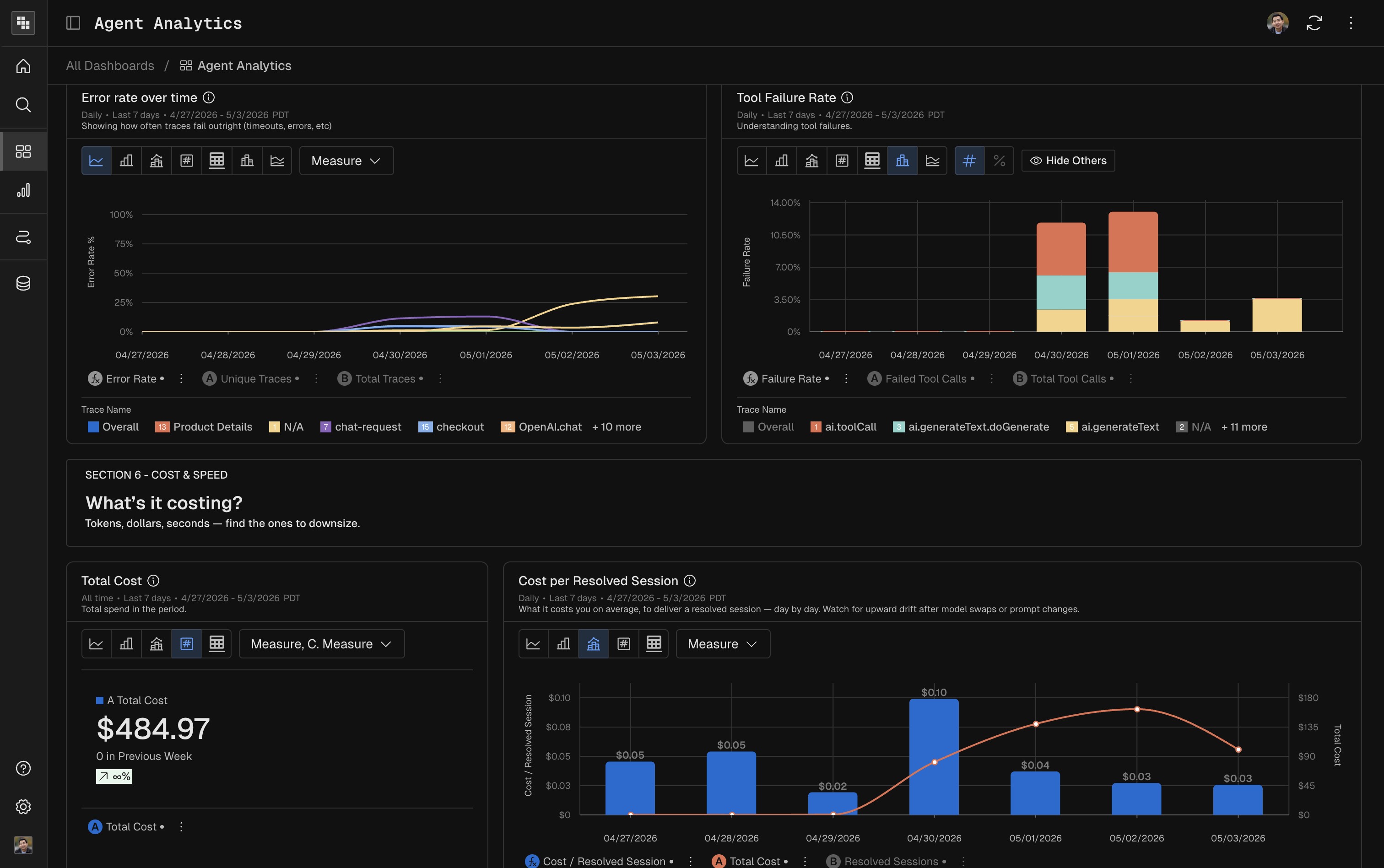
Today’s product combines the old reports with agent analytics. Kubit can bring in OpenTelemetry spans, CDP events or warehouse tables; its modeler puts trace events and clickstream events under a shared user identity. A team can ask whether a shopping agent’s suggestion preceded a purchase, whether repeat prompts led to churn, or whether a costly model path actually improved conversion. Its MCP server and Claude Code skills bring those questions into a developer’s workspace as well as a dashboard.
Consider a retail assistant that recommends a pair of shoes. An observability screen can show that the model answered and its tools returned normally. A product funnel can show that the shopper abandoned checkout. Joined together, the records can reveal whether that shopper asked for a different size, saw a product page, returned to the agent, or gave up. None of those observations proves why the person left. They do give a team a far better experiment than “make the model faster.” That is Kubit’s particular expertise: turning messy sequences into cohorts and reports that a product team can test.
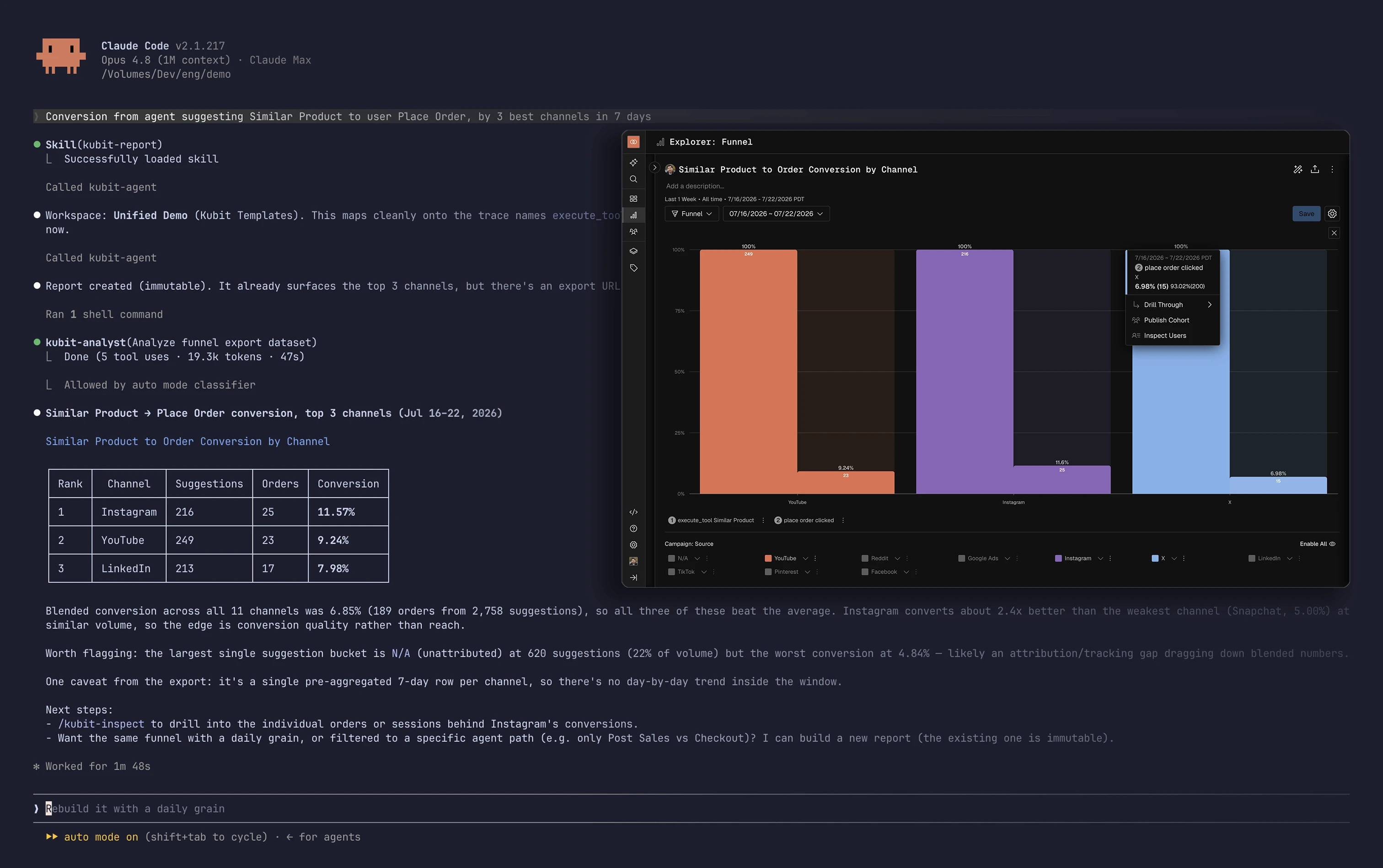
The report that did not need a queue
Miro offers a useful picture of the first half of this business. Its case study says more than 240 weekly active users ran over 2,500 Kubit queries a month. The gain was access: product staff could ask questions themselves, while data analysts spent less time servicing one-off requests. Serko, the travel platform, reports a tenfold increase in visualizations and segmentations. Influence Mobile says it used onboarding analysis to improve ROI by more than 30% within a month. These are customer-reported outcomes, not promises that the same gains arrive with a login.
Figures are from Kubit’s published customer case studies.
The most revealing testimonial is modest. Randall Britten, a senior data scientist at Serko, says a question about user behavior can become an answer “within a minute or two.” Speed is not the whole point. It changes which questions get asked. If every curiosity requires a ticket, only the urgent ones survive. If a product manager can test a hunch before lunch, the smaller questions have a chance to improve a product.
“With Kubit, if I have a question pop into my mind about user behavior, within a minute or two, I can get an answer.”Randall Britten · Senior Data Scientist, Serko
Ask Kubit, introduced in August 2025, pushes that idea further: type a question in ordinary language and receive a report grounded in governed warehouse metrics. For the agent era, the company has widened the audience to engineers. Its newer observability work clusters agent runs by their execution paths and looks for loops, stalls and the customer outcomes attached to them. As of September 2026, Kubit is recruiting a seven-team early-access cohort for that product. The published cohort requires production agents and traces already in Snowflake or Databricks, or a trace-file trial to start.
A price on people, not clicks
Kubit’s public pricing now makes its commercial bet unusually legible. The Starter plan has no base fee, includes 10,000 monthly tracked users and lists $0.008 for each additional tracked user. Pro starts at $199 a month, includes 100,000 tracked users and lists $0.006 beyond that. Enterprise pricing is custom. All plans advertise unlimited events and seats. A tracked user is a uniquely identified person with at least one event or span in the billing month; anonymous users are excluded by the published definition.
10,000 monthly tracked users included
Then $0.008 per additional user100,000 monthly tracked users included
Then $0.006 per additional userThat choice is more than a billing detail. An event-based meter can make teams sample away the very behavior they need to understand. A user-based meter gives them room to inspect more steps for each person. The full cost still depends on the number of identified users and, in a direct warehouse setup, the compute used to run queries. The pricing page does not turn the modeling work into a free lunch.
Where the argument holds
Kubit occupies an odd crossing. Amplitude, Mixpanel, Heap and PostHog help teams read product behavior. LangSmith and Langfuse help teams inspect AI application traces. Kubit is betting that the valuable question starts when those records meet. A successful agent is not merely one with a clean run; it is one whose user got somewhere. The company’s 2022 $18 million Series A, led by Insight Partners, funded a product analytics business. Its present wager is that the same analytics habits can make agent software accountable to human outcomes.
The idea is copyable even without buying Kubit. Pick a consequential user journey. Give agent sessions and product events a common, privacy-safe identity. Record re-prompts and exits as carefully as tool errors. Compare cohorts by outcome, then inspect the traces behind a bad path. It works best where an organization has enough repeated interactions to see patterns and enough data discipline to trust the join. If identities are fragmented, events are poorly defined, or agents are only a lab experiment, the cleverest funnel will produce a confident-looking guess.
The company’s name comes from “qubit,” a nod to something famously hard to observe. Kubit’s subject is more ordinary and more useful: the click after the answer. That click may be tiny. It may also be the difference between a system that performed and a person who got what they came for.