Imagine the meeting. The dashboard is open, the chart is immaculate, and someone asks whether the campaign worked better in Germany among new customers. A reasonable question. Also, apparently, a new project. Somebody must request another breakdown from the data team. Meanwhile, the person spending the money opens a spreadsheet.
Clarisights has built a company around this small humiliation of modern office life: possessing plenty of data and still needing permission to ask it something. The enterprise marketing analytics platform gathers advertising, attribution and internal business data, joins it, and gives marketers a workspace they can rearrange without writing SQL. Its bet is that the next question matters as much as the first.
- The job: let enterprise marketers investigate performance themselves.
- The turn: leave ad automation behind and concentrate on reporting.
- The customers: teams at Delivery Hero, HelloFresh, On and Bitpanda.
- The buying test: count the time between a question and a usable answer.
01 / What the spreadsheet understood
A dashboard is good at displaying a question someone has already anticipated. Marketing supplies an inconvenient stream of questions nobody anticipated. A new channel appears. A campaign name changes. A creative idea performs differently by market. The reporting system has to accommodate those changes while the campaign is still worth changing.
Clarisights’s explanation for the survival of spreadsheets is unusually sympathetic. People keep them because they can move things around. A locked-down chart offers tidy presentation; a sheet offers the freedom to think. In his 2021 funding announcement, CEO Arun Srinivasan reduced the distinction to five words.
“Dashboards are not reports.”
Arun Srinivasan · 2021
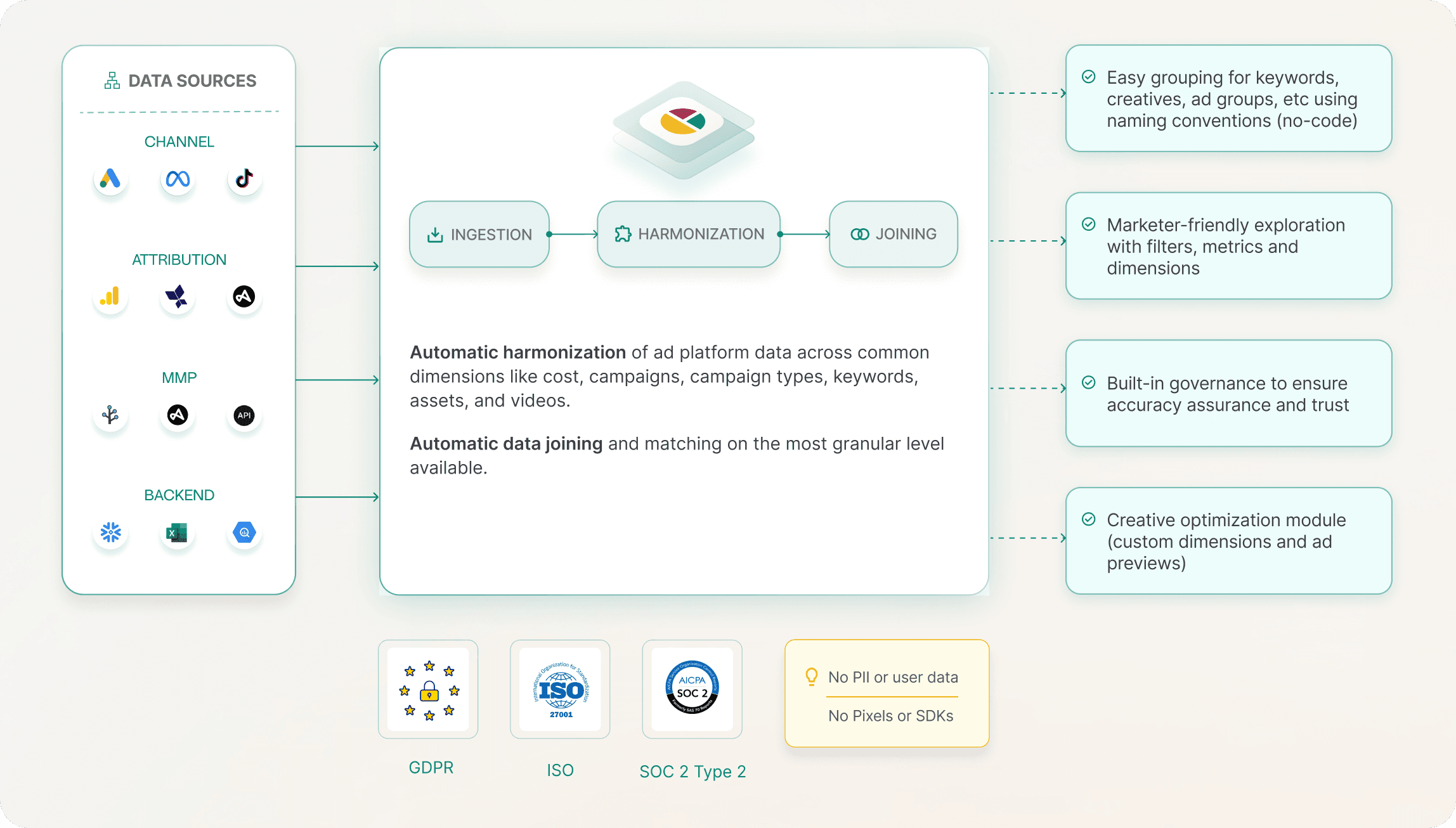
The product attempts to preserve that freedom while taking over the repetitive work underneath. Its managed connections bring in channel data; its processing aligns that data with attribution and backend records. Marketers can then change groupings, dimensions and calculated metrics. Data teams retain governance and access controls. Freedom becomes more useful when colleagues can agree what the numbers mean.
02 / The useful part survived
Clarisights emerged from AdWyze, an earlier marketing automation and optimization business. Co-founder Ankur Gupta’s account of the beginning contains a pleasingly unheroic detail: after leaving large technology companies, he considered several consumer businesses, then decided they involved too much operational work.
He met Srinivasan through a startup program in Bengaluru. Discussion became construction after Srinivasan took him to see a campaign manager’s problems firsthand. Later customer conversations pushed the founders to remove the automation features. Gupta worried that Facebook or another platform would eventually supply much of that functionality itself. Reporting offered a problem that crossed platform boundaries.
That was a product decision with an obvious opportunity cost: work already done was being discarded. It also made the remaining proposition easier to understand. The founders concentrated on helping marketers work with data instead of competing feature by feature with the systems selling them ads.

03 / An enterprise-sized change of mind
The company then had to reconsider whom it was helping. In a 2025 interview, Srinivasan said the early assumption favored startups without data teams. Yet successful startups could hire those teams and replace outside tools; unsuccessful ones could cut spending. Delivery Hero helped expose a different opportunity: a large organization whose reporting complexity persisted despite substantial internal capabilities.
The published Delivery Hero case describes the organizational difficulty. Central teams needed a view across brands and regions. Local marketers needed detail for their own campaign decisions. A dashboard useful to headquarters could still leave a channel manager waiting for a new segment.
Clarisights says the deployment gives more than 300 marketers access to exploration without SQL or manual data preparation. Processed exports also feed Tableau and measurement systems. That detail matters: an enterprise can add a specialized marketing workspace while continuing to use corporate BI.
The market position follows from this. Clarisights competes with assembled reporting stacks as well as marketing data platforms. Alternatives include Funnel, Supermetrics or Adverity, and ingestion tools paired with warehouses and Looker, Tableau or Power BI. Buyers should compare the complete workflow, including who maintains it and who can change a report.
Conceptual workflow comparison. No universal time saving is implied.
04 / The price of another question
Clarisights sells subscription software to businesses through a demo-led sales process. The useful cost discussion starts with the work surrounding the subscription: integration, maintenance, report changes and the experiments nobody runs because getting the numbers takes too long.
HelloFresh supplies a concrete example. Its published case study says performance marketing teams were onboarded in under four weeks, requiring half a day of data resources for setup. An internal assessment credited the changed reporting setup with freeing 1.5 data engineering full-time equivalents from maintenance and with a 5-10% reduction in customer acquisition cost during the first year. These are reported customer outcomes, not a promise for the next buyer.
HelloFresh case study · company-published deployment figures and internal assessment.
The software’s practical appeal is visible at the ad level. Bitpanda’s case describes putting creative previews alongside performance metrics, then grouping ads by concepts or formats and watching for fatigue. A marketer can see the object being discussed instead of deciphering a campaign name and hunting for the corresponding image elsewhere.
That opens specific decisions: refresh a tiring creative, investigate a market, compare paid and organic search, or examine acquisition performance against an internal business metric. A prettier chart alone would be a slender reason to change systems. A shorter path to those decisions is a more substantial one.
The financing followed the reporting focus. In October 2021, Clarisights announced a $14 million Series A led by Sequoia Capital India, joined by OMERS Ventures, existing investors and angels. Capital supported its ambition to build the ingestion, processing and reporting layers together. That breadth is part of the proposition, and part of the engineering burden.
05 / The database learned to wait
One engineering account explains why that burden is distinctive. Clarisights initially stored dimensions and metrics together in large MongoDB documents. A changing performance number could force the system to rewrite descriptive information that had stayed the same. Repeated updates made the design expensive.
The team moved its analytical workload to ClickHouse and developed MorselDB, separating object information from measurements. Its engineers describe preparing sorted data before queries arrive, allowing efficient joins when a marketer asks for a report. They used the processing window available in a workflow built around daily and longer trends.
It is an instructive distinction for buyers. Fast exploration concerns how quickly a query returns. Freshness concerns when source data becomes available. One does not establish the other. The lesson for engineers is equally practical: specify the customer’s timing requirements before paying to satisfy an assumption.

06 / An AI with a visitor’s pass
The current product extends the workspace through Marketing Data MCP, an interface for compatible AI tools. Clarisights advertises more than 50 connectors, existing custom metric definitions and the user’s established access permissions. Its interface is read-only: the AI can investigate reporting data rather than change campaign budgets.
This is a coherent extension of the reporting business. A natural-language question still needs agreed definitions, joined data and permission to see it. Giving an assistant access to those things may reduce another kind of friction. It does not remove the need to check whether an analysis supports the decision being proposed.
07 / Copy the questions before the software
There is a useful exercise here even for a team that never buys Clarisights. List the last five marketing questions that required help. Record how long each waited, which data it needed and whether anyone acted on the answer. The list will describe the actual reporting problem more honestly than an inventory of dashboards.
For a trial, use those questions. Ask for a new breakdown, include a business metric, inspect an ad and test access restrictions. Involve the data team early. The company’s own collaboration argument depends on both groups having a workable arrangement.
A small team with simple reporting and a satisfactory existing setup may have little reason to add an enterprise platform. No reporting interface can repair an undefined metric or establish causality merely by displaying a correlation. The opportunity is strongest where complex data, frequent questions and a costly queue meet. Clarisights’s story gives that queue a name and asks whether it still needs to be there.