Story • Product Analytics
Your Best Users Are Blowing Up Your Amplitude Bill
Amplitude's pricing has long punished the products that fire the most events. As those bills balloon, high-volume teams are quietly re-instrumenting on Mixpanel.
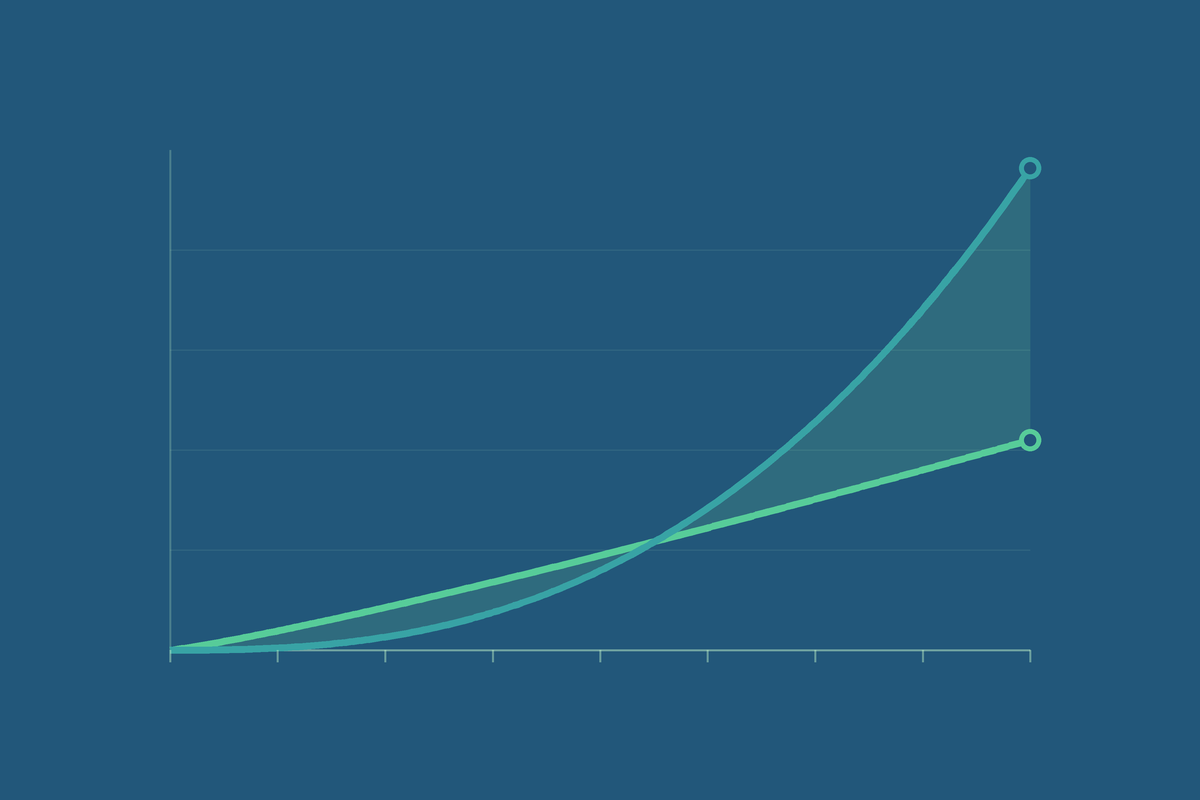
The gap between the two curves is the whole story: as event volume climbs, one pricing model rises far faster than the other. Illustration: YesPress.
The pitch decks always start with features. Cohorts, funnels, retention curves, session replay, the AI copilot that writes the query for you. Sit through enough analytics demos and they blur together, because at this point the two biggest product-analytics tools do most of the same things. So when a team finally rips one out and installs the other, the natural assumption is that somebody found a killer feature. They almost never did. They found the invoice.
The migration story of the last two years is Amplitude to Mixpanel, and the trigger is boring in the way that expensive things usually are. It is not a capability gap. It is event volume, and the way pricing turns event volume into money. Amplitude's model has historically leaned hardest on the products that generate the most activity - the successful ones, the sticky ones, the ones where users do a lot. The better your product performed, the more the meter ran.
Nobody migrates for a feature. They migrate for the invoice.
The tax on your own success
Here is the uncomfortable mechanic. A product analytics tool charges you for scale, and scale can be measured two ways: by how many people use your product, or by how much they do inside it. Those are very different numbers. A meditation app might have millions of users who each open it once a day. A trading terminal or a collaborative editor might have a fraction of the users, each firing hundreds of events an hour.
Amplitude built its reputation around behavioral analysis and, for years, framed pricing around monthly tracked users - the count of unique people who trigger events. Mixpanel, since a big pricing change in February 2025, charges plainly for events: the first million a month are free on its Growth plan, and after that it is roughly twenty-eight cents per thousand events. Amplitude's public pricing has since moved toward event-volume tiers of its own, which narrows the gap on paper. It does not close it for the products that fire the most events, where overage costs still climb hard.
The result is that the same product can be cheaper on either tool, depending on a single ratio: events fired per user. A wide, shallow product - lots of users, few events each - tends to do well on event-based pricing. A narrow, deep product - fewer users, enormous per-session activity - can get punished when every one of those events is a billable line item, and can sometimes do better on a per-user model. The trap is that most teams never model this ratio until the renewal quote lands and the number has a comma in it that was not there last year.
Illustrative annual cost as event volume grows
Directional, not quoted. The point is the widening gap, not the absolute figures - your real numbers depend on events per user.
Why the switch happens quietly
Re-instrumenting an analytics stack is not glamorous work. It means re-checking every tracking call, mapping event names, making sure the funnel that finance stares at every Monday still reports the same number the day after the cutover. Teams do not announce it. There is no launch blog. It shows up as a line in an engineering sprint called "analytics migration," and three weeks later the old contract lapses.
Mixpanel has leaned into being the easy exit. It publishes a free migration service that exports Amplitude data, transforms it, and loads both events and user profiles into a new project. The detail that engineers actually appreciate is a DRY_RUN flag: pass it and the tool tells you how many events a migration would move before a single one is billed. That is a rare piece of honesty to bake into documentation, and it does quiet work in a buyer's head. You can see the size of the bill before you agree to it.
Pricing is product. How you charge decides who stays.
There is a catch worth stating plainly, because it bites teams who move fast. Backfilling historical events counts against the current month's plan. Import two years of history in one afternoon and you can spike that month's bill even though the data is old. Mixpanel says as much and recommends testing on the free plan first. It is the kind of footnote that separates a clean migration from an angry Slack thread.
The real lesson is about pricing, not tools
Strip away the logos and this is a small case study in something larger: how you charge for a product decides who stays with it. A pricing model is not a spreadsheet detail bolted on after the features are built. It is part of the product, and it tells your best customers whether their success is something you share in or something you meter. When the model taxes the exact behavior you want more of - engagement, activity, events - you have built a reason for your happiest users to shop around.
Instrumentation, meanwhile, has quietly become a finance decision. A decade ago, deciding which events to fire was an engineering call about observability. Now every event is a recurring cost, and the person who names a new tracking call is, in a small way, spending money every month forever. The teams that stay ahead of this treat their event taxonomy like a budget: they audit what they track, kill the noise, and model the bill at next year's volume before they sign anything.
None of this makes Amplitude a bad tool. Teams that migrate usually respect the product; several would happily use it again at a different scale or a different event profile. The complaint is narrow and specific - the invoice stopped making sense at their volume. That is a solvable problem, and the solution, for a growing number of them, has been to move the events somewhere the meter runs slower.
If there is a single thing to take from the whole episode, it is this: read the pricing page before your users get engaged, not after. The best time to model your analytics bill at scale is when the numbers are still small enough to be a rounding error. The second best time is right now, before the renewal quote arrives with its extra comma.
Sources & further reading
- Mixpanel — official site
- Amplitude — official site
- Migrating from Amplitude — Mixpanel docs
- How Mixpanel pricing works — Mixpanel docs
- Simpler pricing: 1M free events — Mixpanel blog
- Amplitude pricing in 2026 — Userpilot
- Mixpanel vs. Amplitude — comparison guide
Questions people ask
Why do teams migrate from Amplitude to Mixpanel?
Usually cost, not features. Products firing a high volume of events per user have seen Amplitude bills climb sharply as usage grows, which makes Mixpanel's transparent event-based pricing more attractive.
Is Mixpanel actually cheaper?
It depends on your events-per-user ratio. Event-based pricing tends to favor products with many users firing relatively few events each. Heavy per-session event firing can favor per-user models. Model your own volume first.
How hard is the migration?
Mixpanel offers a free, documented migration that exports Amplitude data and loads events and user profiles. A DRY_RUN option previews how many events will move before you commit.
Will backfilling old data spike my bill?
It can. Events ingested during migration count toward the current month's plan, so Mixpanel recommends testing on the Free plan and modeling costs before backfilling history.
What changed in Mixpanel's pricing in 2025?
In February 2025 Mixpanel moved to simpler event-based pricing that includes the first 1 million events free each month on Growth, charging roughly $0.28 per 1,000 events above that.