Somewhere inside the old Kissmetrics blog was a rather expensive joke. It had published 1,812 posts, attracted roughly 62 million pageviews and become a small monument to the idea that a company could write its way into the market. When the analytics firm eventually joined those articles to its customer records, it found that 598 posts had drawn 15.9 million views and produced no paying readers. The audience was real. The commercial result was something else.
This is the kind of discovery that can make a marketing meeting go quiet. It is also a neat introduction to Kissmetrics, the software company founded by Hiten Shah and Neil Patel in 2008. Its product asks businesses to follow the actions of people through time: the first visit, the trial, the purchase, the return, the cancellation. A pageview is a moment. A customer is a plot.
- Kissmetrics sells event-based customer analytics for SaaS, ecommerce and other digital businesses.
- Its old blog audit found that 45 posts accounted for half of revenue attributed to a reader's first article.
- The product connects events to people, then turns them into funnels, cohorts, revenue reports and behavioral groups.
- A free workspace covers 100,000 events a month; the published Growth plan starts at $99 a month.
Fame is an excellent disguise
The company's own retrospective is unusually unsentimental. Of the roughly $14.8 million it assigned to a specific first blog post read, half came from 45 articles. Analytics posts earned nearly seven times as much revenue per view as SEO posts. Yet SEO supplied a larger slice of traffic. Social shares, normalized by views, had almost no relationship with first-touch revenue. In other words, the content that made the loudest entrance seldom brought a wallet.
There is no magic lesson that would have let the editors pick those 45 winners in advance. Publishing many articles was, in part, how the company discovered them. The practical lesson comes later: once you can see readers become customers, keep that view beside the traffic chart. A post that reaches a small, qualified audience may be worth more than a famous one read by people with no reason to buy.
A customer has a memory
To understand the product, picture a shopper who finds a store through search on Monday, reads a comparison on Wednesday, signs up on a phone Friday, and buys on a laptop the following week. A conventional web report can count the visits. Kissmetrics tries to connect the sequence to one person, provided the business has a way to identify that person. It records events - viewing a product, starting a trial, paying an invoice - and attaches properties such as campaign, plan or device.
That record is the raw material for a more useful set of questions. Which acquisition channel brings customers who stay? How long do trial users take to reach a feature that predicts renewal? Which checkout step loses repeat buyers? Which group has started to disappear? Funnel reports show progression; cohorts compare people who started at different times; revenue reports put money next to behavior. Populations turn a definition such as “trial users who have not completed the core action” into a segment that can be examined or exported.
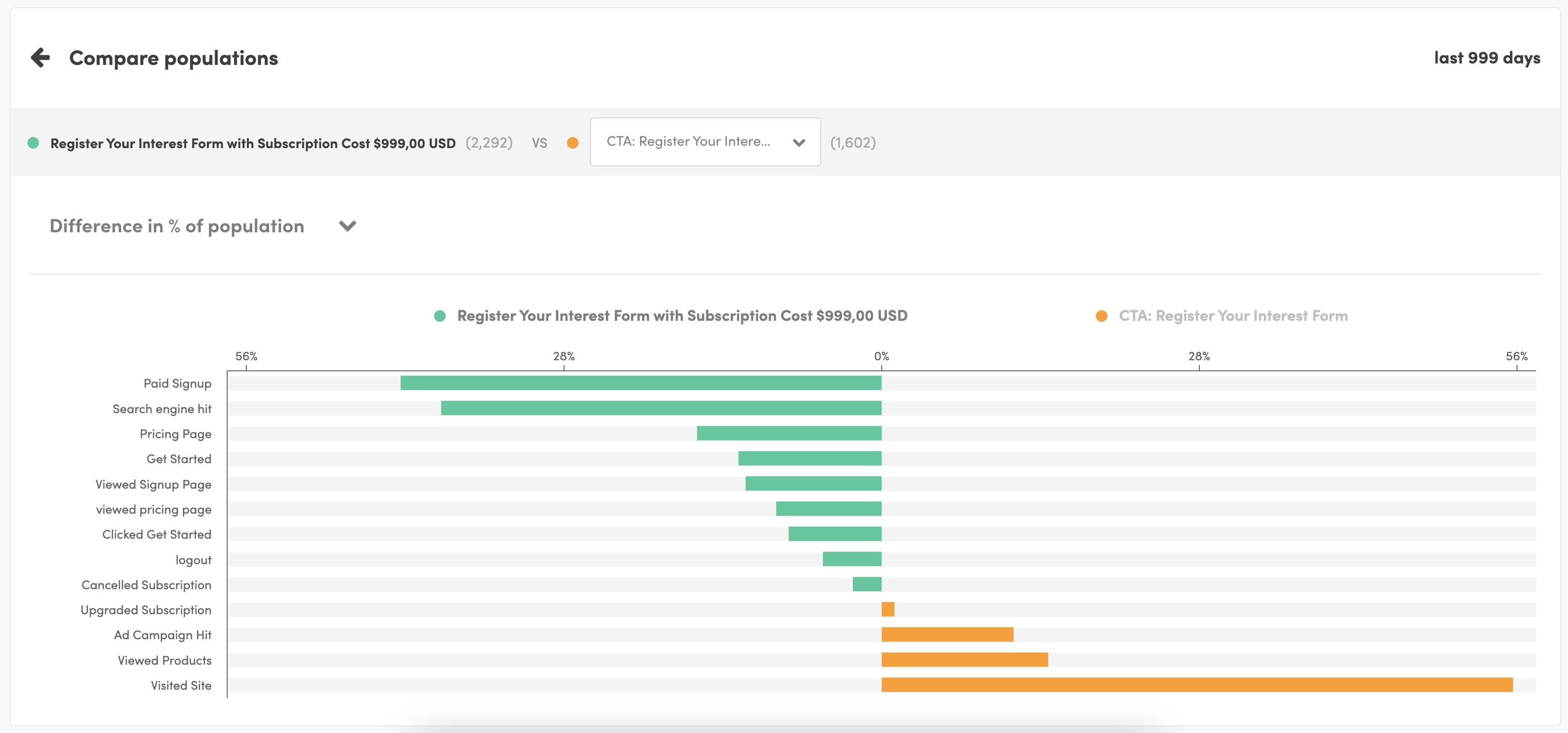
Its obvious rivals include Google Analytics 4 for website measurement and Mixpanel, Amplitude and Heap for product behavior. Kissmetrics occupies the overlap between marketing and product analysis, with identity across visits at the center. It appeals to companies that care less about how many sessions a campaign produced than what those sessions became. A SaaS team can follow a trial into recurring revenue; an online retailer can connect a first purchase to a second one. The company says it has helped more than 10,000 businesses since 2008, a historical count rather than a disclosed tally of present paying accounts.
“Track people, not pageviews.”Kissmetrics' published product line
The bill, and the harder bill
The software's price is unusually easy to find. Its free workspace offers 100,000 monthly events and three seats. The published Growth tier starts at $99 a month for 500,000 events, with annual billing discounted by 20 percent; larger volumes cost more, and custom terms begin beyond the published tiers. There is also an Accelerator service: a written assessment, a small deposit, and a success fee tied to an agreed outcome. The economic logic is plain. The software charges for the volume and depth of analysis, while the service charges for getting a usable system into a company.
But the subscription is only part of the cost. Any analytics team must decide what a “signup” means, whether a purchase fired twice, how a person moves between devices, and which events are legal and appropriate to collect. The company acknowledges that the time between installing a snippet and trusting a number can stretch for weeks. Its answer in the 2026 V2 rebuild is to capture events automatically, infer what sort of business a site runs, assign likely roles to those events, and draft the first dashboard. The draft is editable. It needs to be: an inferred conversion can be wrong with exquisite confidence.
Record
A site snippet collects behavior as events.
Interpret
The software proposes event roles and an initial dashboard.
Correct
A team reviews the schema before using its answers.
That is a significant shift in emphasis. The earlier pitch was about the detail a person-based report could reveal. The new one begins with the work required to make such a report trustworthy. The product now advertises plain-English questions that become saved, repeatable reports. That matters because a clever answer in March is less valuable if a colleague cannot reproduce it in June.
The test a reader can borrow
A team can copy the Kissmetrics audit without buying Kissmetrics. Choose the actions that mark progress toward revenue. Connect campaign and content visits to identified signups and purchases where consent and data permit. Then rank pages twice: once by attention, once by customers or revenue per reader. Compare cohorts over time. Ask whether a popular article reaches future buyers or merely wins a brief argument with an algorithm. Do not let the two rankings blur together.
There are limits. A business that cannot identify returning users reliably, that sells through a long offline procurement process, or that lacks enough conversions to compare cohorts will get weaker answers. First-touch attribution also grants the first article credit for a sale that may have required demos, emails and a good product. Kissmetrics' old blog analysis is most useful as a diagnostic, not as a claim that 45 articles single-handedly created half the business.
The company has had other chapters: a 2013 funding round, a 2025 acquisition of Sandstorm Analytics assets for a gaming division, and now a rebuilt product. But the 62-million-view story explains its place in the market better than a feature grid can. Kissmetrics sold a way to remember the person behind the visit. Eventually, it turned that memory on itself. The result was a famous blog looking at a much less flattering ledger - and a better question for anyone who has ever celebrated a traffic spike.