At Solace Bands, a growing accessories business, the question was simple: should more money go into Google Performance Max? The answer was buried under a familiar nuisance. Marketing reports could describe where customers had clicked. They could not settle how many sales the advertising had actually caused.
The team used Triple Whale’s Compass to run a holdout test. The company’s published account reports an incremental return on ad spend of 3.25. That gave Solace confidence to increase budgets. A subsequent AppLovin test produced insufficient evidence for a confident decision. The team marked it for another test. Sometimes software earns its keep by giving you a reason to wait.
- One working view: store, advertising and customer data brought together.
- Three measurement lenses: attribution, mix modeling and experiments.
- A step beyond reporting: Moby can prepare work and act within permissions.
First, there was the spreadsheet
Triple Whale’s origin is pleasingly unglamorous. Co-founder Maxx Blank describes a Google Sheet he had grown tired of updating. Running an ecommerce business meant opening different platforms, collecting numbers and assembling an answer to a question that should have been easy: how was the business doing?
Blank, AJ Orbach and Ivan Chernykh built a dashboard. In Blank’s account, they shared an early version with roughly 50 ecommerce operators. People returned. That mattered more than whether the interface was beautiful. A daily irritation had become a daily habit.
The first thing to fail was confidence in the underlying advertising data. Apple’s privacy changes made measurement harder for merchants. Triple Whale responded with its own first-party attribution system, Triple Pixel. The dashboard now needed a foundation sturdy enough to support the decisions happening above it.
The company dates its founding to 2021. In 2022, it announced $27.7 million across a Series A and earlier financing. A $25 million Series B followed in February 2023, including strategic participation from Shopify. The store platform had invested in a business helping its merchants understand their stores.
Three ways to ask who deserves credit
Marketing has a credit problem. A customer sees an advertisement, returns through search and buys after an email. Several platforms can claim an important part in the sale. Adding their claims together is a fine way to purchase an imaginary business.
Triple Whale combines orders, customers, spend and other signals into a common commerce data model. Its expertise sits in the connections between those records: the journey to an order, the value of a returning customer, the difference between reported revenue and useful profit.
Compass adds three complementary approaches. Attribution helps with daily campaign decisions. Marketing mix modeling examines broader patterns across spending and sales, including retail. Incrementality experiments test whether changing exposure changes outcomes. Each answers a different question; none deserves a blank cheque.
Solace’s experience makes the distinction tangible. Its paid-media lead, Jacob Dorian, says, “I am not a data scientist.” The workflow included onboarding, calibrated inputs and regular conversations with Triple Whale’s data science team. The product was accompanied by people who could help interpret it.
The chart has acquired a colleague
The next limitation was human bandwidth. Once a dashboard reveals a problem, somebody must investigate, make a decision and carry it into another tool. In September 2026, Blank described that distance between seeing and solving as a reason for the company’s expansion.
Moby 2, generally available from May 2026, is Triple Whale’s attempt to shorten the trip. It connects AI models to the merchant’s own data and business context. Its advertised tasks include analyzing performance, forecasting inventory, producing creative and building landing pages. Automations add recurring work; Actions connect decisions to changes in advertising accounts.
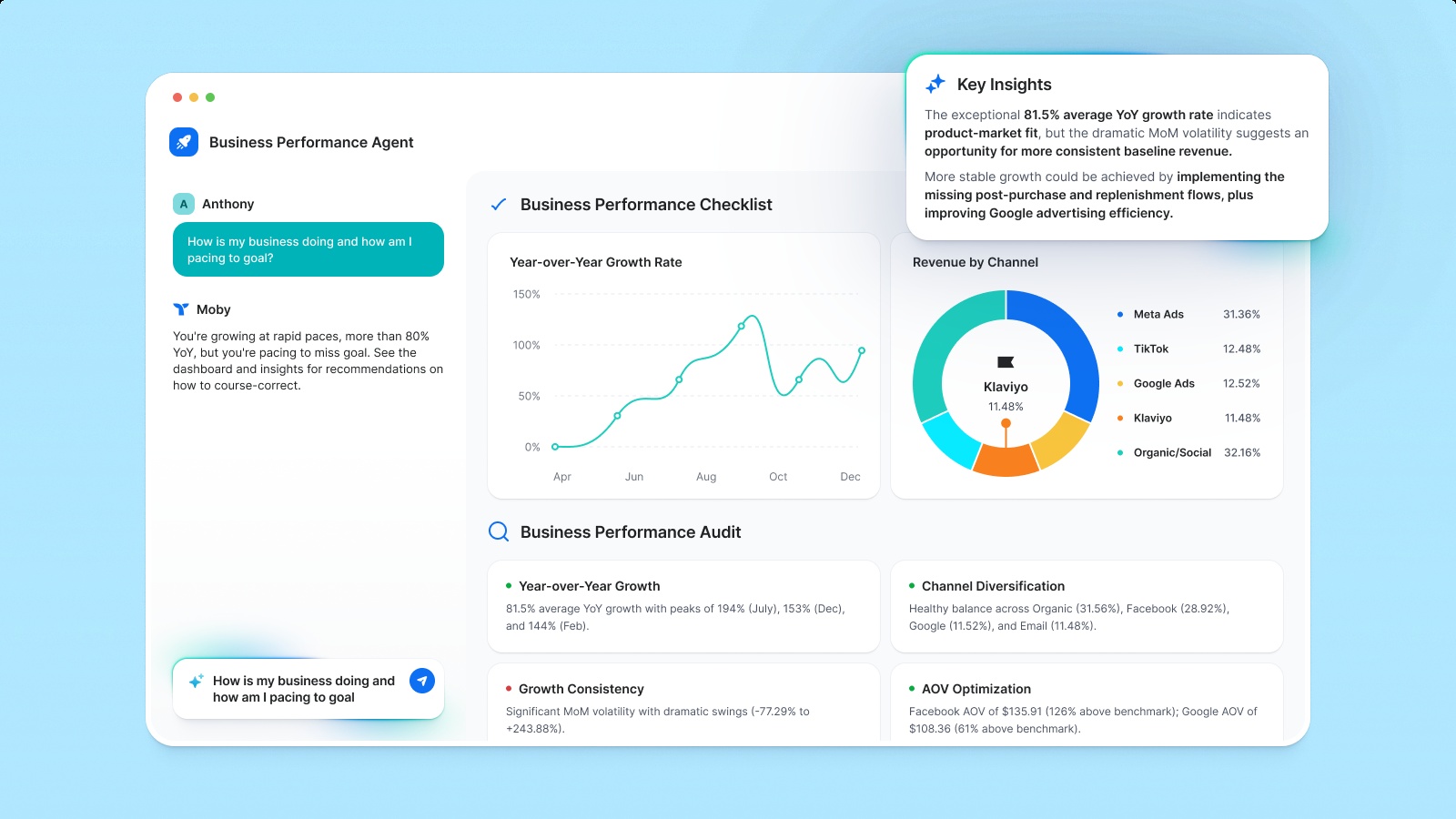
Control is part of the product. Current documentation distinguishes “Ask every time” from “Let Moby decide.” Teams specify goals, schedules and guardrails. An operator can review evidence, approve a proposal or reject it. The useful question is whether the system knows enough about this particular business to deserve that permission.
At skincare company YSE Beauty, Triple Whale’s case study describes a team working without a dedicated analyst. Susan Keating uses Moby to investigate which campaigns attract customers who return, rather than judging everything by the first purchase. Customer segments also inform retention programs. The appeal is practical: fewer hours assembling a question before anyone can answer it.
“AI is only as good as the data feeding into it.”Susan Keating / YSE Beauty
The supporting products make that data useful elsewhere. Sonar enriches signals for advertising and retention tools. Custom BI lets analysts build their own views and query the data with SQL. An impact.com integration brings partnership revenue and commissions into the same reporting environment. A merchant can compare affiliates with paid media without first constructing another spreadsheet. These connections are central to the pitch: the work already crosses tools, so the evidence should travel with it.
The subscription has a second price
Triple Whale sells subscriptions. Its Shopify listing displays a free plan, Foundation at $219 per month and Automate at $749 per month. Those are entry listings. Actual paid pricing depends on annual gross merchandise value and package; optional services and AI usage also matter. Enterprise is sold through the company.
There is an operational price, too: connecting systems, agreeing on metric definitions and deciding who approves changes. A team that cannot trust its inputs cannot delegate its way to trustworthy outputs.
Northbeam competes across attribution, mix modeling and incrementality. Polar Analytics combines commerce data with BI and AI agents. Triple Whale’s proposition bundles measurement, data infrastructure and execution in one environment. For a simple store with modest reporting needs, native reports and a spreadsheet may still be enough.
Copy the habit, then consider the software
By September 2026, Triple Whale reported more than 65,000 brands across over 85 countries. Its expansion includes January’s acquisition of AI-visibility platform Anteater, following shoppers into a new discovery channel.
The transferable lesson is smaller than that footprint. Start with a recurring decision. Reconcile the data it needs. Compare signals, test a disputed assumption and assign someone to act. Automate the repetition after the rules make sense. A dashboard becomes valuable when Monday’s meeting ends with a decision someone can explain.