The most expensive bug on a website rarely announces itself with smoke. It looks like a form field refusing a perfectly good address, a hotel-booking button that thinks for too long, or an out-of-stock product page that politely escorts a shopper toward the exit. The customer leaves. Marketing sees conversion wobble. Engineering sees no fatal error. Product adds an item to a backlog already shaped like a geological era.
Quantum Metric sells a way out of that argument. Its software records what people do across websites and mobile apps, couples those actions to technical signals, and estimates the commercial weight of the friction. A session replay makes the complaint visible. A console error or API call suggests the cause. Revenue and conversion data answer the question that gets budgets moving: how much is this costing?
That combination has made the Colorado company a serious enterprise operator in digital experience analytics, a crowded market shared with Contentsquare, Glassbox and Fullstory, and bordered by product-analytics firms such as Amplitude, Mixpanel and Pendo. Quantum Metric is not the cheapest magnifying glass on the shelf, nor is it meant to be. It sells custom subscriptions to large organizations whose digital journeys are busy enough that a fraction of a percentage point can pay for the investigation.
The first failure was useful
Mario Ciabarra began early. At 15, he tried direct-mail selling and calculated that a 1.1 percent response rate would make the business work. It produced roughly 0.9 percent. The tiny gap swallowed the plan. He later called it “a very successful failure,” because it cured him of confusing an optimistic spreadsheet with reality. Quantum Metric, his fourth startup, carries the scar in a productive place: its whole pitch is about measuring the gap between what a team expects customers to do and what they actually do.
Ciabarra and David Wang founded the company in 2015. Advance Auto Parts became the first customer. Rather than begin with a large institutional round, Ciabarra self-invested and let customer licenses finance much of the early work. One initial customer, he told Forbes in 2019, made multimillion-dollar investments in licensing the technology. That is unusually clean validation: a company with a costly problem paid for the solution before venture investors priced the story.

Then the product began to buckle. At large customers, complex queries that had taken five seconds drifted to 10, then 30, then toward a minute. Add 50 simultaneous users and the analytics platform became the bottleneck to its own success. Quantum Metric spent much of 2017 exploring technologies, building options and throwing away the ones that did not hold up. The team ultimately paired its real-time database with Google BigQuery and invested heavily in security and privacy.
What changed Ciabarra’s mind about outside capital was similarly practical. The company had traction but not enough people in the field, and opportunities were escaping. Insight Venture Partners led a $25 million Series A in September 2018. Quantum Metric added a $25 million debt facility in 2020, then raised a $200 million Series B led by Insight Partners in January 2021 at a valuation above $1 billion. The public total on the company’s current site is $251 million. The lesson is not “bootstrap forever.” It is to know which constraint the money is supposed to remove.
“Data is a burden you give someone to solve. Understanding is a gift you give someone to take action.”Mario Ciabarra, founder and CEO
The product is a shared crime scene
Traditional web analytics is good at the aerial view: visits, funnels, conversion, campaign traffic. Observability tools are good at the machinery: latency, logs, traces and errors. Surveys capture what customers remember saying. Session replay shows the screen. The annoyance is that each answer often lives with a different team. When revenue falls, the war room fills with people carrying incompatible maps.
Quantum Metric autocaptures interaction data so teams do not need to predict and tag every future question. Its platform offers journeys, dashboards, heatmaps, alerts, performance monitoring, error diagnostics, replay and segmentation. Atlas packages common industry journeys and metrics into templates. Visible moves experience data into other systems and workflows. Integrations connect the view to tools such as Salesforce, Datadog, Medallia, Adobe products and Google Cloud.
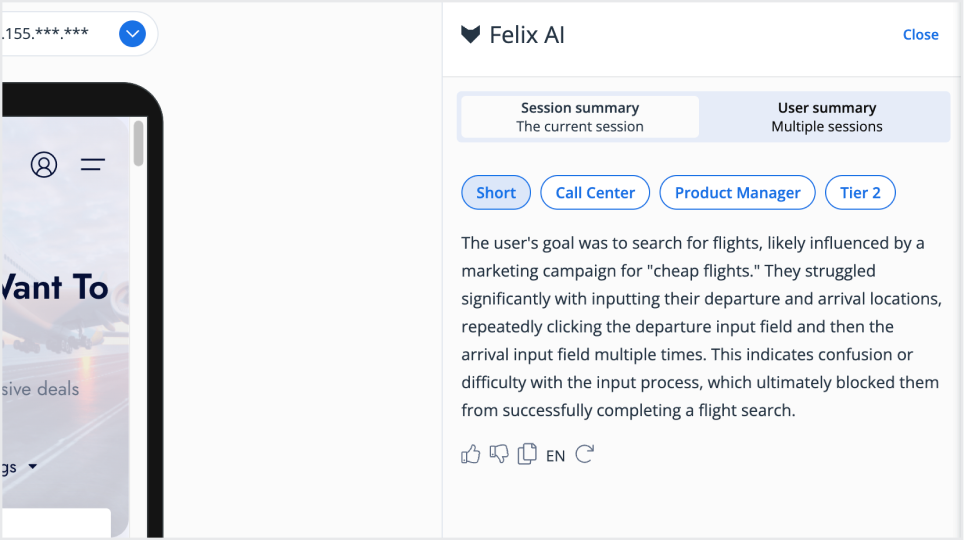
The differentiator is not replay alone. Replay has become table stakes. Quantum Metric’s sharper move is to connect behavioral, technical and business evidence, then quantify an opportunity. That gives an engineer the stack detail, a product manager the affected journey, and an executive the estimated economic consequence. Everybody can disagree, but at least they are disagreeing over the same customer.
The playbook worth stealing
Preserve the journey before you know which question will matter.
Join behavior to errors, performance and business outcomes.
Estimate the people, orders and money affected.
Ship the smallest plausible fix and measure again.
Small frictions, adult-sized numbers
The customer stories make the proposition less abstract. Lululemon used Quantum Metric to find and work through fatal checkout validation errors. Its chief digital officer said the cleanup produced a “multi-tens of millions of dollars” revenue impact. Vitacost found that shoppers with a saved card could be blocked when trying another payment method; after a simple fix, conversion for that segment rose 24 percent.
Bass Pro Shops saw people arriving from Google on pages for products that were unavailable. The team quantified the audience, formed a hypothesis, and tested a “Shop Similar Items” route rather than leaving visitors at a retail cul-de-sac. Conversion rose 8 percent in the test, which the company associated with millions in incremental annual revenue. Radisson found a small booking-form error affecting about 2.5 percent of reservations and pushed the error rate below 1 percent. Wyndham connected Quantum Metric with Datadog and other systems, cutting average resolution time from 60 to 30 minutes.
These are vendor-published case studies, not controlled trials, and each measures a different slice of behavior. Still, the operating pattern is portable. Do not prioritize a bug because it is vivid or because the loudest customer found it. Count the affected sessions. Attach the effect to an outcome. Find the narrowest change that could alter the behavior. Test. This is Continuous Product Design, Quantum Metric’s name for a habit more useful than the trademark: keep decisions close to current customer evidence.
Now the dashboard is supposed to investigate itself
Felix AI began by summarizing sessions and answering questions in conversational form. In March 2026, Quantum Metric introduced Felix Agentic, built with Google’s Gemini models. The pitch moved from assistant to always-on analyst: Felix monitors journeys, investigates a change, explains why it matters and exposes its reasoning. In July, the company made the product generally available with Chat, Background Agents, Copilot, Skills and Workflows.
The important claim is not that an LLM can describe a chart. Many can. Quantum Metric argues that Felix sits on a full-fidelity, first-party experience dataset rich enough to ground the answer in actual sessions, technical events and business objectives. In its telling, this data is 2,700 times richer than traditional analytics or marketing-cloud datasets. Treat that multiple as company positioning, but the architectural point holds: an agent is only as dependable as the context it can inspect.
The business appears to have found fresh momentum after the venture boom. Ciabarra said revenue grew from roughly $100 million to $120 million in 2024 and that the company reached profitability in the fourth quarter. Quantum Metric separately reported 40 percent annualized Q4 growth and a 30 percent year-over-year rise in average contract size. In July 2026 it said first-half ARR growth nearly tripled the pace of the prior-year period and announced a five-year expansion with a Fortune 100 insurer covering more than 2,000 users. Private-company figures deserve the usual caution, but longer contracts are a better signal than a lively demo.

Where the telescope is too large
Quantum Metric works best where traffic is high, journeys cross teams, and a small improvement has meaningful economic value. Retail, banking, airlines, hotels, telecom and healthcare fit the shape. Product, engineering, analytics, service, UX and marketing all get a version of the same evidence. The enterprise sales model, custom pricing and implementation demands make far less sense for a young product with modest traffic and two people already sitting beside each other.
There is also an organizational catch. Software can reveal that a broken promotion, slow API and confusing button sit in the same journey. It cannot make the marketing owner, engineering lead and product executive agree on who gives up roadmap space. Felix can reduce the detective work, but autonomy stops at the edge of authority. Companies that buy understanding without reserving capacity for action have purchased a very articulate witness.
That leaves Quantum Metric in a useful market position. Contentsquare offers a broad experience-analytics suite; Glassbox emphasizes regulated environments and mobile visibility; Fullstory is known for accessible replay and behavioral analysis. Quantum Metric’s case is strongest when real-time diagnosis and economic prioritization must travel together. Its product does not merely ask, “What did the customer do?” It tries to answer, “Why did it happen, what did it cost, and which team should care first?”
The part worth copying costs nothing: start every product debate with a real customer journey, connect the visible frustration to the machinery beneath it, and translate the finding into the unit your organization uses to choose. Revenue is one. Retention, completed applications, successful check-ins and avoided support calls also count. A dashboard is only a view. The business begins when somebody changes what the customer experiences next.