The trouble with a good question is its manners. It arrives late. A feature has shipped, customers have wandered through it, and somebody finally asks whether the people who used it came back. If nobody arranged to record the right interaction, the answer begins with a small administrative tragedy: find an engineer, add tracking, release the change, wait.
Heap built its business around that delay. Founded in 2013 by Matin Movassate and Ravi Parikh, the company proposed collecting supported interactions automatically, then letting people decide which ones deserved a name. The question could arrive after the click. The evidence could already be waiting.
- Collect now, label later. Investigate previously captured behavior without instrumenting each new question.
- Count it, then inspect it. Funnels and cohorts lead into session replay; Sense helps build analysis in everyday language.
- Buy the workflow. Heap is part of Contentsquare, and competitors now offer autocapture too.
The expense of being late
In his 2016 Series A announcement, Movassate used an “Invite a Friend” feature to describe the problem. Did inviting someone correlate with longer retention? A seemingly modest question could require tracking specifications, engineering time, an app release, weeks of accumulating data and another request to the data team.
Heap’s answer reversed the order. Install its capture code; let supported activity accumulate; define the events you want to analyze. Naming an event becomes a way of organizing existing evidence. For a product manager, that means a newly noticed detour through onboarding can become an analytical question rather than a future engineering ticket.
There is a boundary to this convenient form of time travel. Retroactive analysis reaches back through data that was actually captured and retained. It cannot summon last year’s clicks from a website that installed Heap this morning. Even the past requires preparation.
A funnel is a map. A replay is a visit.
Heap sells software to teams responsible for digital behavior: product managers examining adoption, marketers checking acquisition quality, designers investigating friction, and analysts joining the pieces. Its analytics include funnels, retention, behavioral segments, dashboards and journeys across devices. The point is to turn a busy website or app into questions a team can answer.
A funnel can show the distance between opening a signup page and completing an account. Retention analysis asks whether users return. A cohort groups people by shared characteristics or behavior. These views describe patterns across many people; they do not automatically tell you what confused the person who gave up.
Session replay brings the investigation down to the individual recorded session. Heap links replays to relevant events, helping a team inspect the moment that interests it instead of browsing recordings at random. A repeated click, an unexpected route or an apparent dead end supplies context for the numbers. Interpreting that context still requires judgment.
Illuminate adds another layer: suggestions about events and groups worth examining, plus signals such as rapid repeated clicks. Its appeal is that an analyst need not anticipate every possible source of friction. A useful clue can come from behavior nobody included in the original funnel.
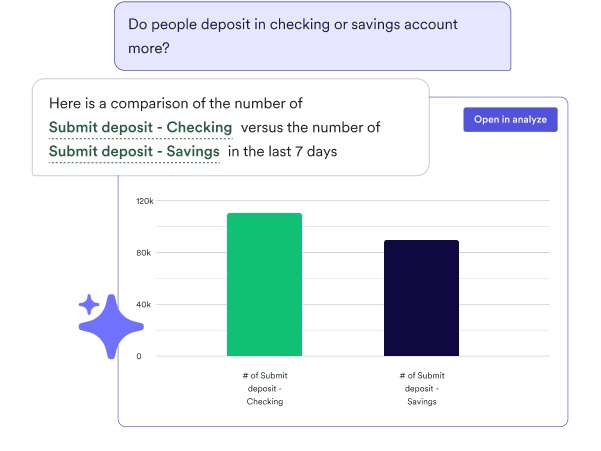
Sense tackles the next bottleneck: knowing how to build the analysis. Ask in ordinary language, generate a chart, read a summary, then pursue a follow-up. Heap’s earlier AI CoPilot announcement described an option to inspect the assistant’s approach. That matters. A polished answer can still rest on an event definition that means something different from what the questioner intended.
Huel found a merchandising problem
Huel, the nutrition business, supplies a useful historical example. Its published account describes a subscription-account area whose behavior the team could not adequately track, and granular funnels that took hours to assemble in Google Analytics. Monthly totals were available. The route customers took was harder to see.
With Heap, Huel examined behavior by country, product and marketing channel, using Shopify and Snowflake integrations to connect the data. Those views exposed parts of its marketing plan that were underperforming. The company changed merchandising and reported more than 30% higher new-customer conversions in some markets.
in some Huel marketsHistorical customer account. Merchandising changed; this is not a guaranteed lift from installing software.
The instructive detail is the segmentation. An overall conversion rate can conceal a weak combination of market, channel and product. Huel found something specific enough to change. Readers can borrow that method without borrowing its percentage.
The prototype took a sprint. The product took longer.
Heap’s own replay story contains a pleasingly unglamorous lesson. Initially, engineers were building integrations with outside replay providers. They kept the design modular, using session identifiers to connect events to recordings. They expected a handful of partners and avoided constructing an elaborate system for a hypothetical hundred.
Then the assignment changed. Heap acquired Auryc in 2022 and wanted native replay. In a later engineering account, Jared Ramsey described a four-month deadline. Because the integration did not assume one particular vendor, the team had a working Auryc integration within a sprint.
The remaining months went into the parts a prototype does not settle: trials, subscription enforcement, internal tools, monitoring, privacy controls and an interface that felt native. Public availability followed on September 1, 2022. The lesson is copyable: isolate the dependency likely to change, keep the abstraction understandable, and budget for the ordinary work that turns “it works” into “people can use it.”
The bill follows the session
Heap’s commercial model is a cloud subscription with a free entry point and paid tiers. At this research snapshot, the free plan allows up to 10,000 monthly sessions and six months of data history. Growth adds capabilities including the AI assistant; Pro and Premier use custom session pricing.
Session replay is listed as an add-on for Pro and Premier. Warehouse access through Heap Connect is an add-on for Pro and included with Premier. Longer history can also change the package. There is no sensible universal dollar figure to attach to all of those combinations.
A buyer should bring traffic estimates and a real use case to the pricing discussion. How much history does seasonal analysis need? Will the team inspect replays? Does behavioral data need to meet business records in a warehouse? “We need analytics” is an expensive specification because it leaves the important choices until later.
Every click still needs a definition
Automatic collection does not settle what a business means by “activated.” Nor does a click necessarily mean a purchase completed. Heap’s governance workflow addresses this organizational problem through four verbs: define, validate, monitor and evolve. Naming conventions, a data dictionary and definition history help teams make their reports intelligible to one another.
“Our analysts easily define unknowns retroactively”
Brandon Walsh, Amway / Heap’s autocapture guide
Collection itself has limits. Heap’s web capture controls can block or allow particular sites and pages; replay has separate privacy settings. Its form guidance says text-field contents are not captured by default. Embedded frames can require their own installation or integration. A server-side business outcome may need explicit tracking. These are implementation choices that determine which questions the dataset can support.
The human obligation remains equally concrete. Validate the event against what actually happened. Agree on the definition. Check that the observation period is comparable. A larger collection of poorly understood events simply gives a disagreement more places to hide.
The idea acquired competitors. Then Heap acquired a parent.
Heap’s early positioning made autocapture sound like a border separating it from established analytics tools. That border has become porous. Amplitude documents automatic capture and retroactive visual labeling; Mixpanel introduced its own Autocapture in 2025. Comparing today’s products requires examining their actual workflows, supported platforms and commercial terms.
Heap now sits within Contentsquare, which completed the acquisition on December 7, 2023. The fit is understandable: product analytics follows behavior across a customer’s lifetime, while experience analysis inspects the detail of particular sessions. In November 2024, Contentsquare announced an expanded platform combining strengths from Heap, Hotjar and its own offering.
automatic capture
native replay
acquisition closes
expands
Before that sale, Heap announced a $110 million Series D at a $960 million valuation in 2021. Those are historical financing figures, not the acquisition price. Movassate’s earlier Series B note offered a useful cultural counterweight: “We don’t celebrate fundraises internally at Heap.” He said the company preferred celebrating products and happy customers. Its published people material also emphasizes respectful candor and a virtual-first workplace.
Borrow the habit, not the percentage
A practical trial starts with one outcome: completing onboarding, making a first purchase or returning next week. Check the relevant event definitions, build the funnel, break it down by a meaningful group, and inspect recordings around the point of abandonment. Write down the suspected cause before changing anything.
Then test a specific intervention and measure the same outcome again. People who use a feature may already be more engaged; their higher retention does not prove the feature caused it. The software can help find the pattern. The team must decide how to test the explanation.
That is the useful idea inside Heap’s history. Teams are allowed to become curious after launch. They still need enough evidence, a defensible definition and the discipline to change one thing they can learn from. A good question may arrive late. It need not spend the next month in a queue.