The Quiet War Over Who Names Your Events
Segment and Amplitude usually run side by side, not head to head. The real fight is quieter - which one gets to decide what an event is called before the whole company builds dashboards on top of it.
Here is a meeting that happens at almost every company that has grown past its first analytics dashboard. Someone pulls up a funnel, points at a number, and says it looks wrong. An engineer says the tracking is fine. A product manager says the tracking was never right. And then everyone spends forty minutes discovering that three teams have been logging the same button click under three different names.
This is usually framed as a tooling problem, and the tool everyone reaches for is a comparison. Segment versus Amplitude. Which one is better. Which one to buy. But that framing has a bug in it, because most serious teams already run both. Segment collects and routes the events. Amplitude reads them back as behavior. They are not fighting for the same budget line. They are roommates sharing one data stream.
So the interesting question is not which product wins. It is quieter and much harder to schedule a meeting about: which tool gets to decide what an event is called, and who is allowed to add a new one. That is the schema governance question, and it turns out to be the whole ballgame.
It helps to be precise about what these two things actually are, because the marketing blurs it. Segment, now part of Twilio, is a customer data platform - it sits at the front of your stack, receives events from your apps and websites, and fans them out to dozens of destinations, one of which is often Amplitude itself. Amplitude is a product analytics platform - it takes behavioral events and turns them into funnels, retention curves, and cohorts. In a healthy stack, the same event flows through Segment and lands in Amplitude within seconds. That tight coupling is exactly why the naming question is not academic. Whatever Segment calls an event is, by default, whatever Amplitude has to work with.
Bad analytics data is rarely a bug. It is an unowned interface between two tools that both think they are in charge.
Why the names matter more than the tools
An event name is a promise. When you log Order Completed, you are telling every future dashboard, every marketing automation, every finance model that this string means one specific thing. The moment a second team logs order_completed or purchase for what is basically the same action, the promise breaks. Nobody notices immediately. The events keep flowing. The warehouse keeps filling. And weeks later a chart splits in half and nobody can say why.
This is called schema drift, and it behaves like debt. It compounds silently. By the time it surfaces in a broken metric, the malformed events are already months deep in your storage, wired into cohorts and alerts and quarterly board decks. You cannot retro-fix a name that a hundred queries depend on. You can only decide, earlier, that someone owns the vocabulary.
Consider the small version of this. A mobile engineer ships signup_completed. A web team, working from a different ticket, ships Signup Complete. A growth PM instruments a new onboarding flow and, reasonably, calls the finish line Account Created. Three teams, three tickets, three names for one moment in a user's life. Every one of them was acting in good faith. There was simply no place where the name had to be agreed on before the code shipped. Multiply that across a year of releases and you do not have a tracking problem. You have a translation problem, and translation is expensive.
The two philosophies, side by side
Both platforms have real governance products. They just put the checkpoint in different places, and that difference tells you a lot about how each one sees the world.
Segment Protocols governs at the pipe. You write a Tracking Plan - a spec of the events and properties you intend to collect - and Protocols validates incoming events against it in real time. Anything that does not match generates a violation. If you turn the controls up, Segment will block the non-conforming event before it reaches any destination, or route it to a quarantined source for review. It is prevention, upstream, before the bad data can spread.
Amplitude Govern governs where the humans are. It lives inside the analytics tool that product managers and analysts open every day. It audits events, flags unusual ones, assigns ownership, and keeps the taxonomy consistent, with a Taxonomy API for teams that want to automate it. It is less a bouncer and more a spellcheck for your product's language, sitting exactly where the naming decisions actually get made.
Segment Protocols
- Enforces at the pipe, before data leaves
- Validates events in real time against the plan
- Can block or quarantine bad events
- One source of truth for many destinations
- Owned by data engineering
Amplitude Govern
- Enforces where analysts and PMs work
- Audits, flags, and assigns event ownership
- Notification-based, taxonomy-first hygiene
- Taxonomy API for automation
- Owned by product and analytics
One is a bouncer at the door. The other is a spellcheck for the language. You want both, but only one can be the source of truth.
The failure mode nobody schedules for
The worst outcome is not picking the wrong tool. It is picking neither as the owner and letting both define events independently. When Segment has one tracking plan and Amplitude has another, and no human is responsible for keeping them in sync, you get the illusion of governance with none of the protection. Two systems of record is the same as zero.
This is why the decision is really an organizational one dressed up as a technical one. If you enforce at the pipe with Protocols, you are saying data engineering owns the contract, and that clean data is a precondition, not a cleanup task. If you lean on Amplitude Govern, you are saying the people closest to the questions should own the vocabulary, and that governance should live where the analysis happens. Both are defensible. Doing both without deciding is not.
There is a cultural tell in where a team instinctively wants the checkpoint. Engineering-led organizations tend to like Protocols, because blocking a malformed event at the source feels like a unit test: fail fast, fail loud, keep the bad thing out of production. Product-led organizations tend to like Govern, because it treats the taxonomy as a living document owned by the people who read it, not a gate that throws errors at deploy time. Neither instinct is wrong. The mistake is assuming the other side will quietly fall in line without anyone writing down who decides.
sources
(the gate)
+ warehouse
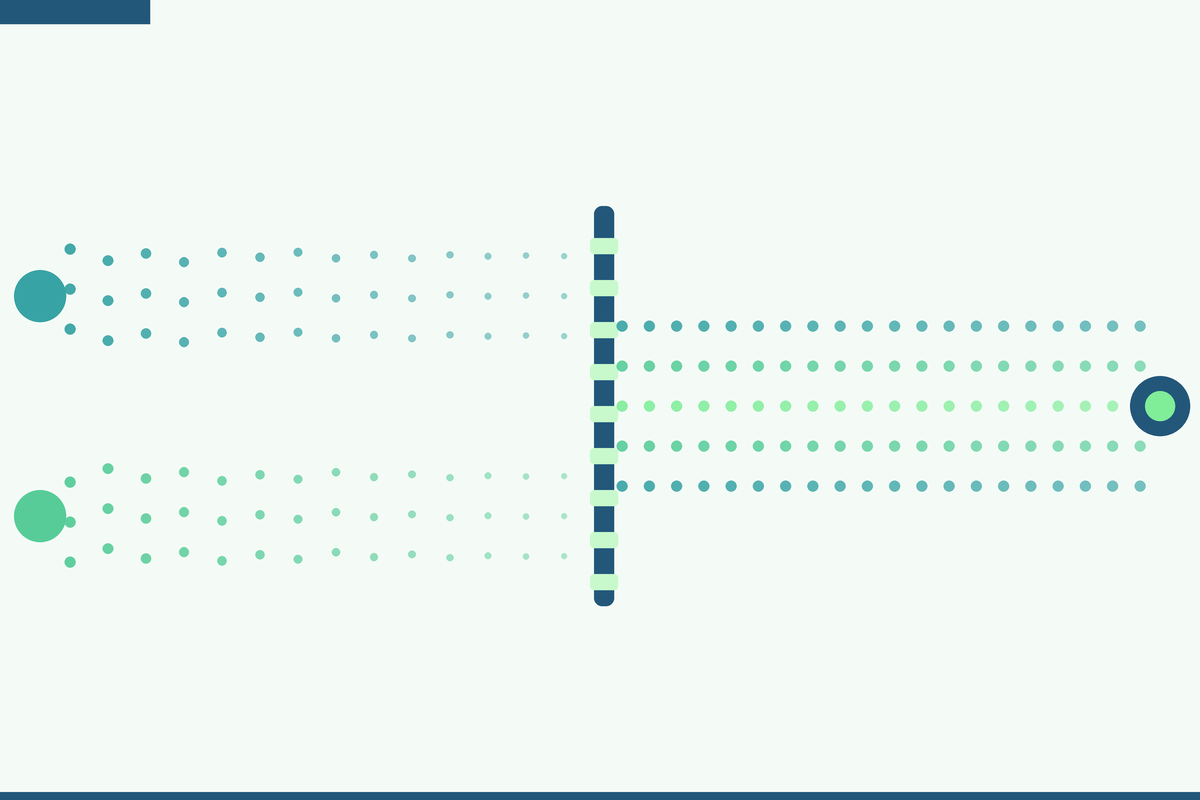
The picture is not complicated. Events come in, they pass through a schema gate, and clean data comes out the other side into Amplitude and the warehouse. The only real question is where you put the gate, and who holds the key.
A rule of thumb
If your pain is that bad data reaches downstream tools and you find out too late, put the checkpoint upstream. Turn on Segment Protocols, write the tracking plan, and let it block or quarantine what does not fit. Prevention beats forensics.
If your pain is that your Amplitude taxonomy is a mess - duplicate events, no owners, nobody sure which chart to trust - start with Amplitude Govern, because it fixes the problem where your analysts actually feel it. Then, once the vocabulary is clean, push it upstream so the pipe protects it.
Either way, the first move is not a purchase. It is naming a person, or a small group, who is allowed to say what an event is called and who has to approve a new one. The cheapest data-quality tool you own is that one decision. Make it before the button gets its fourth name.
A useful discipline sits underneath all of this: treat a new event the way you treat a new public API. It has a name, a shape, an owner, and a small cost to change once other people depend on it. Teams that ship events casually and govern them later are doing the equivalent of publishing an API with no versioning and hoping consumers guess correctly. Teams that agree on the name first - in a tracking plan, reviewed by whoever owns it - pay a few minutes up front and skip the war room later. The tooling from Segment and Amplitude just makes that discipline enforceable. It cannot install the discipline for you.
The event you named carelessly on a Tuesday becomes the metric your board argues about in a quarter.
Segment and Amplitude will both keep shipping smarter governance features - real-time blocking, ownership workflows, AI assistants that spot the odd event before a human would. All of it helps. None of it decides for you who owns the schema. That part is still, stubbornly, a management call. And the teams that make it early are the ones who stop being surprised by their own dashboards.