A player finishes a level. An advertisement appears. Somewhere behind that ordinary interruption, several businesses have competed for a few seconds of attention. The developer who built the game has a surprisingly difficult job: finding out whether the winning ad was worth showing.
- Appodeal connects mobile publishers with competing ad buyers.
- Its growth tools connect acquisition spending with what users earn.
- The useful habit to copy: test the machinery behind the headline number.
That is the territory Appodeal occupies. It sells the infrastructure around a mobile app’s advertising business: mediation, analytics, acquisition automation and publishing support. Its customers include solo developers and game studios. The product may be an SDK, but the problem is a familiar one. Someone else understands your marketplace better than you do.
01 The publisher becomes the auctioneer
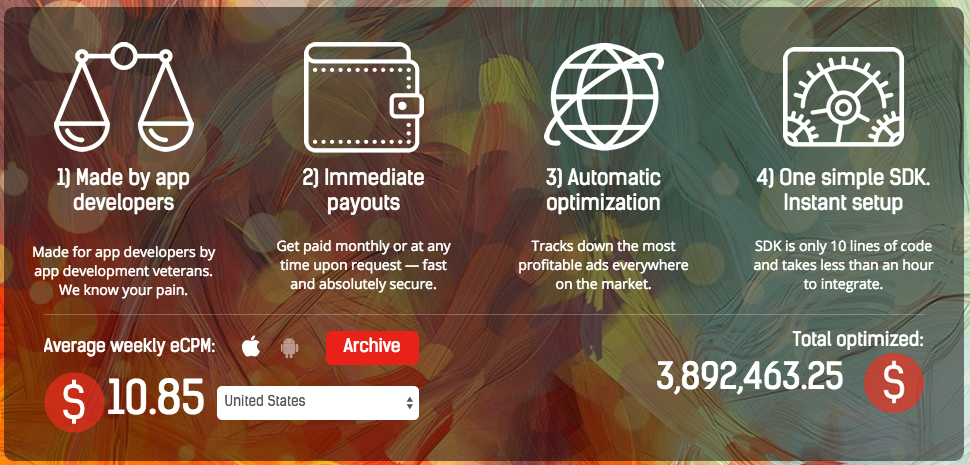
Pavel Golubev encountered that imbalance while running Alfa Productions, his mobile publishing business. In his account of Appodeal’s first year, managing monetization meant constant adjustments across ad networks. An internal tool entered private testing in September 2014. Appodeal launched publicly in January 2015.
The early distribution channel was charmingly direct: a mobile developer forum. Fundraising proved harder. After venture investors turned him down, Golubev approached publishers who had already tried the product. Those customers became part of a $3.1 million seed financing. The people who could test its usefulness were also people who could fund it.
“We spent our days manually tweaking ad waterfalls, prioritizing networks one by one.”
Alexander Zhitlukhin, CTO, recalling the early work
Mediation puts several advertising sources behind one integration. A waterfall approaches networks in a sequence; bidding lets sources compete through auctions. Appodeal offers both, with automation or manual controls. Its current mediation page reports more than 2,500 publishers and 50 billion monthly impressions. Those are company figures, useful for scale rather than proof of better returns.
02 Buying users is only half the arithmetic
The broader Growth Platform addresses the other side of an app’s finances. Acquiring a player costs money. Keeping that player produces revenue over time. A dashboard that understands only one side can make an expensive campaign look productive, or a valuable audience look disappointing.
One feedback loop. Two sides of the business.
Appodeal brings monetization reports, audience segmentation, lifetime-value analysis and campaign automation together. Its BI supports competing mediation systems, including AppLovin MAX, Unity LevelPlay and AdMob. That matters to a studio with an existing setup: analytics need not begin with replacing every supplier. Adjust’s own customer account describes Appodeal using its tools to organize reporting and campaign data.
The differentiation is visibility and control. Appodeal promotes an open-source SDK, raw auction data and experiments by placement, geography or user group. Its ecosystem also includes BidMachine, an exchange, and advertising acquisition services. Publishers should therefore examine reporting and commercial terms closely. The ability to inspect a client SDK does not reveal every server-side decision.

That broader focus followed a shock. Appodeal’s anniversary account describes Apple’s 2021 tracking changes as a hard hit that prompted rebuilt business intelligence and automated acquisition. The lesson was that monetization could not sit apart from measurement. When the signals available to advertisers changed, the operating system of the business had to change with them.
03 A free test, then a business agreement
For a small game studio, Appodeal’s Accelerator makes the proposition concrete. Its current FAQ describes two Meta test campaigns: $150 worldwide and $150 in the United States, funded by Appodeal. The developer contributes the integration work and a published build. The test money is neither a loan nor an advance.
Passing a test opens a different conversation. Publishing uses a negotiated revenue share; Appodeal says developers retain their intellectual property. A later soft-launch acquisition budget is spending on promotion, not cash handed to the studio. This is a commercial partnership, with economics to read carefully. Appodeal also charges a 4% rush fee for immediate payouts, while regular payouts carry no Appodeal payout fee.
The fit has limits. Accelerator applicants need a playable, stable free-to-play game. Better bidding cannot repair a core loop players abandon. More ads can lift immediate revenue while hurting retention. The practical experiment is to compare cohorts over time, rather than declare victory because revenue per thousand impressions increased.
04 The bill that changed a default
One revealing Appodeal experiment happened inside its own infrastructure. In October 2025, data lead Roman Malyushkin described roughly 35 petabytes under management and a cloud bill that had risen about 30% between May and June. Deleting history would weaken analytics. Sampling events would discard information needed to train its demand-side platform.
Indexed to June = 100. Storage costs, not the whole cloud bill.
The team changed compression from Snappy to Zstandard, wrote new data with the new settings and gradually rewrote old partitions. It reported halving cloud storage costs between June and September without added read latency. The copyable lesson is modest: benchmark the default. Savings depend on data, hardware and workload; the same codec will not deliver the same result everywhere.

There is a similar discipline available to a much smaller publisher. Choose an audience segment, record the existing experience, and define success before changing the ads. A higher price per impression is useful only in context: how often did an ad actually appear, did players return, and did the extra earnings cover acquisition spending? The interesting number is the one that survives those questions.
05 Smaller updates, better questions
That attention to operational details continues in SDK 4.0, announced in February 2026. Core components and network adapters received separate update tracks. A troublesome third-party integration could be isolated without downgrading the whole mediation stack. It is a maintenance improvement with a direct business purpose: fewer unrelated moving parts when something breaks.
Appodeal’s stated workplace values include direct communication, ownership and quick iteration. Its tools invite the same approach from customers. Start with a measured baseline. Change one placement or campaign. Watch retention alongside revenue. Ask who gets paid, when, and for what. A developer cannot control every buyer in an ad auction. Being able to ask better questions is a useful beginning.
Website ↗ · Developer docs ↗ · Blog ↗ · LinkedIn ↗ · X ↗ · Instagram ↗ · Facebook ↗ · GitHub ↗
Watch the original 2015 product pitch ↗
Appodeal on YouTube ↗