Consider the moment before you install an app. You have seen something interesting. You tap. A store opens. You find the button. You tap again. Each instruction seems harmless. Together, they form a small obstacle course between wanting something and getting it. Digital Turbine has built much of its business around shortening that course - and arranging to meet you before you enter it.
- DT connects app makers and advertisers with carriers, phone manufacturers, and publishers.
- Its advantage is access to discovery moments on the device itself.
- Revenue is growing again, but acquisition costs and debt still matter.
The company, now branded DT, is part advertising marketplace, part distribution infrastructure. Its customers include developers who need downloads, publishers who need advertising income, and telecom operators who want their devices to produce revenue after the sale. The phone owner sees an app recommendation or an ad. Behind it sits a negotiated chain of software, access, and payment.
A very valuable place in line
Most app marketers buy attention and hope it becomes action. DT also works with the businesses that put the phone in your hand. Carrier and manufacturer integrations let it offer app discovery during setup and later in the device’s life. That position is its distinguishing asset: an established route to the screen before a developer has persuaded you to search.
DT’s current website reports an Ignite footprint exceeding one billion devices and more than 40 device partners. Its separate in-app network reaches 82,000 apps through direct software integrations. Those figures describe different kinds of access; adding them together would manufacture a meaningless audience. The useful point is that DT can operate both inside an app and at the device level.
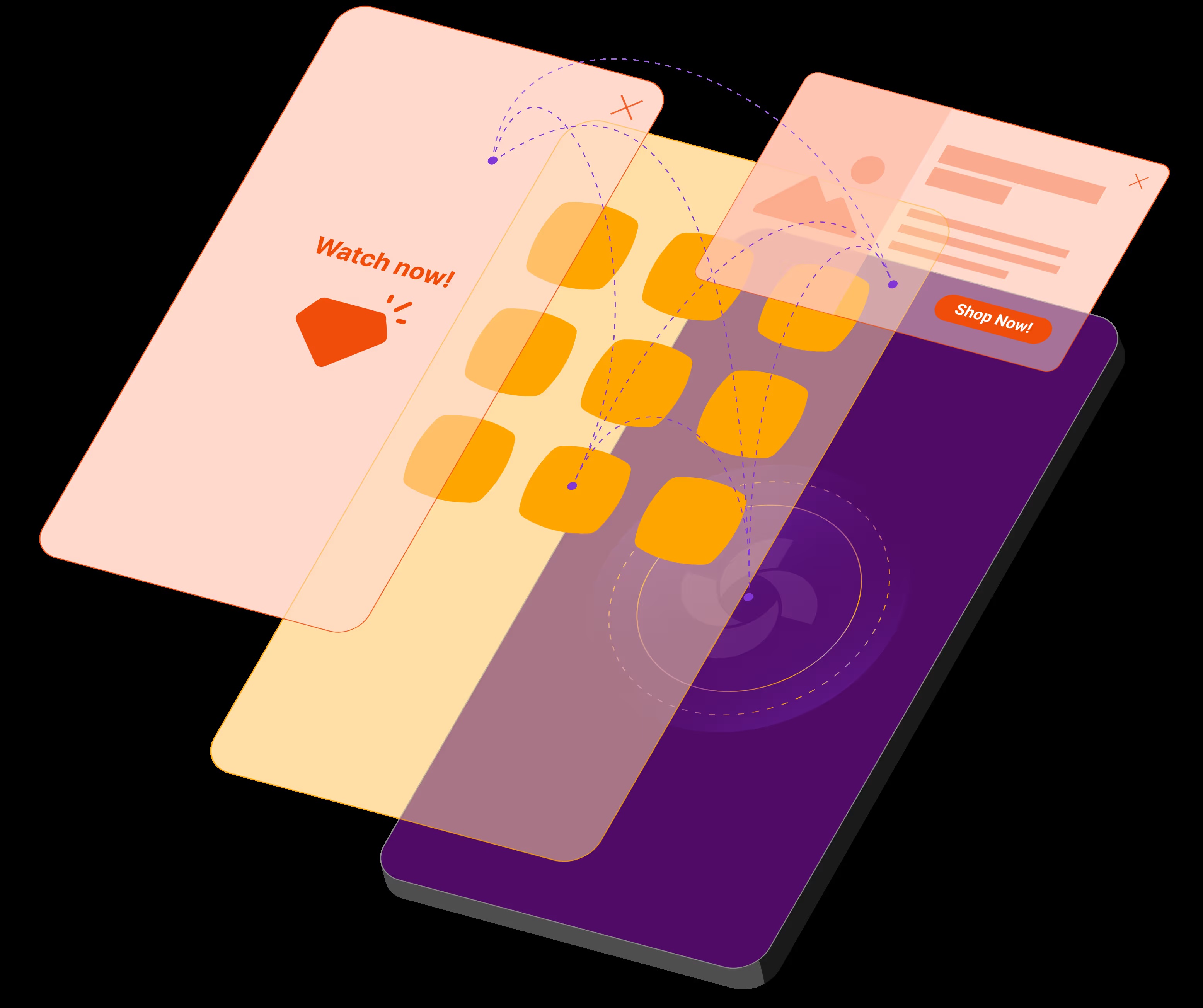
This puts DT alongside advertising alternatives such as AppLovin and Unity, while also competing for acquisition budgets spent with Google and Meta. Its carrier relationships give the pitch a different starting point. Developers can buy another route to discovery rather than depend entirely on winning attention inside somebody else’s feed or storefront.
Three names. One journey.
In June 2026, DT reorganized its public story around Launchpad, Ads, and Ignite. Launchpad handles app distribution across device integrations, direct experiences, in-app opportunities, and traditional stores. Ads brings together advertising and publisher monetization. Ignite supplies app and content experiences on the device. The names are new; many underlying capabilities have longer histories.
“Developers should not be limited to a single path for how their apps reach users.”
Bill Stone, CEO · June 2026
Underneath sit more specific tools. SingleTap supports direct Android installations from eligible placements without a separate store visit. DT Exchange connects publishers with advertising demand. FairBid manages competing advertising sources. Offer Wall lets users earn in-app rewards by completing offers. A developer seeking users and a publisher selling attention can therefore enter different doors of the same business.
Different products address different points where attention becomes revenue.
The economics connect those doors. Advertisers pay for distribution or advertising outcomes, and DT shares revenue with the carriers, manufacturers, and publishers supplying access. This is an advertising and distribution business with partner payments, rather than a simple software subscription. Campaign economics depend on the price of reaching a user and what that user subsequently does.
The second tap has a price
Unico Studio offers a concrete example. In DT’s published case study, the maker of Brain Test ran an Android campaign using SingleTap. DT reports an 850% improvement in conversion rate, more than 79% growth in daily new users, and a reduction in cost per install exceeding 57%. Thirty-second portrait videos performed best for engagement and retention among the tested formats.
These are vendor-reported campaign results, not a promise for the next buyer. Unico expanded beyond the United States into additional markets after the initial campaign. The useful experiment to copy is straightforward: test the installation handoff as carefully as the creative. Then measure retained users, spending, and incremental installs. A cheaper download is worth little if the user never returns.
Buying the rest of the machine
DT did not assemble its advertising capabilities for pocket change. In 2021 it acquired Appreciate, AdColony, and Fyber. Appreciate brought demand-side buying technology; AdColony and Fyber expanded advertising and monetization capabilities. The announced Fyber transaction contemplated $600 million for full ownership, including an earn-out. AdColony’s estimated consideration was $400 million to $425 million. Appreciate cost approximately $20 million in cash.
Then came a harder reckoning. Fiscal 2024 revenue fell 18% to $544.5 million, and DT recorded $336.6 million in goodwill impairment. Its filings described advertising-market weakness alongside consolidation and exits from legacy AdColony operations. The first visible problem in this expansion story was the gap between the acquired businesses’ promise and their financial performance. Buying more capabilities had increased the work of making them perform together.
Fiscal years ended March 31. FY26 still carried a $37.7 million GAAP net loss.
Revenue declined again in fiscal 2025 before recovering 15% to $565.3 million in fiscal 2026. The recovery reduced the annual net loss to $37.7 million. A $430 million refinancing announced in September 2025 extended debt maturities; it replaced an existing facility rather than representing fresh venture funding. Growth and financing obligations belong in the same picture.
The route is the lesson
The next stage combines wider distribution with better decisions. DT’s May 2026 Orange agreement planned a European rollout beginning in the second half of 2026. Partnerships with Databricks and Google Cloud aim to turn mobile signals into better recommendations and advertising optimization. In the June quarter, revenue reached $166 million, up 27%, while the company still reported an $11.3 million net loss.

For buyers, the limits are practical. Device access varies by partner and market. An Android installation result cannot establish an equivalent iPhone outcome. Privacy rules, attribution, and the quality of the app itself affect returns. DT’s own risk disclosures flag dependence on major carriers and customers. Its story offers a useful instruction: inspect how a customer reaches the product. Sometimes the opportunity is waiting between two taps.