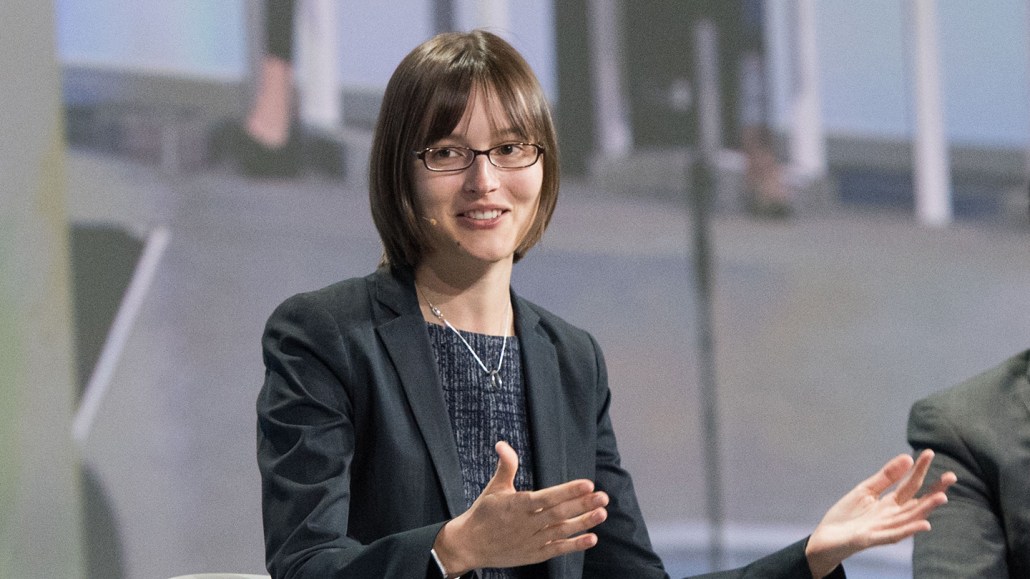
The Factory Floor Founder
Before Instrumental existed, there was a spreadsheet. Hundreds of rows. Each row a defect found by a human inspector squinting at a circuit board in a factory in Shenzhen. Anna-Katrina Shedletsky spent 300 days like that at Apple - flying to China, living in hotels, walking lines, and writing down things that were wrong. She was not a quality inspector. She was the lead product design engineer for the Apple Watch Series 1.
That gap - between the sophistication of the device being built and the primitiveness of how problems got found - was the gap she decided to close.
Even the lowliest employee at a big multi-national corporation like Apple has the ability to create change.
Anna-Katrina ShedletskyIn 2015, she left Apple with her co-founder Samuel Weiss (CTO) and started Instrumental in Palo Alto. The thesis was direct: electronics manufacturers - companies making everything from laptops to medical devices to aerospace components - waste 20 to 35 cents of every production dollar. Not because they want to. Because they can't see what's happening on their own lines fast enough to stop it.
Instrumental's platform puts cameras on assembly lines, collects inspection and test data in real time, and uses AI to find anomalies - known defects and novel ones - before they become expensive recalls or missed shipment windows. The cloud software correlates signals across builds, lines, and factories. Engineers see what's wrong before the board reaches the end of the line.
20 to 35 cents of every dollar spent in manufacturing is wasted. On a $15.4M annual revenue company with customers across aerospace, automotive, consumer electronics, and servers - that's the entire market thesis in one sentence.
From Brewster to Shenzhen
Shedletsky grew up in Brewster, New York - a small city near the Connecticut border - and graduated valedictorian from Brewster High School in 2004 after completing 13 AP classes, including computer science, mathematics, biology, and French. She competed in the Intel Science Talent Search (semi-finalist), placed third nationally in the Young Epidemiology Scholars Competition (winning $20,000), and won a Davidson Fellow Scholarship. Her high school research modeled disease propagation - which, in retrospect, looks a lot like the defect correlation work she does now.
She enrolled at Stanford, earned a BS in Mechanical Engineering with Distinction (3.95 GPA), then stayed for an MS (3.99 GPA). Her graduate research was at the Biomimetics and Dexterous Manipulation Laboratory, where she designed, manufactured, and calibrated components for a gecko-inspired glass-climbing robot. The skill set was precise: fabrication, materials, measurement, calibration. The same skill set required to understand why a batch of Apple Watch cases was failing dimensional tolerance checks in a factory halfway around the world.
Between 2009 and 2015, Shedletsky designed mechanical components for three iPod models and then led product design for the original Apple Watch. She filed 23 patents. She also logged more than 300 days in Chinese manufacturing facilities - not as a visitor, but as the person responsible for the product working when it shipped. That first-hand knowledge of exactly where and how electronics manufacturing breaks is the intellectual foundation of Instrumental.
Building the Company
The first check came from First Round Capital in 2017 - $7.5M seed. Then $10.3M Series A from Eclipse Ventures and Root Ventures. By 2020, Canaan Partners led a $20M Series B. The pitch: cameras, AI, and cloud software to eliminate manufacturing waste. The customers signed up fast: Cisco Meraki, Bose, Axon, Honeywell, SolarEdge, ChargePoint, Lenovo, Motorola, Meta.
In 2021, the numbers caught up to the ambition. Instrumental tripled its bookings. Net revenue retention hit 150%. Fast Company named it the #2 Most Innovative Manufacturing Company in the world - the first manufacturing-focused software company to appear on that list. Inc. Magazine put it on the Top 5000 Fastest-Growing Companies list. That same year, Shedletsky received the Design Automation Conference Under 40 Innovators Award.
In February 2022, BAM Elevate led a $50M Series C. The company expanded its platform to cover high-mix manufacturing, added integrations with SAP (now available on SAP Store as part of SAP Industry Cloud) and Siemens, and pushed into aerospace, automotive, and medical devices.
Raising the Infrastructure for Factory Intelligence
The AI Server Era - and NVIDIA
In March 2026, Instrumental closed a Series D. The investor list included Root Ventures - which has backed the company since Series A - and NVentures, NVIDIA's corporate venture arm. The purpose: accelerate Instrumental's ability to serve the server and rack manufacturing sector, which is building the physical infrastructure of the AI era at speed and scale.
The partnership with NVIDIA has a concrete number attached: by applying Instrumental's AI to server final builds, production can be accelerated by up to 14 days. For companies racing to stand up AI data centers, that's not a nice-to-have. Instrumental exhibited at NVIDIA GTC 2026 in San Jose in March 2026. Shedletsky spoke at CES 2026 in January.
The company now operates within NVIDIA's Metropolis program, enabling fully automated defect detection for complex electronics assembly. It is integrated into SAP Industry Cloud. Its customers span consumer electronics, aerospace, automotive, medical devices, and AI server manufacturing.
Awards & Honors
#2 Most Innovative Manufacturing Company - first manufacturing-focused software firm on the list.
Design Automation Conference award for significant impact in design and automation in electronics (2021).
Named in CloudNOW's annual Top Women Entrepreneurs in Cloud Innovation Awards (2019).
Instrumental on Inc. Magazine's Fastest-Growing Companies list (2021).
$10,000 scholarship awarded for high school research - one of the most selective science recognitions for students under 18.
Filed 23 patents in electronics and mechanical engineering applications during six years at Apple.
The Timeline
WISMP - The Other Company She Built
Two years before she started Instrumental, Shedletsky started something else: the Women in STEM Mentorship Program. She founded WISMP in April 2013 at Stanford while still working at Apple, with Apple's sponsorship. It was a pilot to connect Bay Area women studying STEM with practicing technical professionals - to help them understand what careers were actually available and to create relationships that survived the transition from school to work.
By 2015, the program had 40+ participants. When she left Apple to start Instrumental, she kept running WISMP. It expanded to UC Berkeley, San Jose State University, and eventually a remote program reaching students globally. It has supported hundreds of students. She built a company and a community in parallel.
Visit wismp.org