An old BMW has a way of turning its owner into a student of economics. Andy Powell owned a 1988 M5, the sort of car whose appeal survives repeated encounters with an invoice. “It needs love and money constantly,” he said. The interesting part is what he did with the inconvenience. He built a place to find people who could fix it.
That directory became BimmerShops. Later, a problem inside that business became CallRail. The sequence is pleasingly untidy: a car creates a search, a search creates a directory, and a directory creates a question about whether advertising works. A founder biography can make the route look inevitable. Here, each business supplied the irritation that made the next one worth trying.
Powell is the co-founder and former chief executive of CallRail, the Atlanta software company that connects incoming calls with the marketing that prompted them. The useful thing about his story is its scale of attention. Before there were hundreds of thousands of businesses using the software, there was one directory owner who needed to show his customers something concrete.
The telephone was already ringing. He needed to know why. For a repair shop paying to appear on a website, that distinction could decide whether another month of advertising looked sensible. Powell occupied both sides of the problem: he sold the listing, and he needed evidence that the listing deserved its price.
A teenager with a very odd reading list
Powell grew up in Columbus, Georgia, and attended Georgia Tech. His early commercial education included a website called DumbLaws, which he started with a friend at 14. Its raw material was municipal codes and the peculiar rules buried inside them. The teenage enterprise brought advertising income, television appearances and a publishing deal. Reading local regulations had found an unexpectedly sociable outlet.
His own short biography describes the resulting books as “two very silly books.” That is a useful detail to keep alongside the later software titles. The business began with curiosity and a joke people wanted to pass along. A teenager could find an audience, make something for it and earn money without first acquiring an impressive office.
Early success also gave him a troublesome benchmark. He worried that he might already have reached the high point of his working life. It is an unusual burden for a young entrepreneur: the first venture works, and instead of settling the question of ability, it raises the question of repetition. Can you do it again with something less dependent on novelty?
There was another kind of business in his upbringing. His father worked in sales at IBM and also ran a commercial restroom cleaning franchise. Software and restroom cleaning have different dress codes, but both require customers. The family example gave entrepreneurship an ordinary, practical setting. A useful service could be a business even when nobody would put it on a magazine cover.
Advertising revenue.
Two very silly books.
An unconventional introduction to finding an audience.
The customer was already on the line
BimmerShops began during the Christmas break after Powell finished college in December 2005. He wanted a project to refresh his software skills. Owning the M5 gave the project a subject. The directory initially offered free listings; eventually a shop owner asked about appearing higher up the list. A feature that could be sold had announced itself through a customer request.
The distinction matters. A directory can be pleasant to browse and still struggle to support its creator. A mechanic asking for a better position brings a budget and an intention. Powell had found someone who wanted a specific outcome badly enough to pay for help getting it. The next question was how to demonstrate that outcome.
He joined forces with Kevin Mann, a fellow Georgia Tech graduate. Existing call tracking products were largely built around the needs and budgets of larger companies. Powell and Mann worked on something that smaller businesses could use. Their starting customer was close at hand: Powell himself. There was little distance between the product conversation and the person who needed the answer.
Each founder contributed $2,500. CallRail launched in 2011 and remained bootstrapped until it reached $4 million in annual recurring revenue. Those figures describe a particular order of operations. Money from customers supported the business before substantial outside investment arrived. The original $5,000 was a beginning, rather than an explanation for everything that followed.
At its simplest, call tracking connects a marketing source with a phone number and the calls it receives. A business can distinguish interest generated by one campaign from interest generated by another. That makes the phone call useful twice: once as an opportunity to win work, and again as evidence about where future advertising money might go.
Getting bigger meant listening differently
CallRail grew beyond its first use case. By its tenth anniversary in March 2021, it had added form tracking, conversation intelligence and a communications hub called Lead Center. It reported passing $60 million in annual recurring revenue in 2020. The company was moving further along the customer journey, from identifying an inquiry toward helping businesses handle it.
Growth altered how the team understood its customers. In the early days, employees discussed what users were saying during company meetings. Requests could travel directly from a support conversation into decisions about the product. A small team has an advantage here: people can hear the same complaint without anyone needing to schedule a formal presentation.
As CallRail approached its hundredth employee, that informal arrangement became harder to maintain. The company developed a dedicated user research function. Its own use of its software had become less representative of the small businesses and agencies buying it. Familiarity with the product could no longer stand in for familiarity with the customer.
This is a revealing complication in Powell’s career. Solving your own problem gives a startup an unusually clear beginning. Success can gradually remove that clarity. The organization becomes larger, its habits change, and the founder’s working day looks less like the buyer’s. Keeping the original customer in view requires deliberate effort as the company grows.
Powell received recognition from TiE Atlanta in 2015, placing second in its upper middle market entrepreneur category, and returned among its honorees in 2016. When accepting the earlier recognition, he credited Mann and the wider team. The public prizes belonged to a founder’s biography; the work underneath them belonged to a growing group of people.
The founder who handed over the keys
In June 2021, Powell announced that Marc Ginsberg would become CallRail’s next CEO. Powell had been 26 when he and Mann started the business. A decade later, his announcement described more than 250 employees, more than $100 million raised and more than 180,000 businesses served. The company had become a very different responsibility from the one he began with.
His explanation was unusually specific about the work he wanted to do: starting things and building products himself. He planned to remain a director, adviser and major shareholder. Giving up the chief executive position therefore meant changing his relationship with the company he helped create, while retaining a stake in its future.
There is a practical judgment inside that decision. A founder can enjoy bringing a product into existence and still recognize that a larger organization needs a different daily rhythm. Recruiting, coordination and repeatable operations take more room as a company expands. Powell described the handover in terms of matching the next stage of the business with the person leading it.
CallRail subsequently reached $100 million in annual recurring revenue in 2024, during Ginsberg’s tenure. The timing deserves care. Powell helped establish the company and led its first decade; the later milestone belongs to the continuing business and the people running it. A company that keeps developing after a founder steps aside is part of the story of what that founder built.
“Deep down, I’m a starter-of-things and I’m a hands-on builder.”
Andy Powell · June 2021
Back to the shop floor
Powell co-founded Toolpath in 2021 with Justin Gray, whose background includes NASA engineering software and optimization. This time the work concerned CNC machining: helping turn a digital model into a plan for cutting a physical part. The setting changed from advertising and calls to tooling, materials and manufacturing decisions.
In September 2024, Leaders Fund announced a $10 million seed financing for Toolpath. It had also invested in CallRail. That returning connection supplied a bridge between two otherwise different businesses. The fund described Powell as an entrepreneur who had experienced a problem and built a profitable company around solving it. Its next investment backed another attempt at reducing expensive friction.
Toolpath’s software addresses the work before a machine begins cutting: evaluating a design, choosing tools, estimating a job and preparing machining operations. Its current leadership page lists Gray as CEO and co-founder. For Powell, the durable connection is his role in starting the company, extending a career spent making software useful to people whose principal job lies elsewhere.
The pattern is visible without turning it into a formula. Repair shops needed customers. Advertisers needed evidence. Machine shops need to move from a drawing to work they can price and produce. These are specific commercial tasks, with real consequences for the people doing them. Powell has repeatedly built near that boundary between a computer screen and somebody’s working day.
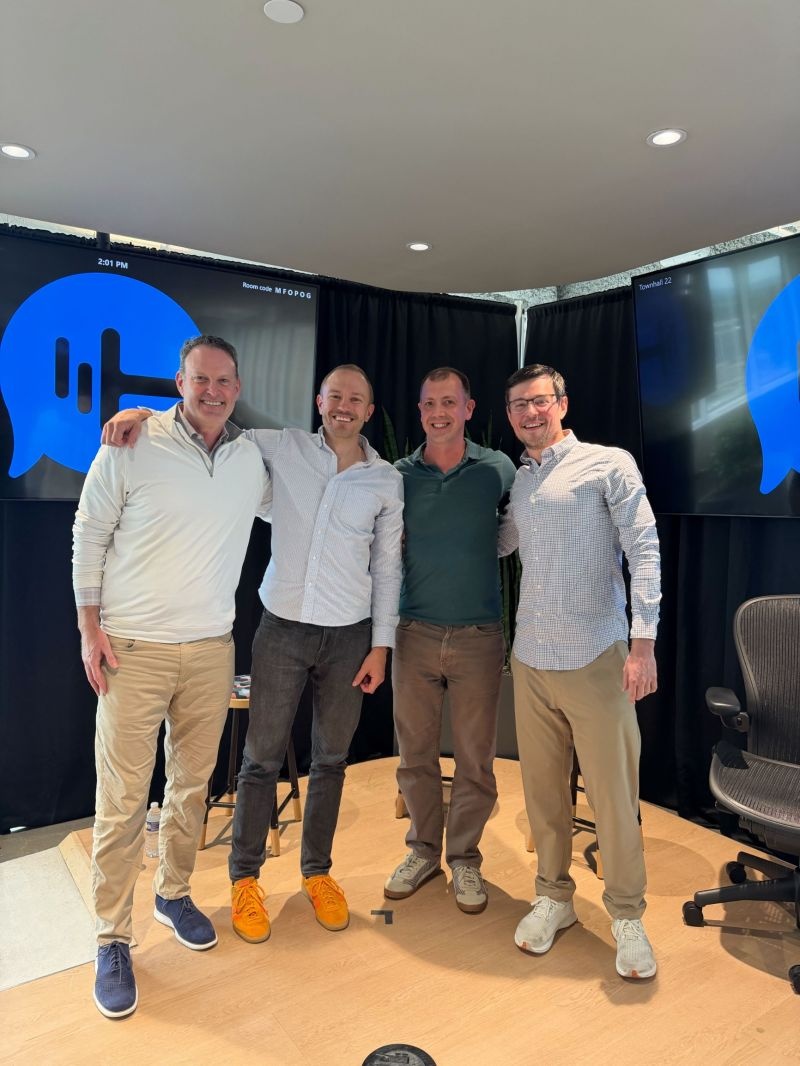
CallRail’s fifteenth anniversary brought Powell together with Mann, Ginsberg and chief technology officer Elliott Wood for a fireside conversation. The photograph has the relaxed air of colleagues who have quite a lot to remember. Behind the software metrics are years of decisions shared with other people, including the decision to let somebody else lead.
The M5 was an expensive way to discover a business problem. It did, however, provide a remarkably productive complaint. Powell needed a mechanic; the mechanics needed proof; a software company grew in the space between them. His next venture returned him to shops and the work that happens inside them. There is a certain economy to the journey, even if the car itself never promised any.