A change of ownership fits on a calendar. Keeping a customer’s trust takes rather longer. When GE HealthCare completed its acquisition of MIM Software on April 1, 2024, Andy Nelson greeted the occasion with a promise of continuity. The company would keep its commitment to vendor-neutral software and service. A family business had entered a larger organization. Its customers were still entitled to expect the products to work.
That is a useful place to begin with Nelson, whose career at MIM connects the practical business of answering customers with the executive business of explaining an acquisition. He helped build the company alongside his father and brother-in-law. Years later, he was talking about what the company would carry into its next chapter. The buyer’s name was new to the ownership story. The obligation he described was familiar.
Three relatives, several jobs
MIM was founded in 2003. Dennis Nelson developed its initial software, then recruited his son Andy and son-in-law Pete Simmelink to help grow the business. The origin gives each relative a place in the story. Dennis supplied the first version. Andy and Pete joined the work of making a company around it.
Andy’s early responsibilities crossed implementation, business models and hands-on customer support. Those jobs sit at different points in a purchase: deciding how to sell something, getting it into use and dealing with what happens afterward. A title can make them look separate. A small company has fewer opportunities to indulge that distinction.
The early work also supplies a concrete way to understand the customer emphasis in his later statements. Nelson had been involved in the work around delivery, rather than only the announcement of it. The business grew through attention to users and their requirements. Listening belonged to the operating work.
There is something pleasingly unceremonious about that beginning. A software business requires software, of course, but it also requires someone to answer the questions that appear once other people start using it. The gap between those two requirements is where much of the daily work lives. Nelson’s early responsibilities put him on both sides of the sale.
A sale with a continuing obligation
On January 8, 2024, GE HealthCare announced its agreement to acquire MIM. Nelson’s statement looked back over two decades of product development and service. He described a business built around products that could work across vendors, and around earning customers’ trust. He also anticipated increasingly integrated digital solutions under the new ownership.
The transaction closed less than three months later. Nelson was identified as CEO of MIM Software at GE HealthCare. The completion announcement made the ownership change definite; his message kept the customer relationship in view.
“Today marks an exciting new chapter for our team and technology.”
Andy Nelson, April 1, 2024
Acquisition language tends to point forward. Nelson’s statements also looked backward, toward the service commitment the company had already made. Both directions matter. A buyer acquires an existing business with existing users, existing expectations and a history of decisions. The next product must arrive in the middle of all that.
For a founder, the sale supplies a conspicuous milestone. For a customer, the relevant milestones may be smaller: a task completed, an issue resolved, an update that fits the systems already in place. Those are different calendars. Nelson’s recurring emphasis on service connects the executive announcement to the less ceremonial calendar of everyday use.
- An agreementGE HealthCare announces the proposed acquisition.
- A completed dealMIM becomes part of GE HealthCare.
- A combined releaseThe first joint software release with MIM Encore is announced.
The phrase “vendor-neutral” deserves its place in this story. In ordinary business terms, it expresses a commitment to serving users across equipment brands. Joining a manufacturer creates an interesting operating question for such a company: how to integrate more closely with the parent while continuing to work for customers with other systems. Nelson’s later language retained that commitment.
The business had already learned to work with others
MIM’s relationships extended beyond its own products before the acquisition. In February 2022, it announced a global partnership with GenesisCare. The agreement covered supplying, implementing and supporting software across a network operating in the United States, Australia, the United Kingdom and Spain. Nelson, identified as CEO, spoke about delivering technology at scale.
Those three verbs deserve attention: supply, implement, support. They describe an ongoing responsibility after the product has been selected. Across several countries, the delivery work becomes part of the partnership itself.
Another collaboration followed the acquisition. In April 2024, MIM and Elekta announced plans to combine their respective software strengths and draw on their regional markets to make solutions available globally. Nelson appeared in that announcement too. The sequence places him in a business built through external relationships as well as its own development. Joining GE HealthCare added a parent company to an already collaborative operating story.
Two logos, one biscuit
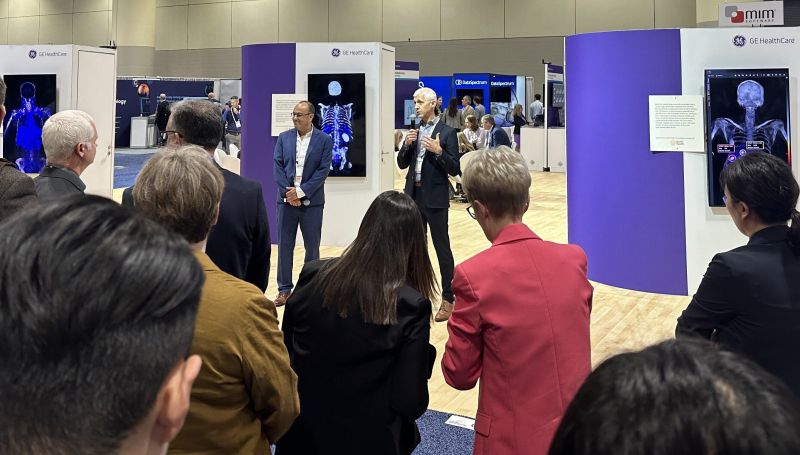
By June 2024, the new relationship had acquired a public gathering and a modest edible emblem. MIM’s photographs from its welcome at GE HealthCare’s SNMMI booth showed Nelson addressing the assembled group. Erez Levy, a GE HealthCare executive, also took part. The setting was a conference floor, with people standing around the speakers.
Another photograph showed individually wrapped cookies bearing both companies’ branding. There are many ways to explain a corporate combination. A biscuit is refreshingly legible.
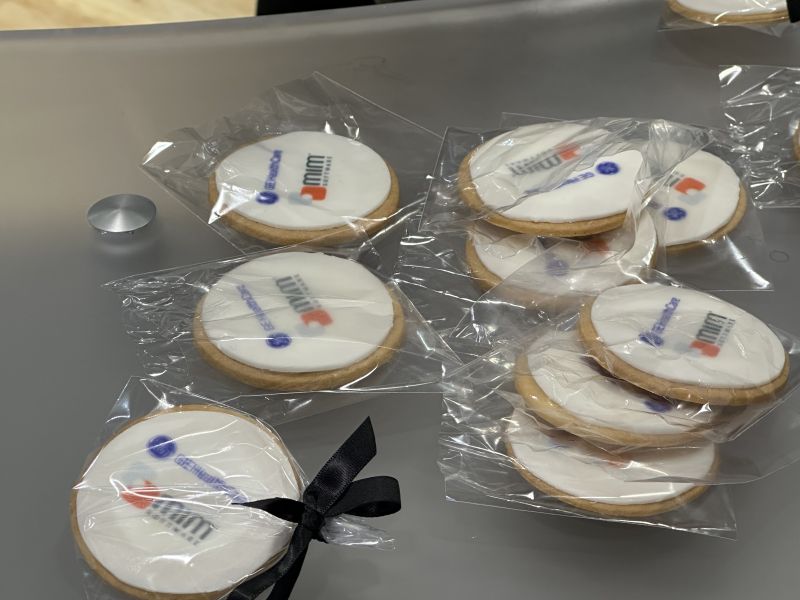
The photographs preserve a particular moment in Nelson’s business story: the welcome after the transaction. They also put people back into an event usually represented by a release date. Colleagues gather, someone speaks, the companies appear together. The next stage of work begins with introductions as well as integration.
MIM’s event invitations that year included an opportunity to hear Nelson discuss developments since the acquisition. By June 2025, its event program again listed him as CEO and scheduled additional remarks from him in New Orleans. The announcement of a sale had been followed by further appearances explaining the business to its audience.
The people behind the company name
June 2024 brought a different kind of recognition. MIM received a Northeast Ohio Top Workplaces honor from cleveland.com and The Plain Dealer. The list was based on employee feedback gathered through a third-party survey administered by Energage. It asked about the experience of working at the company, including respect, support and opportunities to grow.
Nelson’s response credited MIM’s people. He thanked the team for making the company a place to work and develop. The award belonged to the organization. His role in the moment was to acknowledge the employees behind it.
That distinction matters in a profile bearing one person’s name. A founder can become a convenient shorthand for an entire company. Here, even the beginning involved three relatives with different contributions. As a business grows, the shorthand becomes still less adequate. Implementation, engineering, support and the rest of the work require people beyond the names on the founding story.
An employee survey captures a particular moment, too. It should be read with its date attached. The June 2024 honor tells us something specific about recognition MIM received around the time of its ownership change. It is a company milestone in Nelson’s tenure, rather than a permanent verdict on every employee’s experience.
Nelson also appeared among the executives pictured at an industry Corporate Advisory Council gathering in Washington, DC, in October 2024. The photograph, published in the council’s winter 2025 coverage, listed him alongside representatives from other companies. The council brings together corporate decision makers from businesses of different sizes. Its reported agenda that year included cybersecurity and practices for preventing cyberattacks. That appearance adds another setting to his working life: a shared industry table, alongside the customer meetings, company events and product announcements. The family business had become one participant in a much wider network of organizations.
The sequel arrived as software
On June 12, 2025, the acquisition story gained a product milestone: GE HealthCare announced its first combined software release with MIM Encore. Nelson was quoted as CEO of MIM Software, a GE HealthCare Company. The joint release connected the parent’s features and algorithms with MIM’s platform.
“Customers are telling us that this pairing is exactly what users have been looking for.”
Andrew Nelson, June 12, 2025
He went on to describe development shaped by user input, with attention to usability and a vendor-neutral experience. The announcement addressed fewer manual steps, easier adoption across roles and communication between departments. These were stated aims of the software release. The announcement gave no reason to turn them into a claim about every user’s results.
For Nelson’s story, the release is a concrete sequel to the transaction. A company welcome can put two brands in the same room. A combined release involves the products behind those brands. It gives the ownership change an operating expression beyond the deal itself.
The two commitments in Nelson’s language remain side by side: closer integration and vendor neutrality. One concerns the new relationship within the company. The other concerns the relationships customers already have with their systems. Keeping both in view gives the next chapter a practical shape.
There is an understandable temptation to end a founder’s story at the sale. It is a tidy ending with a date attached. Nelson’s public story continues into the work afterward: welcoming colleagues, crediting employees, discussing a release and repeating the importance of customer input.
The family company began with Dennis’s software and the work Andy and Pete joined him to do. Under its new parent, that work acquired a different organizational setting. Nelson’s promise left a familiar question on the desk: what will the customer experience next? The answer has to arrive through the software and the service, one ordinary working day at a time.