Frank C. Sullivan put his philosophy on his car. Three digits, 168, appeared on the license plate. An executive could have chosen initials, a birthday or a small declaration of importance. Sullivan chose multiplication: seven days, twenty-four hours each. The week was the same length for everyone. What interested him was what people did with it.
In an archival photograph, he stands beside the car in a hat and a double-breasted suit, one hand resting on the bodywork. The plate is visible below. It is an unusually compact business statement. No consultant needed a second slide. Sullivan believed that life and the time to do something with it were gifts, and that time deserved care at work, at home and in the community.
He founded Republic Powdered Metals in May 1947. Today, the business is RPM International, and another Frank C. Sullivan, his grandson, chairs the company and serves as chief executive. Between those two Franks came Thomas C. Sullivan, the founder’s son. Across those generations, the number stayed. So did a question worth asking of any employer: how do you treat the people spending their hours with you?
Work · Family · Community
A roof coating, a garage, a beginning
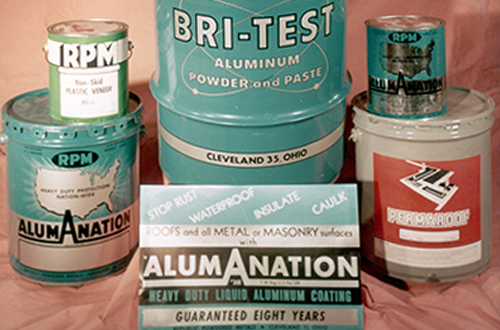
Sullivan came to entrepreneurship with experience selling paint. Before starting his own company, he had worked as a sales executive for a Cleveland paint manufacturer. In 1947, he set up Republic Powdered Metals in a garage on Cleveland’s west side with a $20,000 investment. The first product was Alumanation, a heavy-duty aluminum roof coating. First-year sales reached $90,000.
The proposition was practical: maintain and protect structures already standing. Waterproofing and rust prevention are rarely the glamorous end of construction. They become rather more interesting when the alternative is an expensive repair. Sullivan’s business began with that ordinary, persistent need. The early product tins advertise roofs, metal and masonry, the vocabulary of things someone has already paid to build and would prefer to keep.
There is a pleasing fit between the product and the philosophy. A maintenance coating asks a customer to think beyond the immediate moment, to spend a little attention now on something expected to last. Read that alongside the license plate and the two ideas seem comfortable together. That is a way of reading Sullivan’s choices, rather than a claim that he planned the symbolism. The roof coating had a job to do. It still bears the Alumanation name.
The customers inside the company
Sullivan rarely called on customers himself. He treated the sales force as his own customers, reasoning that meeting their needs would help them serve the people buying Republic’s products. For a founder with a sales background, that is a revealing choice. He placed his attention one step behind the transaction, with the people expected to make it happen.
His approach included free employee lunches, transportation to public transit stops and loans that helped employees buy stock while the company was still privately held. Those details give the philosophy some weight. Lunch costs money. Getting people to a transit connection takes organization. Helping someone acquire shares gives that person a financial stake extending beyond the next payday.
The pattern suggests a useful reading of his management: pay attention to the conditions around the work. A speech about commitment is easy to deliver. A ride to the bus stop is something a person can actually use. Sullivan’s enduring hiring advice joined three responsibilities together: find capable people, make them want to stay and allow them room to work.
Each part puts a different demand on a boss. Recruitment requires judgment. Retention requires attention after the hiring celebration has ended. Giving people room requires restraint, particularly from a founder accustomed to having the answer. The advice remains appealing because it leaves management with plenty to do, even after it has stopped hovering over everyone else.
“Hire the best people you can find, create an atmosphere that will keep them, then let them do their jobs.”
Frank C. Sullivan / RPM founder
Forty-eight hours in Ohio
By 1963, Republic was ready to widen its ownership. It offered 25,000 common shares to the public in Ohio. They sold out in forty-eight hours. The offering was intrastate, a local step toward the national public offering that followed in 1969. A business that began in a garage was acquiring a different sort of audience.
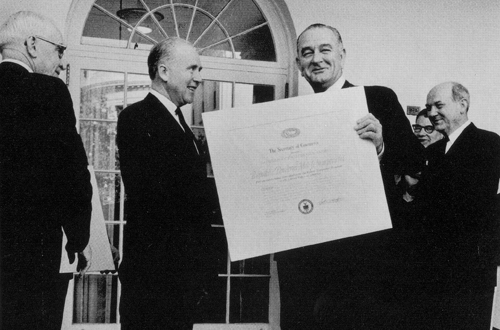
The next year brought a visit to the White House. President Lyndon B. Johnson presented the company with an “E” Award recognizing its contribution to American export expansion. In the surviving photograph, a large certificate occupies much of the scene. The practical roof-coating business had found customers far enough beyond its beginnings to receive national recognition.
In 1966, Republic bought The Reardon Company of St. Louis for $2.3 million, its first acquisition. Reardon traced its history to 1883 and was associated with cement-based paints and coatings. This added an established business with a history of its own. The acquisition strategy later associated with RPM had an early chapter during the founder’s leadership.
These events describe distinct kinds of growth: new owners, overseas trade and an acquired company. Putting them together is more useful than treating success as a single rising line. Sullivan’s company was changing its relationships as well as its size. It had to answer to investors, reach buyers farther away and make room for another business.
A name passes through three generations
Tom Sullivan joined Republic in 1961 as a division sales manager. He became vice president in 1967 and executive vice president in 1969. His preparation included something less formal than a title: business and entrepreneurship were part of his education around the family dinner table. The company had entered family life before it became his responsibility to lead it.
The founder’s tenure ended in 1971, and Tom assumed leadership of a business with roughly $11 million in annual sales. Later that year, RPM, Inc. was formed as a holding company with plans for more acquisitions. The distinction matters. Frank established the business and made its first purchase; Tom and his colleagues developed the acquisition program that would reshape its scale.
With Jim Karman, Tom led RPM through decades of expansion. By the time they retired as executive officers in 2002, annual sales were approximately $2 billion. Tom’s son, the younger Frank C. Sullivan, became president and chief executive that year, later adding the chairmanship in 2008. A shared name can compress all this into one biography. The actual story contains separate careers and decisions.
The family did share the plate number. In a 2022 interview, the grandson explained that his grandfather had used 168, his father had followed and he now used it himself. An inherited number is a small object to carry beside an inherited business. It also makes the family philosophy portable. Anyone following the car has access to the same arithmetic.
- 1947Frank C. SullivanEstablishes Republic Powdered Metals
- 1971Thomas C. SullivanAssumes leadership; holding company formed that year
- 2002Frank C. SullivanThe founder’s grandson becomes CEO
What happens when a license plate becomes policy
The number eventually acquired a formal home in RPM’s code of conduct, The Values & Expectations of 168. A private reminder had become language used across a multinational company. RPM’s board approved an updated code in October 2022, and the company makes translations available so employees in different countries can read its expectations.
The code gives the idea specific duties. Its principles address integrity, commitment, responsible entrepreneurship and the courage to report concerns. It discusses accurate records, conflicts of interest and fair competition. This is the administrative afterlife of an appealing sentiment: people need to know what a value asks them to do when a decision becomes inconvenient.
That is where the number earns scrutiny. Every company can praise the wise use of time. A code turns the praise into questions about conduct. How should someone respond to pressure? What happens when personal interests overlap with company business? Where can a concern be raised? These are ordinary working situations in which a philosophy either becomes useful or remains decoration.
In 2022, the company reported that 88% of respondents to its first company-wide employee engagement survey were proud to be part of RPM. The percentage records a response at a particular moment, rather than settling every question about the workplace. It does, however, show a later generation asking employees directly about the institution they helped sustain. For a business that still invokes its founder’s appreciation of employees’ time, listening to those employees is a relevant way to test the inherited language.
The founder’s idea also survives through employee recognition. In July 2025, RPM announced its Living the Values Award winners after receiving more than 360 nominations from colleagues. The recipients included a data specialist at Toxement in Colombia and a meetings and events director in the United States. The people, jobs and geography had moved far beyond the original garage.
Sullivan could not have managed those later employees or made their choices. His successors chose to keep his number in circulation, and the employees supply its present meaning through their own work. That is a more interesting legacy than a founder’s portrait alone: a phrase must remain useful to people who never met the person who introduced it.
The tins, the shares and the acquisitions all belong in his story. So do lunch and the journey to a transit stop. Together they make his management philosophy less abstract: people have work to do and lives around that work, and the arrangements matter. Beside the car, Sullivan’s three digits offer a modestly demanding reminder. Next week brings another 168 hours. Spending this week’s well is already a full assignment.
Keep the story going
Explore RPM’s company history, The Values & Expectations of 168 and the grandson’s 2022 interview.
More from the company: RPM on LinkedIn · RPM’s YouTube channel · 2025 Living the Values Awards.