When Tom Hyde went looking for an investor, he had something he wanted the investor to understand. ProCare LTC had been built around service. Expansion would have to carry that service with it. Money could help the company reach new markets; the terms of the relationship mattered because customers would still expect the business they knew.
Hyde’s phrase was to “expand responsibly into new markets without sacrificing quality.” It is a modest-sounding condition with a considerable amount of work tucked inside. Bigger companies need more people, more coordination and more ways of making sure an unanswered question does not disappear between departments. Growth is excellent at creating departments.
He had founded ProCare with Paul Meyeroff in 2007. Both came to the venture with professional training and experience in its sector. They were building a business around a familiar proposition: customers ought to receive attentive service and good economic value. The difficult part would be delivering that proposition repeatedly, then delivering it across a larger organization.
The conditions attached to growth
The founding partnership gives Hyde’s career its starting point. ProCare was based in Farmingdale, New York. By the time Sverica Capital Management announced its investment, the company served more than 150 facilities in five states and employed more than 400 people. It had become an organization in which maintaining a promise required the coordinated work of hundreds of colleagues.
Hyde, then founder and chief executive, described a search for a partner who understood the company’s particular service model. His explanation put the operating business inside the investment decision. The attraction of capital was its ability to support expansion; the test was whether that expansion could preserve the quality customers associated with ProCare.
“expand responsibly into new markets without sacrificing quality”
Tom Hyde · on the Sverica partnership
There is a useful tension in that position. A founder asking for investment is asking for change. New markets will bring new colleagues and unfamiliar customers. Yet Hyde also described something he wanted to protect. His condition makes the growth story more interesting than a succession of additional locations. It gives the expansion a standard against which to be judged.
That standard also makes customer service a management assignment. Personal attention sounds simple when a company is small enough for everyone to know whom to ask. As it expands, attention has to travel through schedules, responsibilities and systems. A familiar voice on the telephone depends on somebody having enough time to answer.
The work behind the expansion
Hyde’s account of ProCare’s working arrangements offers a more detailed picture of his operating concerns. The business used IND Consulting to help with repetitive data entry, then broadened the relationship to supplement its internal resources. Additional support could help the company cope when demand increased. The arrangement also extended into network and IT infrastructure.
His explanation was practical. An internal team has a finite amount of time. Work arriving at an inconvenient hour still needs attention. Remote resources can add capacity without requiring every task to be completed by the people already carrying the daily workload. In Hyde’s description, outside support was part of how the existing team could remain available to customers.
The technology involved included FrameworkLTC, the company’s management system from SoftWriters. Hyde described remote colleagues working within established workflows. His comparison was to employees working in different parts of the same building: physical distance alone did not have to determine whether the work fitted together. The organization of the work mattered.
That is a revealing way for a founder to discuss technology. The subject becomes where work goes, who is available and how an additional pair of hands joins the process. The interesting detail is the handoff. A remote arrangement needs a shared way of doing things if the extra capacity is going to be useful.
- 01Establish the internal workflow
- 02Add remote support where needed
- 03Keep the internal team available
A schematic of the approach Hyde described, not a measurement of results.
Hyde also spoke of IT as continuous work. “Managing our IT is a 24/7 job,” he said. It is the sort of sentence that gives a growing business some weight. Infrastructure does not observe the convenient rhythm of a strategy presentation. Someone must maintain it after the meeting has ended.
There is an unshowy willingness here to describe reliance on other organizations. Hyde’s account gives partners a defined place in ProCare’s operations. A company can build its own identity while drawing on capabilities beyond its payroll. The management question is how those capabilities fit together well enough for customers to experience a dependable whole.
An evening with the people behind the business
In 2019, a different view of Hyde and Meyeroff appeared at Jefferson’s Ferry. The community honored the two ProCare founders at its annual Monte Carlo fundraiser. Nearly 250 people gathered for a buffet, gaming tables, conversation and dancing. For once, the operating environment included rather more dice.
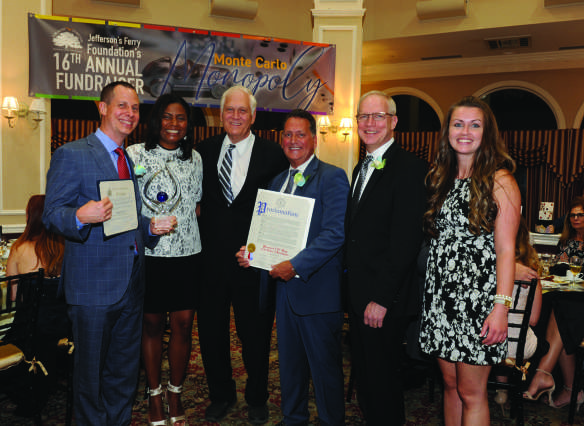
The event raised more than $82,000 after expenses for the Resident Assistance Fund. The fund helped residents facing financial need, including those who had outlived their assets. Raffle prizes included Billy Joel floor seats at Madison Square Garden, a television and an iPad. The evening had both a serious purpose and a healthy respect for the appeal of a good prize.
Hyde and Meyeroff were being recognized within a community connected to their business. That setting adds something an executive title cannot. A company’s relationships also exist in rooms where people gather, exchange congratulations and put names to faces. Here the founders were part of a shared occasion, alongside the people whose community the fundraiser supported.
The photograph preserves that scale of the story. The group stands together, dressed for an evening out, with awards in hand. ProCare’s growth can be expressed in facilities and employees; this moment records an established relationship between the founders’ organization and another community. It belongs beside the corporate milestones.
A founder makes room
By 2021, the company’s leadership structure was changing. ProCare announced that Hyde had moved into the chief operating officer role, while Meyeroff had become growth leader of LTC. The announcement also welcomed Terrye Enslow as chief financial officer. Hammad Shah was by then identified as ProCare’s chief executive.
Hyde shared the leadership news on LinkedIn and welcomed Enslow to the team. It was a brief public gesture, tied to a concrete organizational change. The business he had helped start was adding executive expertise, and his own assignment had changed with it. Founding the company remained part of his identity while responsibility was distributed across a broader team.
The distinction between founder and chief executive matters in this story. Founder describes the beginning of a company. Chief executive describes a job at a particular time. Hyde’s path included both, followed by operating leadership. Later, a Clarest biography identified him as president of LTC markets, extending the sequence beyond the original chief executive role.
The welcome to Enslow is worth pausing over because it puts a colleague at the center of an expansion announcement. Finance was acquiring a new leader; the founders were taking on distinct assignments. The names and roles make the change legible. A larger company needs people with different areas of responsibility, and those people must arrive as colleagues. Hyde’s post was a small part of that arrival, a public welcome attached to the practical work of reorganizing a business.
Read in order, those positions describe a career inside an evolving organization. They also keep the founding partnership in view: Hyde and Meyeroff continued to appear together in the leadership story, even as their titles diverged. A business begun by two people had acquired a larger cast, with more specialized responsibilities.
Hyde and Paul Meyeroff establish ProCare LTC.
ProCare announces new founder roles and a new CFO.
The organization introduces the Clarest Health name.
A new name, an older promise
On April 14, 2022, ProCare LTC rebranded as Clarest Health. Shah was chief executive at the announcement. The new identity was developed with Sustena, a brand consulting firm. ProCare continued as a division within the broader organization, carrying its established name into the next stage of the business.
A rebrand gives a company a date on which to introduce itself again. Underneath, the organization still has colleagues, established relationships and work waiting to be done. In this case, the new identity arrived fifteen years after Hyde and Meyeroff founded ProCare. The distance between those dates is filled with the less ceremonial business of building capacity and allocating responsibility.
Hyde’s earlier comments give that sequence a personal through line. He wanted room for expansion and a partner who understood the service model. He described outside support in terms of practical capacity. He welcomed a new executive as his own role changed. Those are specific decisions and statements from a founder learning to work within a larger enterprise.
The lasting question in his story is the one tucked into the investor search: what does a company need to carry with it as it gets bigger? Hyde’s answer centered on service and quality. The rest of the story gives that answer an organization chart, a set of partners and a room full of people. Getting bigger leaves plenty of fine print to attend to.