A budget can be perfectly accurate and almost useless. It can tell you, with admirable precision, what you should have known before you spent the money. Hyrum Kirton encountered that problem in procurement: people examined last month’s profit-and-loss statement, while the decisions that produced it had already slipped into the past. The arithmetic worked. The timing did not.
That is an unexpectedly modest opening for the career of a former chief executive. Kirton would go on to lead Bristol Hospice during years of expansion, then join its board. But the purchasing desk offers a useful way into his story. Before the larger footprint and the executive handover came questions about what people could see, when they could see it, and whether the tools helped them act.
Procurement rarely enjoys a starring role in business profiles. The word itself sounds as though it has been waiting in a queue. Yet it contains decisions about money, judgment, responsibility, and the difference between a policy that looks sensible on paper and one that survives an ordinary working day.
The budget arrived after the purchase
At Avalon, Kirton described an organization with a substantial amount of spending outside its control. The solution he wanted had to give buyers usable information while a purchase was still a choice. A report delivered afterward could describe the result; it could hardly help someone reconsider an order that had already been placed.
His explanation was direct: “We needed technology.” He also wanted something intuitive enough for people to learn and reliable enough for them to trust. Those requirements matter together. A system can contain all the right figures and still fail its user if finding them becomes a separate occupation.
“We needed technology.”
Hyrum Kirton, on Avalon’s purchasing problem
The important distinction is between recording a decision and helping to make it. Both are necessary in a business, but they happen at different moments. Kirton’s attention to the earlier moment gives his procurement work its interest. The person choosing a purchase needed a clear view of the consequences while there was still something to do about them.
That leaves a demanding question for any management tool: what can its user change after reading the screen? If the answer is very little, the information may have arrived at the wrong stage. The figures can be immaculate. The opportunity has already gone.
A desk was the wrong assumption
Avalon went live with Coupa in 2013. By the time Kirton discussed the work at a San Francisco conference in 2015, his concerns included mobile approvals and local purchasing. Managers were not always near a computer when an approval needed their attention. A process designed around that computer introduced a wait of its own.
Mobile access addressed the situation of the person using the system. Local purchasing addressed the situation of the business. Sprinkler inspections, parking-lot repairs, and snow removal could still require local suppliers even when the administration was centralized. Kirton described a way for managers to enter those purchases through a web form.
A national organization’s parking lot remains stubbornly local. It has a particular surface, a particular weather forecast, and someone nearby who can turn up with the necessary equipment. That small example makes the wider point: a purchasing system has to accommodate work as it happens, including the inconvenient bits that resist a tidy central catalog.
There is a useful restraint in this approach. Software does not have to make every office identical to make spending visible. A local choice and a common approval process can coexist. The challenge is to make the arrangement clear enough that people can use it without inventing their own route around it.
The arithmetic behind the ambition
Avalon reported invoice approval moving from three days to under eight hours and fewer people processing invoices. These are company-reported outcomes, but they make the intended effect concrete: less waiting and less administrative effort attached to the same recurring work.
In 2018, Avalon reported $12 million saved over two years. It also described adding ten facilities to the purchasing platform in thirty days without additional headcount. Read those figures as historical accounts of a business implementation. They belong to their stated periods, rather than to a running total of Kirton’s career.
The combination is instructive. Buying less expensively is one problem. Bringing new operations into a working system is another. An expanding company needs both. Otherwise, every addition to the organization can bring another set of records, another approval route, and another small administrative kingdom demanding its own forms.
Kirton also discussed introducing expense software quickly. The expense tool reached 170 users in three weeks. Speed, here, concerned a specific implementation rather than a general promise that business change would be effortless. There were named users, a defined tool, and a period in which the work was done.
Avalon’s reported savings over two years, announced in 2018.
These examples give the later executive story some texture. They show the kinds of questions an operator handles before growth becomes an announcement: how long does a routine decision take, how much work accompanies it, and what happens when the number of locations increases?
The map starts filling in
Kirton’s Avalon career included internal officer positions between 2007 and 2017 and leadership of Brighton Rehabilitation Healthcare Services. He became an Avalon board director in 2017. His education at Western Governors University paired information technology management with an MBA, a combination that fits the business and systems questions visible in his earlier work.
By November 2017, he was Bristol’s CEO when Avalon sold the company to Webster Capital. The transaction closed on November 30. Bristol then had eleven locations across seven states. A change of ownership gave this chapter a clear date, though the work of running the business continued beyond the signature.
In September 2018, financing for two further acquisitions described a business set to reach twenty-three facilities in eight states. The announced credit facilities totaled $144 million. Financing gave the expansion its structure; the acquired operations gave it a larger footprint. Neither relieved the company of the daily work that follows a deal.
announced after acquisitions
In 2020, Bristol acquired Sojourn’s Utah and California operations, adding eight locations that would take the Bristol name. The transaction also moved Bristol’s home-based operations in Salt Lake City and Porterville to Sojourn’s parent company. Expansion could therefore involve a reshaping of the business as well as adding offices.
By late 2021, Bristol’s acquisition activity included further California providers. The transactions filled gaps in its geographic coverage. In a growing organization, a map can tell you where the business operates. It leaves the next questions to management: how the new offices connect, what remains local, and how a larger organization works together.
Kirton’s earlier interest in purchasing makes those questions especially relevant to his career. The connection is a way to read the work, rather than proof that one software implementation caused later expansion. Systems and acquisitions are different jobs. Both require attention to the people making decisions inside them.
A photograph with the builder
A photograph Kirton shared publicly supplies a less formal moment. He stands beside Steve Wozniak, both smiling, an arm around the Apple co-founder. Kirton called him the “great and powerful woz.” The caption has the pleasure of someone who enjoyed the meeting and saw no reason to pretend otherwise.
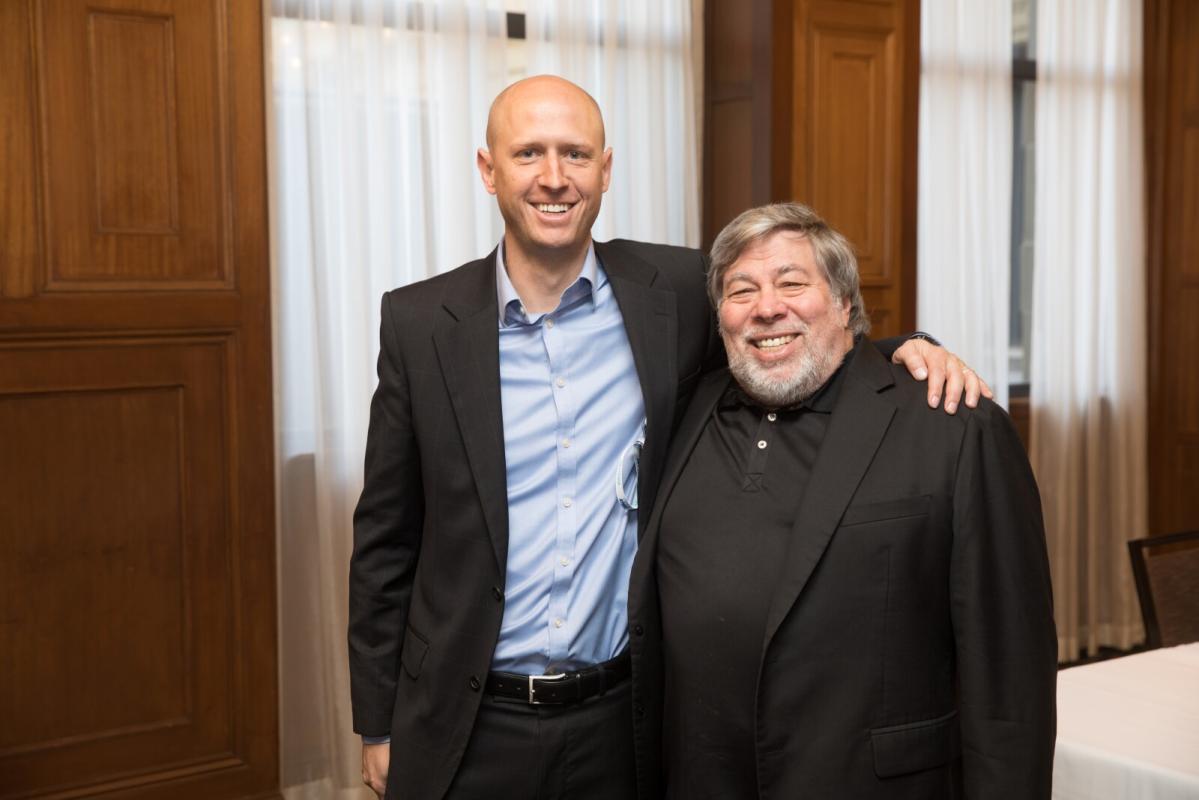
His reflection lingered on Wozniak’s continued curiosity about technology and his interest in education. What caught Kirton’s attention was the appetite for understanding how things worked after commercial success. He described the encounter as changing some of his assumptions about leaders.
There is a natural affinity between that curiosity and the practical questions in Kirton’s operating work. Why does an approval take so long? Why does a manager need to reach a desk? Why does a local supplier struggle to fit a central process? Each invites someone to look inside an arrangement rather than accept the delay as part of the scenery.
The photograph adds warmth to a career otherwise recorded largely through titles, transactions, and business figures. It also provides a useful reminder that executives have their own moments of being the interested person in the room. Even a senior operator can enjoy meeting someone whose work prompts another question.
The next person takes the chair
Alex Mauricio became Bristol’s CEO on February 1, 2023. Kirton moved to the board. At the time of the announcement, Bristol employed more than three thousand people and operated more than seventy-six locations across eighteen states. These were the scale markers at the handover, rather than a description of today’s company.
The transition kept Kirton connected to Bristol while placing executive responsibility with his successor. Mauricio described him as continuing in an advisory and board capacity. That matters to the shape of the career: the CEO tenure ended, and another form of involvement followed.
A handover is an operating event too. The company needs to continue making decisions after the person at the top changes. Its systems, relationships, and accumulated experience have to be available to the next leadership team. The title attracts attention; the continuity has work to do.
Kirton’s story gives that continuity a practical starting point. A purchase should be understood before it is made. An approval should fit the working day of its approver. A larger organization should still be able to see what is happening inside it. Those are useful questions to bring into a boardroom, especially after spending years close enough to the buying desk to know why they matter.