The company Andrew O'Shaughnessy expected to run made cloth. His family owned Dripsey Woollen Mills in County Cork, a business with generations behind it and customers far beyond Ireland. He had studied computer science at University College Cork before joining the mill. The future appeared to have a family name attached. Then the mill closed, and the job he was preparing for disappeared with it.
Cheap imports and a punishing economy helped bring the business down. O'Shaughnessy also remembers a failure inside the building: management and employees did too little talking to one another. In his account, an inherited habit of giving orders left too little room for collaboration. He would spend much of his subsequent career thinking about what a company might do differently if more of its people were allowed into the conversation.
A future cut from different cloth
He moved to London in 1988. Later, back in Ireland, he worked at Intel in Kildare. There he experienced the ambitions of a technology company operating internationally, and enjoyed the feeling of working among people who took that scale for granted. A family manufacturer and an American chipmaker offered rather different business educations. Between them, they gave him both a reason to build and an idea of how far a business could reach.
O'Shaughnessy wanted a company of his own before he had settled on the company it should be. That admission makes his career more interesting than the usual retrospective procession of inevitable decisions. The purpose became clearer through the work. He knew he wanted to create a workplace where people could contribute, and he wanted the enterprise to succeed commercially. Making the two ambitions coexist would take some experimentation.
In 1996 he started e-search, an online directory through which people could be found by details such as name, job or university. Looking back, he described it as an early relative of professional networking. He also described the difficulty of finding finance and the damage done by the dotcom collapse. A useful idea could still arrive at an awkward time. The internet has never offered refunds for punctuality.
The crowded inbox had a neglected neighbour
By the time Newsweaver was established as an email marketing business, O'Shaughnessy had a product, customers and a problem. The market was crowded. Selling more diligently into it offered a living, but little prospect of the international distinction he wanted. Four years of flat revenue eventually made the question unavoidable: was he building the business he meant to build, or merely becoming more experienced at running the one he had?
His response was to look inside the companies buying communications software. Marketers had plenty of tools for addressing customers. The people trying to reach their own colleagues looked less well served. A workforce spread across locations needed relevant information, ways to respond and some means of understanding whether messages were reaching anyone. Those needs were familiar from his earlier working life. They also offered a clearer customer to design for.
The move into employee communications took shape in the early 2010s. It changed the audience and the product's purpose. Rather than competing for another piece of the marketing budget, the business concentrated on the people responsible for keeping employees informed. In 2016 it recruited former Irish Examiner editor Tim Vaughan to lead content and corporate communications. O'Shaughnessy was building expertise around the software as well as adding features to it.
customersNewsweaver’s earlier focus
colleaguesThe market Poppulo pursued
The name caught up in 2017. Newsweaver became Poppulo, a name drawn from the Latin for people. Newsweaver could sound like a media business; Poppulo was intended to express the company's focus on workforces. It was a fairly substantial career change for a newsletter. The rebrand arrived with offices in Cork and Boston and a client list that included Rolls-Royce, Nestlé and Experian. The audience inside the organisation had become a business in its own right.
A customer is a demanding kind of investor
For years, the company financed much of its growth through trading. Early angel investors had helped it survive, but customer revenue became the discipline that shaped expansion. In 2017, with 160 employees and a reported 40 per cent increase in the previous year's revenue, O'Shaughnessy was still making the case for earning the money to grow. A paying customer provides an opinion with consequences, which gives product discussions a useful edge.
“Every penny we make is reinvested in the business.”
Andrew O'Shaughnessy, 2017
That approach eventually ran into the cost of moving faster. In January 2019, Poppulo announced a $35 million investment from Susquehanna Growth Equity, reported in Ireland as approximately €30 million. The money was intended to accelerate international expansion. Existing shareholders, including O'Shaughnessy, retained majority ownership after the investment. He had reached a size at which outside capital could fund the next stage while leaving the existing owners in control.
By May, he was showing business minister Heather Humphreys around Poppulo's Cork headquarters as the company announced plans for 125 additional jobs in Ireland and 80 in the United States. At that point it employed 200 people, with 163 in Cork and 37 in Boston. The Irish roles would concentrate on engineering and research and development, alongside other functions. Enterprise Ireland supported the expansion. His international ambitions were producing quite local vacancies.
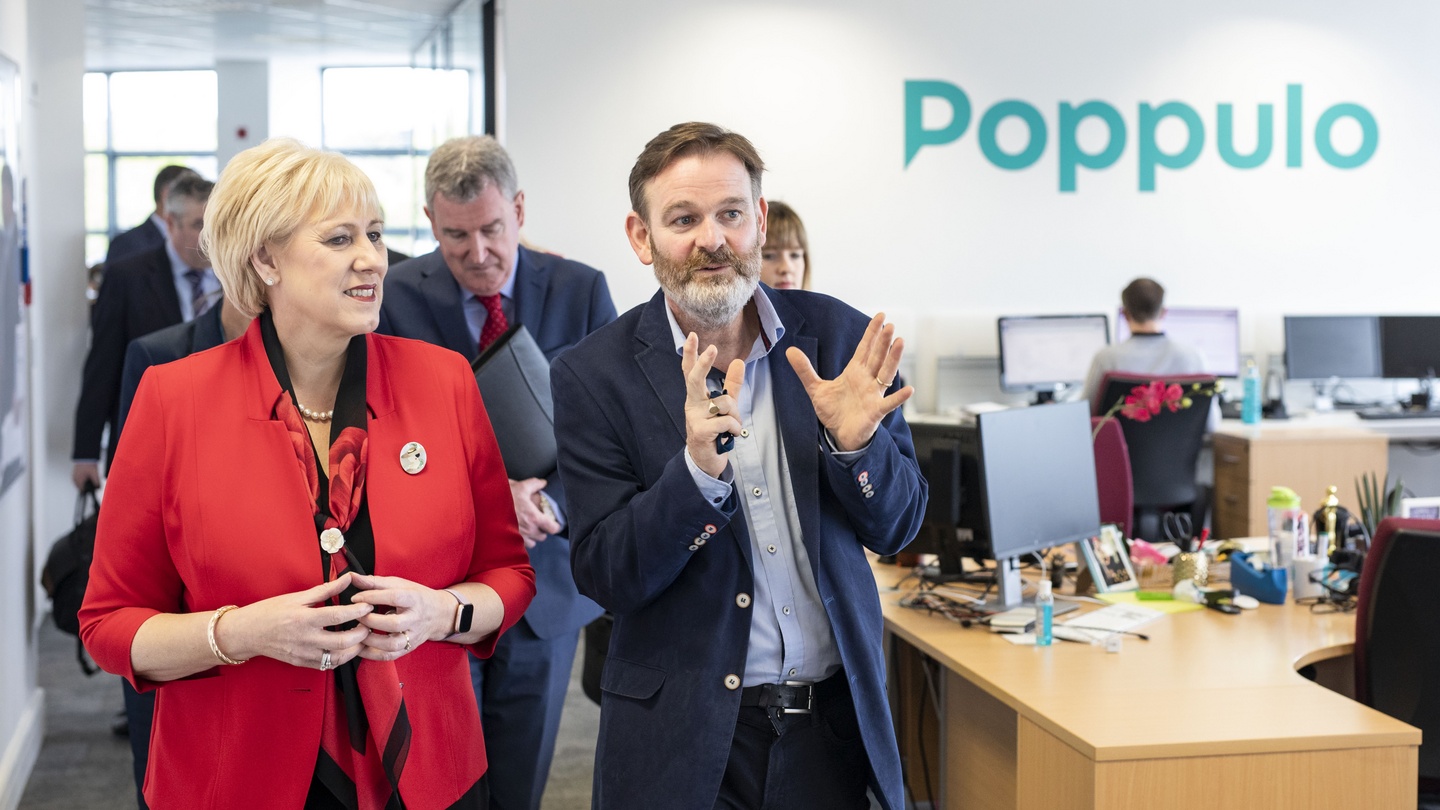
Staff at the time of the 2019 expansion announcement.
Those figures describe a particular moment, rather than the company's present size. They also make the journey tangible. O'Shaughnessy had watched one employer disappear; now he could walk through an office where his own company was preparing to employ more people. There is no tidy compensation between the two events. Still, the connection helps explain why workplace culture remained such a persistent part of his account of the business.
The communications company gets a question
There was a concrete test of that commitment before the rebrand. In 2017, Newsweaver received a workplace award for listening and communicating with employees. Its SWOT to Strategy project put O’Shaughnessy in workshops with representatives from every team, identifying strengths, weaknesses, opportunities and threats. He used those discussions to build a strategic plan. The employees had helped decide what required attention, rather than merely receiving the finished instructions.
A company selling better communication has an obvious difficulty: its employees can test the proposition every working day. O'Shaughnessy described the Boston and Cork offices as one team working in two places. That formulation required repeated explanation, rather than an occasional visit and a reassuring slide. The Atlantic is a sizeable gap for any organisation chart to cover. He kept returning to the importance of colleagues belonging to the same enterprise.
In his account of managing remote teams, he described a daily newsletter, the Daily Buzz, covering business updates, new arrivals and recognition of achievements. He also made a weekly video update and took questions about the business, with employees able to submit them anonymously. The format gave the chief executive a regular appointment with the people he expected to follow the company's plans. It also gave them a way to answer back.
His advice on difficult feedback was similarly practical: use a conversation that gets as close as possible to meeting face to face. Written words can leave too much room for misunderstanding. For someone whose business included email, that is a useful limit to acknowledge. A communication tool has to suit the exchange. The existence of a send button is a remarkably weak argument for pressing it.
“Listen and heed.”
Andrew O'Shaughnessy, on managing remote teams
Recognition followed the commercial growth. He was an international-category finalist in the 2020 EY Entrepreneur of the Year programme. In November 2022, he received the Tech Person of the Year award at the it@cork Leaders Awards, as the organisation launched the Tech Industry Alliance name. The award recognised his work in founding and scaling Poppulo and his contribution to the technology sector. The milestones put a public marker on a career built over decades.
Leaving the chief executive’s chair
In March 2021, Poppulo and Four Winds Interactive announced their combination, bringing employee communications together with digital signage. SmartSpace was part of the wider transaction. The merged operation could reach people through screens as well as email and mobile channels, with operations spanning Cork, Boston, Denver and Luton. For a founder who had found opportunity by concentrating on a neglected audience, the deal expanded the ways that audience could be reached.
After helping settle the merger, O'Shaughnessy stepped down as chief executive and retained a board seat. His later account of the decision was strikingly contented: he felt he had achieved what he wanted from the business. The departure did not require him to pretend that another round of growth was impossible. He could recognise that the company had another stage ahead and that he was ready for a different role himself.
- Newsweaver becomes Poppulo
- $35m growth investment announced
- Combination with Four Winds Interactive
- Tech Person of the Year award
- Investing, mentoring and sharing the experience
Back in the room, on the other side of the table
That role includes investing and mentoring. His investments have included Squid Loyalty, which provides digital loyalty services. He has also returned to the Entrepreneur Experience, the programme he first attended in 2011 when he was seeking advice. AxisBIC describes the event as a concentrated exchange between emerging founders and experienced business leaders. O'Shaughnessy's participation has taken him from the person asking how to move forward to someone helping others examine their choices.
The work has a visible public side too. In 2024 he joined a Cork enterprise panel about resilience alongside speakers including Joan Lucey and Donncha O'Callaghan. In an October 2025 account of a Dublin event hosted by Resolve Partners, Social Entrepreneurs Ireland and Euronext, he appeared alongside Caroline Keeling in a discussion about leadership, culture and communication as businesses grow. The subjects had followed him out of the chief executive's office.
He continues to favour the conversation that brings an awkward problem into view. It is a thread running from his recollection of the mill to his management practices and his mentoring. A founder can spend years becoming fluent in the things they already do well. O'Shaughnessy's experience offers a more uncomfortable use for a room full of colleagues: let someone ask about the part of the business you have been avoiding.
The mill and the software company belong to different industries and different eras. What connects them in O'Shaughnessy's telling is the working relationship between people expected to do a job together. He has built products, changed markets, taken investment and handed over the chief executive's role. The question he keeps bringing back to the table is still small enough for anyone in the room to answer: what needs to be said?
Continue the conversation
Interviews, a recorded discussion and places to follow his work.