There is a particular kind of document that enters an office with the confidence of a legal requirement and leaves with the readership of a parking receipt. The Summary Plan Description is one of these. It can run 130 or 144 pages. It explains what happens when a family gets sick, a worker retires or an employee needs to understand a benefit that costs the company real money. It is also, in its natural state, very good at being ignored.
Smith Communication Partners has spent two decades working on this odd contradiction. Employers invest in benefits, compensation, training, safety and strategy. Then they announce the investment in language built for lawyers, systems or the people who designed the program. The workforce receives the information, which is not the same thing as understanding it.
The Atlanta firm works in that last mile. It researches the audience, finds the message, gives it a shape, chooses the channels and manages the production. A project may end as a guide, intranet, video, poster, text message, training module or meeting. Often it ends as several of them at once. The output is communication; the product being sold is useful action.
The craft begins where distribution ends
Smith's name is an argument. A smith is a craftsperson, someone who learns by doing and keeps doing after becoming senior. The firm says its consultants have at least 10 years of communication experience. More telling is its follow-up: senior people do not merely attend the kickoff, supervise juniors and return for the presentation. They do the work.
“We do the work. All the work. Every time.”Smith's stated operating approach
That sounds like an internal staffing choice, but it changes the offer. Smith can handle an assignment from strategy through delivery, or slip into a client's team for one piece of it. It can also work behind another consulting firm. The company says it partners with roughly two dozen consultancies; one relationship begun in 2011 has produced more than 750 projects for more than 400 end clients. As many as 30 Smith consultants have supported that channel in a year.
This is where Smith fits in the market. An in-house HR team may know the program but lack writing, design or production capacity. A creative agency may know campaigns but not the strange vocabulary of total rewards and compliance. A large human-capital consultancy may have the subject expertise but need flexible communication talent. Smith makes a living between those groups - part adviser, part studio, part expandable bench.
Three outcomes that passed the “so what?” test
The first thing to fail was paper
Consider a 2022 acquisition. Aaron's had bought BrandsMart USA, adding 1,267 employees across 10 stores. The acquired workforce enrolled in benefits on paper. There was no central benefits hub and no settled communication system. Worse, the benefits were changing without becoming identical to Aaron's, so simply repainting the parent company's materials would have blurred a distinction employees needed to see.
Smith built a one-page portal, then borrowed the visual language already present in mural art at BrandsMart's headquarters. The campaign became a comic: the Dynamic Duo versus Dr. Distraction. The joke was not pasted on top. It organized postcards, posters, guides and presentations in English and Spanish while preserving the acquired company's identity.
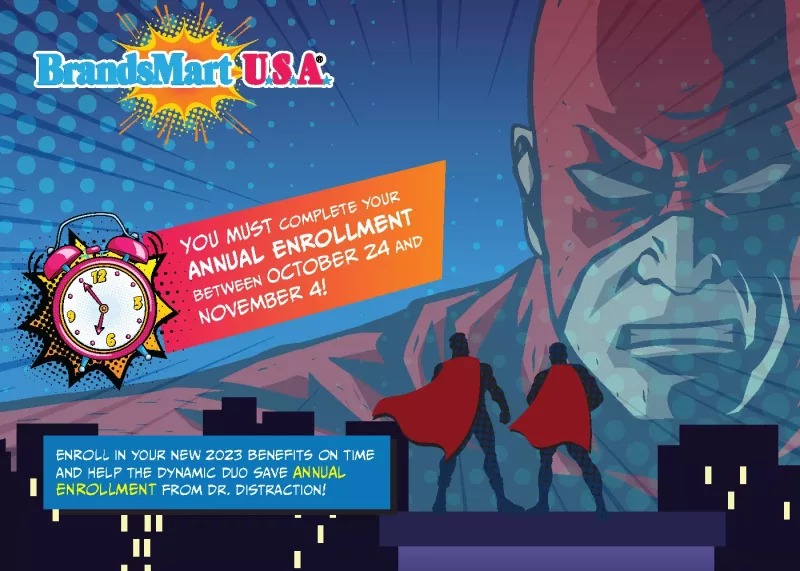
The lesson is easy to copy and hard to fake. Start with the audience's existing visual world. Preserve distinctions that matter. Give the person one obvious place to go. Then repeat the same action across the places they already encounter. A clever theme without that operational spine is decoration.
What changed their minds was evidence
Smith's case studies keep returning to listening before making. For a pharmaceutical company's total-rewards reorganization, the firm began with executives and moved through nearly a dozen employee segments. Almost 5,000 people contributed through interviews, focus groups and surveys. The result was not only a campaign. Smith reorganized the rewards themselves into a structure employees found more intuitive, then mapped three years of communication around it.
At Johnsonville, the assignment began as an audit of plans, content, audiences and channels. The technology question could have become a software beauty contest. Instead, Smith and a technology partner set criteria, reviewed more than 20 intranet platforms, narrowed the field to three and helped with the chosen system's design. The audit changed the decision from “Which platform looks modern?” to “Which platform fits the way this culture communicates?”
The numbers matter because internal communication is unusually susceptible to polite applause. A stock purchase plan went to employees in 16 countries in English, Spanish and French, with local rules addressed in the materials. Eleven percent of eligible employees enrolled, twice the forecast. A healthcare benefits campaign used postcards, newsletters, guides, presentations, video, email, displays and text messaging under one visual identity; more than 95 percent enrolled on time.
And sometimes the useful result is charmingly physical. A Midwest university needed employees to notice its mental-health programs during the pandemic. Smith made an accordion-fold newsletter with one program per panel and a digital companion with live links. Employees unfolded the print piece and hung it on cubicle and office walls. The client kept updating it annually. The supposedly old-fashioned format won because it became a reference object.
Smith does not post a rate card. It sells both turnkey engagements and selected services, so the bill follows scope: audience research, number of channels, languages, compliance review, production and project management. The co-sourcing model offers another route - flexible senior capacity without building every specialty in-house.
A platform for the legal thicket
In June 2026, workforce-services platform Allvia acquired Smith for an undisclosed amount. Allvia already combined HR and benefits administration businesses; Smith brought the communication layer. Trey Wood, Smith's president and managing partner, stayed with the full leadership team. The logic is plain: designing and administering a workforce program only goes so far if employees do not trust or use it.
Three weeks later, Smith launched a technology-enabled compliance communications practice. The service covers required documents and notices, including SPDs, SMMs and SBCs. Workflow software handles document management, version control, approvals and audit readiness; specialists provide the judgment. It is a careful extension of the original idea. The firm that made long documents readable is now trying to make the machinery behind them controllable.
There are conditions. This method depends on access to employees, leaders and program owners. Segmentation needs reliable audience data. A multilingual rollout needs time for regulatory and cultural adaptation. Most of all, communication cannot rescue a benefit that is poor, a strategy leaders will not explain or a change whose consequences are being concealed. Craft can clarify the proposition; it cannot improve the proposition by typography.
But when the underlying program is sound, Smith offers a useful test for anyone who writes at work. Do not ask whether the email went out. Ask what the employee could explain afterward. Ask what action became easier. Ask whether the thing was useful enough to pin to a wall. That is a higher bar than distribution, and a much more interesting business.