The worst moment to discover that nobody owns the employee email is when a reporter has already called. By then, the clock is loud. The lawyers want precision. The executives want speed. Employees want candor. Customers want reassurance. Everyone is using the word “urgent,” and each person means something slightly different by it.
KVA - Kelly Voelker & Associates - has built a business inside that difference. The Charlotte consultancy works on crisis communications, corporate change, employer branding and the internal systems that keep a company’s story from splintering. Its clients have included Vitamix, IHG, Kimball International and the Baby Safety Alliance. They are not buying more words. They are buying order: who speaks, who hears first, what can be said now and what must wait.
A sequence for the moment the org chart stops helping
Communications agencies are easy to describe by their outputs - a press release, a town hall, a media pitch, an executive script. KVA’s more revealing product is the sequence beneath those artifacts. In a layoff, for example, the company argues that the formal announcement comes late. First comes a private map: the people who need advance notice, the managers who need usable answers, the colleagues who can steady others and the audiences likely to hear the news sideways.
This is where KVA sits in the market. It is smaller than a global PR network and broader than a solo fractional executive. Public profiles place the team in the low teens, supported by a network of specialists. The firm says its practitioners average roughly 20 years of experience and that senior people execute the work. For a buyer, the promise is direct: the person with judgment stays after the pitch meeting.
“You want to know when something is simmering before it’s a full-on boil.”
Founder Kelly Voelker knows the large-company side of the table. Before starting KVA in 2014, she held communications roles around global brands and agency clients. Her biography includes IHG, Newell Brands’ Graco business, Edelman and Mower. It also includes “former theater kid,” which turns out to be useful training. Corporate communications is partly an exercise in staging: entrances, cues, the audience’s sightline and the unsettling knowledge that somebody may forget a line.
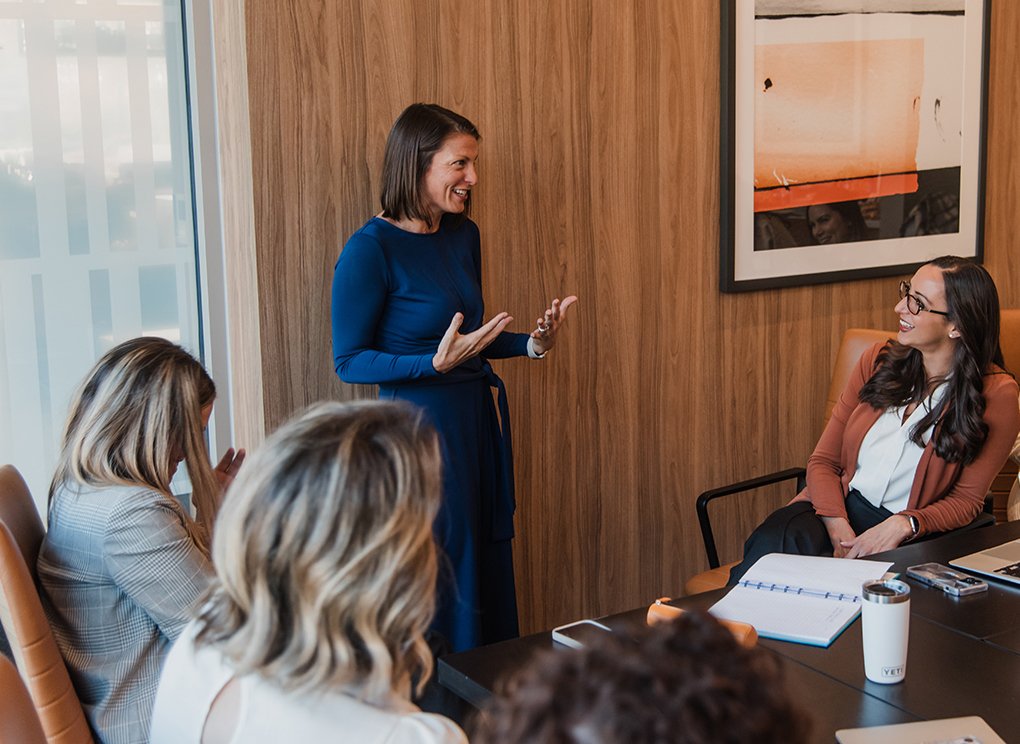
Usually, it is not the message. It is the machinery.
KVA’s public work repeatedly begins with the same malfunction: a business has changed faster than its communications infrastructure. Growth adds leaders, channels and stakeholders. The old cadence becomes reactive. Employees get buried in undifferentiated updates. Messages conflict because no one is the gatekeeper. A company thinks it has a writing problem when it has an ownership problem.
That diagnosis changed the shape of KVA’s offer. The firm does not restrict itself to publicity. It audits channels, interviews employees, creates operating rhythms, builds leader toolkits and stays to execute. Its internal-communications process has four verbs - audit, architect, activate and anchor. The final verb matters. A strategy that lives in a slide deck is an expensive souvenir.
The proof is varied because the assignments are varied. For Messenger and Messenger Kids, KVA supported an agency team with influencer partnerships, events, parent-safety messaging and media outreach; the campaign reported more than 100 million impressions. For Associate Staffing, a consistent LinkedIn program paired leadership content with employee participation and helped the recruiting firm pass 100,000 followers. For Vitamix’s centennial, the work stretched across a year of events, video, email, internal social channels, speeches and new internal branding.
Five letters for when everyone else has twelve opinions
KVA’s crisis method is called STEPS. Acronyms can be corporate wallpaper, but this one works because it follows the order in which panic needs to be dismantled. Start by imagining plausible scenarios and ranking likelihood against damage. Build the team before it is needed. Install warning signals. Define the process. Prepare a strategic response that can be adapted without being invented under fire.
The risk grid is deliberately plain: likelihood runs one direction, magnitude the other, and anything scoring above 15 receives immediate attention. Its virtue is not predictive genius. It gives an emotional room something objective to point at. The same logic applies to the holding statement. The first message should acknowledge the issue, show empathy, connect action to values and explain what people can expect. It does not need to perform omniscience. Voelker’s advice is blunt: it is acceptable to say you do not know yet.
The model works when access beats scale.
A senior boutique is useful when the problem crosses functions, leadership wants an embedded partner and the work requires both advice and execution. It is a weaker fit for buyers seeking cheap commodity content, a giant global media-buying operation or a self-serve software product.
Making every client feel like the only client
KVA’s stated mission has two halves: make every client feel like the only client, and give every team member freedom to build a career they love. The first half is a service position. The second is operating design. The company is women-owned, women-led and remote. It pairs a core team with experienced specialists in writing, strategy and creative work, expanding expertise without pretending to be a holding company.

The culture has small evidence of deliberate maintenance. Every other month, the team holds a 30-minute virtual “Lunch & Laugh” where shop talk is forbidden. Its anniversary retreat has involved archery, honey tasting and dumpling making. These are charming details, but they carry a business point. A distributed consultancy that sells calm collaboration has to practice connection before a difficult client call demands it.
The most ambitious expression of the model may be the 2025 transformation of the Juvenile Products Manufacturers Association into the Baby Safety Alliance. KVA led parent focus groups and member conversations, recommended the name and built the brand system across the main organization and its sub-brands. The new identity put the mission - baby safety - where nobody could miss it. The work later received two Platinum MarCom awards. More importantly, it solved the old brand’s first problem: the name described an industry category while the organization wanted to describe a public purpose.
The copyable part is not the copy
KVA’s best lesson is portable because it is procedural. Most leaders wait too long to decide how decisions will be made. They draft sentences before mapping audiences. They publish before preparing managers. They measure the noise after launch but never define the signal beforehand.
A five-question preflight
- Which plausible event would do the most damage, even if it is not the most likely?
- Who owns the decision, and who merely advises it?
- Which audience must hear directly from you before hearing from someone else?
- What can you honestly say in the first hour, even with incomplete facts?
- What will managers need in hand to answer the next question?
This approach will not rescue a company whose leaders refuse to share facts, whose values disappear under pressure or whose approvals consume the entire response window. Nor is a specialist firm automatically the answer to every routine announcement. KVA is most persuasive where the stakes are high, the audience map is complicated and the internal team needs both extra capacity and an outside voice willing to ask the awkward question.
There is a pleasing modesty in the company’s phrase “communications made simple.” Simple does not mean easy, and it certainly does not mean small. It means the CEO knows the next call. The manager has the talking points. The employee hears the reason, not just the event. The spokesperson knows what remains unknown. In the forty-eight hours nobody wants, that can feel less like messaging and more like getting the floor back under the building.