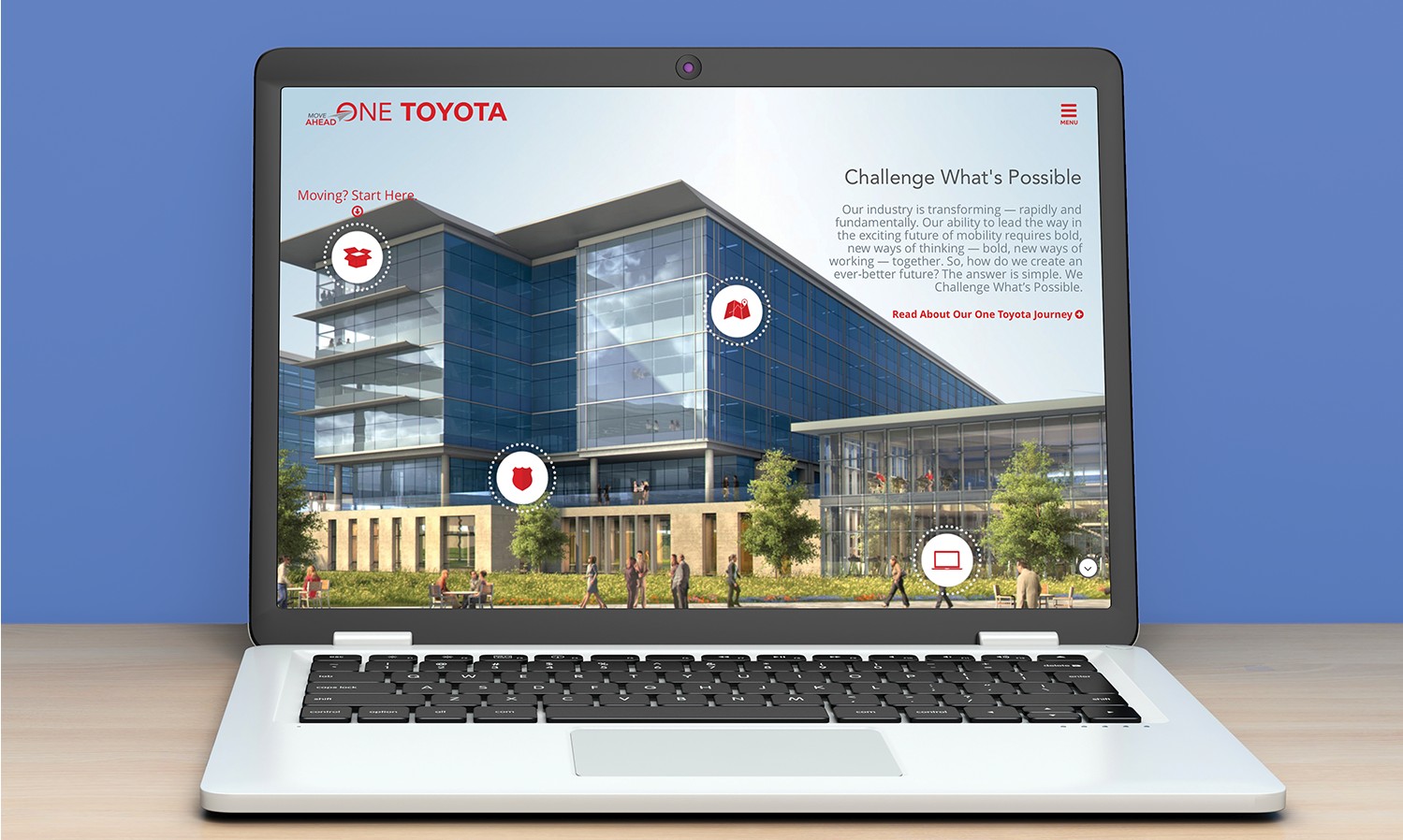
In the usual telling, Toyota moved to Texas. Buildings rose in Plano. Corporate functions that had lived in California, Kentucky and elsewhere acquired one address. Trucks were booked; boxes were labeled; eventually, the office lights came on. But a headquarters is not furniture. It is thousands of private calculations: Will my spouse find work? Is my career still here? What happens to the people who refuse? And does “One Toyota” mean anything more than a slogan on a slide?
HudsonLake worked in those calculations. The Alexandria, Virginia firm helped Toyota treat its North American consolidation as a change and culture program, not merely a move. It supported leadership briefings, designed workshops, aligned functions and built an internal visual identity that could sit above three distinct brands. The reported outcome was unusually concrete for the communications business: more than 60 percent of affected employees stayed, roughly three times the benchmark cited by the firm; engagement topped 80 percent; customers and dealers saw no disruption.
That is the cleanest way to understand what HudsonLake sells. It is not publicity in the red-carpet sense. It is communications as operational infrastructure - the messages, managers, feedback routes, visuals and moments of explanation that help a complicated decision survive contact with people.
The invisible half of the announcement
Cynthia Hudson founded the firm in 2000 after a career that included running Burson-Marsteller's global public affairs practice, then a business of more than 250 people across 20 offices. She had handled labor relations, restructurings and reputational crises. Those assignments share an inconvenient truth: the press release is usually the visible end of an argument that began months earlier inside the organization.
HudsonLake built its position around that hidden half. Its services now cover organizational transformation, employee experience and recruitment marketing, labor and workforce communications, brand and visual systems, crisis and public affairs, and executive positioning. The customer might be a Fortune 50 company moving a workforce, a healthcare system negotiating with nurses, a nonprofit arguing for NIH funding, or a public park trying to become real in the community before its gates open.
“For years, we've helped organizations build strong cultures and navigate complex change through a leader-led approach.”Don Smialowicz, CEO
Smialowicz took over as chief executive in 2022. He had spent more than 18 years at DDC Public Affairs, where he oversaw 150 employees and more than 300 clients and participated in the firm's sale to Omnicom. The appointment made sense: HudsonLake's work had become as much about running complex programs and integrating change as writing language.
What fails first
In a difficult change, the first failure is often not the decision. It is the transmission. A leader knows too much and says too little. A manager hears the news at the same time as the team and cannot answer the obvious questions. An annual survey gathers opinions, then disappears into a dashboard. Rumor moves faster because rumor, unlike the official process, is available.
HudsonLake's recent guidance argues that the old event-based engagement model no longer matches a workplace in continuous disruption. A survey, a program and a burst of executive communication cannot repair shifting priorities, urgency fatigue or workloads with no visible tradeoffs. The firm's prescription is less theatrical: design the work more clearly, listen continuously, show what changed, and equip managers for repeated conversations.
The same mechanics appeared in a California healthcare labor negotiation. HudsonLake prepared nurse leaders before wider updates, created feedback loops, issued post-negotiation summaries, personalized compensation statements and maintained a dedicated information site. The agreement was reached and ratified without the drawn-out disruption the health system feared. The client is unnamed, and the firm does not publish the engagement fee. The useful evidence is procedural: leaders were briefed first; employees had one place for facts; communication followed the cadence of bargaining.
From hearts to spreadsheets
HudsonLake is differentiated less by one format than by its willingness to combine formats. For United for Medical Research, a coalition advocating sustained federal NIH investment, the firm pairs state-level economic data with stories from patients, families and scientists. In 2025, the coalition's economic data received more than 150,000 online views, appeared in more than 100 news stories and was referenced by more than 150 members of Congress.
For Halperin Park in Dallas, the input was different: a future public space connecting historically underserved neighborhoods, accelerated by a $23 million philanthropic gift. HudsonLake created an identity that could live on fencing, signs, merchandise, event materials and screens before the park opened in May 2026. The job was not to decorate a finished place. It was to make a construction site legible as a civic promise.
This creative range brought six MarCom recognitions for 2025 work: Platinum awards for reports produced for Children's Health and the Reagan-Udall Foundation for the FDA; Gold awards for Halperin Park and PeaceHealth's Nurture360 caregiver events; and honorable mentions for campaigns supporting Coast Guard Mutual Assistance and United for Medical Research. The list is revealing. Employees, scientists, donors, caregivers, policymakers and park neighbors are different audiences, but each needs evidence that an institution understands the world from where they stand.
Why the buyer came calling
In May 2026, MikeWorldWide acquired HudsonLake. The price was not disclosed. HudsonLake kept its name and became part of MWW's corporate communications and advisory practice. What changed was the available toolkit: MikeWorldWide brought more scale and capabilities in AI, analytics, digital strategy and influencer engagement. HudsonLake brought the workforce.
The acquisition amounts to a market thesis. Reputation used to be divided into neat territories: employees belonged to internal communications, customers to marketing, policymakers to public affairs, journalists to PR. That division is hard to defend when a screenshot from an employee channel becomes a news story, or when a public promise collides with a manager's behavior. MWW wanted the inside and outside of reputation under one roof.
HudsonLake's model is likely to be expensive relative to a templated campaign because it uses senior people, custom work and sustained involvement. There is no public price card, revenue figure or acquisition valuation. It is also not magic. The method depends on leadership alignment, managers willing to communicate, access to operational truth and visible action after feedback. If executives want language that disguises a decision, or a listening exercise with no intention of changing anything, the machinery turns into theater.
But under the right conditions, the reader can borrow the most important part for free: begin with the people who must live inside the change. Tell them early enough to make sense of it. Give their managers more than slogans. Keep one reliable home for the facts. Measure the business outcome, not the volume of communication. The clever line is optional. The functioning organization is the point.