In 2005, the fastest way to raise money for a software company in Eden Prairie, Minnesota was not a pitch deck. It was a phone call to Eveleth. Darren Wercinski, a former Dartmouth hockey player who had grown up on the Iron Range, went back to the town he came from and asked about twenty neighbors to write checks of roughly ten thousand dollars each. They knew him from the 1993 Eveleth-Gilbert state championship team. They wrote the checks. That $350,000 became REACH Media Network - a company that would eventually run more than 25,000 screens around the world.
Two decades later, in February 2025, that hometown-funded business was acquired by Poppulo, a workplace-communications software company backed by Vista Equity Partners. No venture rounds in between. No Series A theater. Just twenty years of selling digital signage software to schools, gyms, hospitals, and the occasional Fortune 500 - and keeping enough of them happy to end up with more than 9,000 customers.
01 / WHAT IT DOESOne tab, every screen
Strip away the jargon and REACH sells a fairly simple promise: manage every screen your organization owns from a single browser tab. The product is a cloud-based content management system for digital signage. Log in, drag content into a layout, schedule it, and it plays - on a lobby display, a cafeteria menu board, a video wall, a wayfinding kiosk, an outdoor sign. Real-time updates push to one screen or ten thousand at once.
The design bet was usability over depth. REACH built for the person who is not an IT specialist - the office manager, the athletics director, the front-desk coordinator who inherited the screens and has no interest in learning a broadcast system. Drag-and-drop layouts, custom zones, multi-user permissions, and a library of more than 100 free apps and plugins - weather, news, social feeds, dashboards, sports scores, calendars - that drop in without a line of code.
The catalog matters more than it looks. Every app REACH built is one fewer reason a customer needs a developer, a consultant, or a workaround. Want live sports scores in the corner of a gym lobby display? There is an app for that. Menu prices that update when a spreadsheet changes? Covered. Social feeds, RSS, wayfinding directories, room-schedule panels - the long tail of small requests that would otherwise sink a support team became, instead, a menu. That is a moat you can only dig by staying close to the boring problems real customers actually have.
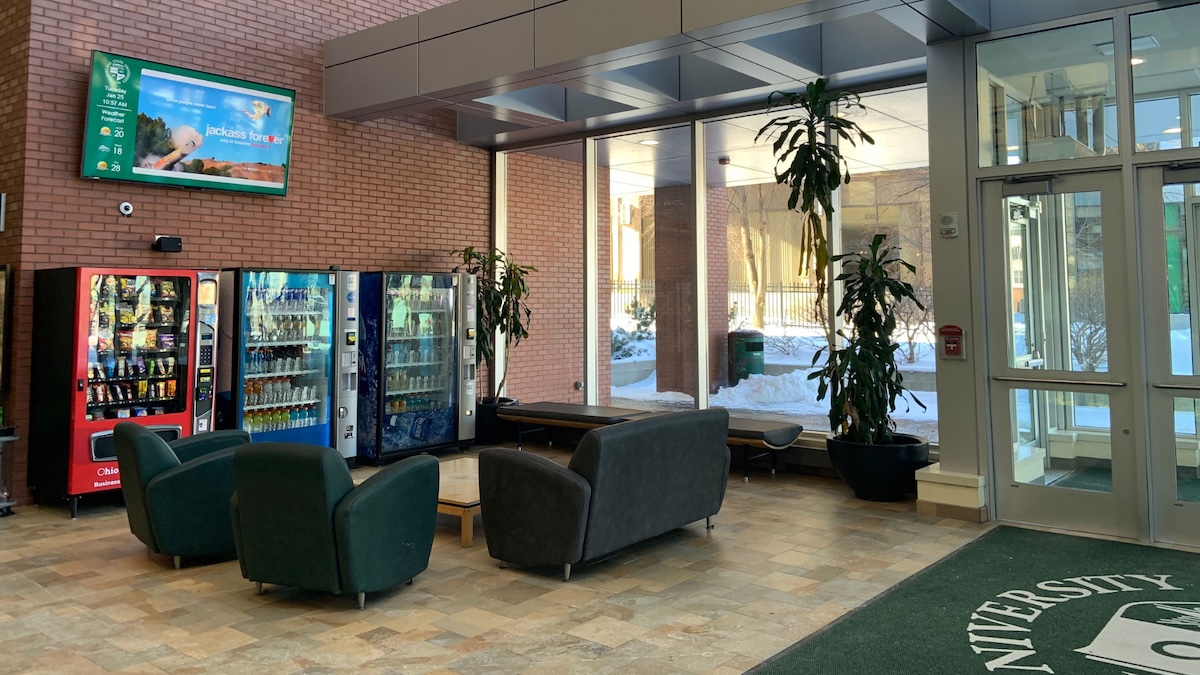
Two engineering choices did quiet, heavy lifting. The players are hardware-agnostic - REACH supports cheap plug-and-play devices like the Amazon Signage Stick and BrightSign boxes rather than locking customers into a proprietary appliance. And the players cache content locally, so a screen keeps playing even when the building's internet drops. In signage, a black screen is the worst possible outcome. REACH engineered around it.
02 / THE PROBLEMScreens are easy. Screens at scale are not
Any restaurant can hang a TV. The problem shows up at the tenth location, or the hundredth: how do you change every menu board at once when the price of fries goes up? How do you push an emergency alert to every hallway screen on a campus in seconds? How do you keep the branding consistent across a hospital system when the person updating the screens in one wing has never met the person doing it in another?
That is the problem REACH solves - centralized control of decentralized screens. Multi-location management, industry-specific templates, custom zone scheduling, content security, and multi-user permissions all exist to answer one question: who can change what, where, and when. Emergency alerting turns the whole network into a single broadcast channel when it matters most.
03 / WHO USES IT3M to Dairy Queen
The customer list is the tell. On one end sit enterprises - 3M, Logitech, Caterpillar, TransUnion. On the other, a neighborhood Dairy Queen menu board and a church lobby screen. In between: Northwestern University, UCLA, USC, K-12 districts, city governments, hospitals, hotels, gyms, transit hubs, and manufacturers. Roughly a dozen verticals, one product.
That range is unusual, and it is the reason the acquisition made sense. Poppulo already sold to large enterprises. What it did not have was a dense book of mid-market and SMB customers running smaller, simpler deployments. REACH was exactly that - which is why the trade press framed the deal as Poppulo buying itself a distinct SMB-focused option rather than a competitor.
04 / THE DIFFERENCEEasy, not enterprise
The digital signage market is full of platforms that sell to Fortune 500 IT departments with long implementations and longer contracts. REACH went the other direction on purpose. Its edge was not the deepest feature set - it was the shallowest learning curve. G2 users handed it both the "Top Leader" and "Users Love Us" badges. SelectHub's analysts named it Best Overall Digital Signage Software and best-in-class for Integrations.
There is a quieter differentiator worth noting: REACH did not start here. It began as a digital out-of-home (DOOH) advertising network and, over roughly two decades, rebuilt itself into an end-to-end signage platform - without a splashy rebrand. The company that got acquired in 2025 was, in product terms, a very different animal from the one those Eveleth investors funded in 2005.

05 / THE BUSINESSBoring on purpose
The model is B2B SaaS in its most durable form: recurring subscription licensing tied to screens and players, plus hardware sales for the media players and paid onboarding, support, and training. Estimated annual revenue sits around $8.1M with roughly 59 employees - a lean shop by software standards, and a profitable-looking one given it grew for twenty years without institutional capital.
That last part is the interesting business fact. Most software stories of this size run on venture fuel. REACH's ran on customer revenue and $350,000 of hometown money. The result was an outcome that does not make headlines - bootstrapped, steady, acquired - but is arguably the more repeatable playbook: sell to real customers in an unglamorous market, keep churn low with usability and support, compound quietly, and exit clean.
There is a condition attached, and it is worth being honest about. This path works when the market is large, fragmented, and underserved by the incumbents chasing bigger logos - which digital signage was. It works less well when a category consolidates around one or two platforms, or when the product needs enormous up-front capital before the first customer will pay. REACH had neither problem. It sold a tool that a small organization could adopt on a modest budget and expand over time, which is precisely the kind of business that compounds without a war chest behind it.
06 / THE ARCTwenty years, five moves
07 / WHAT'S NEXTA division, not a footnote
Poppulo has said it will keep both platforms running to serve a broader range of customers rather than folding REACH into a single product. REACH operates as a distinct SMB-focused division under new Division President Kiersten Gibson, and the branding now reads "REACH Media Network by Poppulo." For the 9,000 customers, the pitch is continuity: the software they liked, backed by a bigger company's resources.
The honest caveat is that continuity is a promise, not a guarantee - acquisitions have a way of narrowing product roadmaps over time. But the shape of the deal, keeping REACH as a separate SMB brand rather than absorbing it, suggests the thing being bought was precisely the small-customer approachability that made REACH work in the first place. If you are building software for an unglamorous market, that is the part worth copying: the moat was ease of use, and the acquirer paid for it.