The most revealing moment in Poppulo's history came when its first idea stopped being special. The company began in County Cork in 1996 as Newsweaver, software for making and sending marketing emails. It worked. Then everyone discovered email marketing, the category filled up, and founder Andrew O'Shaughnessy faced the sort of choice that turns a useful small company into either a footnote or a new business.
Newsweaver did not try to out-shout the crowd. In 2012, it changed the audience. Instead of helping companies talk to customers, it focused on helping them talk to their own employees. Five years later, the company renamed itself Poppulo, a people-centered name for a people-centered bet. The move sounds modest until you consider the stakes: a promotional email can be ignored; a safety alert, policy change, merger update, or factory target cannot.
Go narrow enough, and the boring problem becomes expensive
Internal communication is a peculiar enterprise problem. The buyer may be a communications leader, but delivery depends on HR data, identity systems, Microsoft 365, mobile access, security rules, translations, and the habits of people who may never sit at a desk. Ordinary email tools can send a newsletter. They struggle to target a night shift in one plant, let local editors change approved content, measure whether a campaign reached the intended group, and keep an audit trail that procurement will accept.
Poppulo turned those complications into product. Its employee communications suite builds and targets email and newsletters, sends mobile updates, connects with Teams and SharePoint, translates content, and analyzes performance. The company increasingly talks about outcomes rather than opens: did people understand the message, act on it, or stop hunting for information elsewhere?
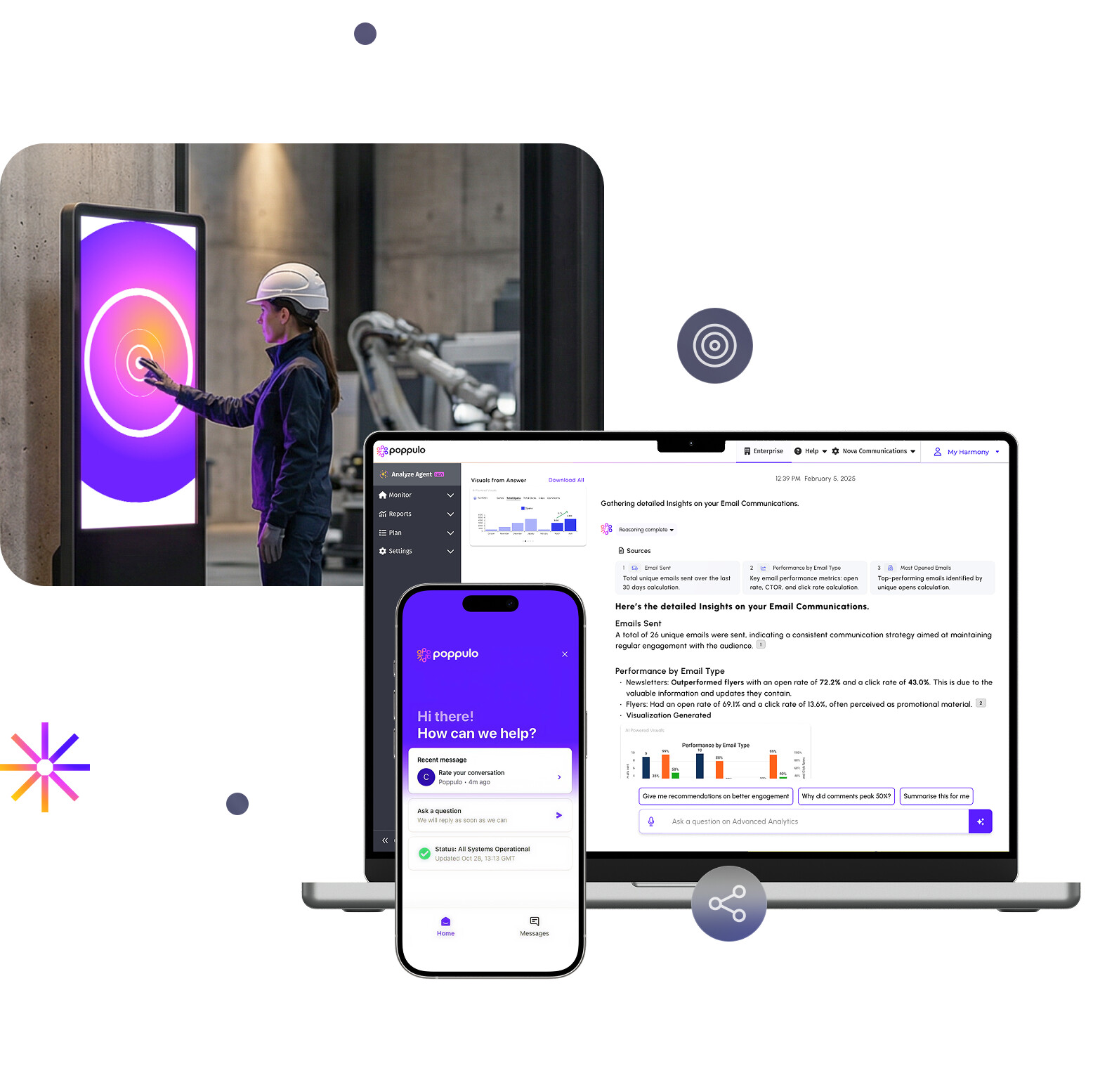
That narrow position attracted serious customers. Poppulo names Delta Air Lines, Hilton, Northrop Grumman, Norwegian Cruise Line, the University of Vermont, and more than 40 Fortune 100 companies among its users. Its software sits in the hands of internal communications teams, but also HR, IT, facilities, operations, and customer-experience groups. The common thread is scale: many people, many locations, and a meaningful cost when information arrives late or not at all.
“Organizations need clearer ways to connect communication to action.”Ruth Fornell, Poppulo CEO
First it simplified the story. Then it bought the missing chapters
Poppulo's corporate history has a neat boomerang shape. It escaped a broad market by specializing, earned a $35 million growth-equity investment from Susquehanna in 2019, and then expanded into adjacent problems once it had credibility. In 2021 it combined with Denver-based Four Winds Interactive, an enterprise digital-signage company backed by Vista Equity Partners. SmartSpace, with workplace booking and management technology, joined the mix. By late 2022, all three operated under the Poppulo name.
Newsweaver begins
Email publishing software starts in County Cork.
The retreat that worked
A pivot to employee communication ends with the Poppulo rebrand.
Screens enter the picture
FWI, SmartSpace, and Poppulo combine, then take one name.
REACH adds the middle market
A signage acquisition brings simpler deployments and thousands of smaller customers.
Sociabble adds the front door
Social intranet, mobile, advocacy, recognition, and rewards join the platform.
The sequence matters. Four Winds contributed the screens in lobbies, factories, campuses, casinos, and ships. SmartSpace added the rooms and desks around them. REACH Media Network, acquired in 2025, brought a simpler signage product and a large mid-market customer base. Poppulo explicitly kept both signage platforms, a practical admission that a hotel with a few dozen screens and a multinational governing thousands of endpoints do not need the same machinery.
The May 2026 acquisition of Paris-based Sociabble filled another gap. It added a social intranet, stronger frontline mobile support, employee advocacy, recognition, and rewards. Poppulo could now claim a continuous surface from a chief executive's email to a worker's phone, a company home page, a Teams tab, and a display above the factory floor.
The screens are where the story gets physical
Digital signage is not merely television for the office kitchen. Poppulo's system manages content, schedules, users, devices, permissions, live data, and alerts from a central platform. It supports Windows, Android, BrightSign, and commercial displays from major manufacturers. Customers can connect RFID readers, barcode scanners, room schedules, Power BI dashboards, emergency systems, and wayfinding. Poppulo also sells or supports the less glamorous parts: configured players, compatibility tests, remote monitoring, on-site installation, maintenance, and replacement hardware.

This breadth differentiates Poppulo from point solutions. ContactMonkey specializes in internal email. Appspace is a familiar signage and workplace alternative. Staffbase, Firstup, Workvivo, Simpplr, Unily, and Interact compete across employee communications, apps, and intranets. A determined IT department can assemble Microsoft 365 and specialist tools. Poppulo's argument is that one governed portfolio reduces handoffs, duplicate audience lists, inconsistent messages, and analytics that never reconcile.
The argument is strongest when a customer is large, regulated, dispersed, and already paying the hidden cost of fragmentation. Poppulo's ISO 27001 and SOC 2 Type II-based security program speaks directly to that buyer. The company also says it was first in its industry to achieve ISO 42001 certification for AI management systems, useful procurement ammunition as AI translation, content generation, knowledge retrieval, and analytics move into sensitive employee workflows.
What did it cost, and what did the buyer get?
Poppulo does not publish a list price. It sells annual subscriptions by quote, with scope shaped by employee count, products, integrations, services, hardware, and deployment complexity. That opacity is common in enterprise software, but it makes the company's 2025 commissioned Forrester study unusually useful because the model shows its homework.
The license assumed for a composite organization with 110,000 employees. The model also included $20,000 in implementation services and $220,500 a year for internal training and management. It is an illustration, not Poppulo's price list.
Forrester interviewed four large customers and constructed that composite. Over three years, the analysis modeled $1.34 million in risk-adjusted total costs, $4.18 million in quantified benefits, a 375 percent return, and payback in under six months. It credited Poppulo with doubling employee reach, saving employees time finding information, reclaiming 32 working days per communicator each year, and reducing communications-staff turnover by 5 percent.
Those numbers are not universal results. The study was commissioned by Poppulo, and a 110,000-person composite has enormous leverage: saving a few minutes across that workforce produces millions of dollars on a spreadsheet. The useful lesson is the measurement design. A buyer should set baselines for reach, production time, search time, turnover, and crisis-response speed before implementation. Otherwise “better communication” remains a warm feeling with a renewal invoice attached.
What failed first, and what can be copied
The first thing to fail was not the product. It was differentiation. Email marketing became crowded, and Poppulo changed its mind about whom it should serve. That is more instructive than the later acquisitions. The company chose a user with specific workflows, a buyer with budget, and a problem whose cost rises with organizational size. Only after establishing that wedge did it add channels around the same job.
- Change the customer before rebuilding everything. Newsweaver's email expertise transferred neatly to internal communications.
- Sell the consequence, not the feature. A template editor is cheap; verified reach during a safety event is not.
- Add adjacent surfaces around one workflow. Mobile, Teams, intranet, and screens all solve the same routing problem.
- Budget for adoption and operations. The Forrester model assigns as much annual cost to internal management and training as to the license.
- Measure before rollout. Without a baseline, the buyer cannot tell whether more channels produced more clarity or merely more noise.
The approach will not work everywhere. A 300-person company with one office, a reliable inbox, and no regulated messaging probably does not need enterprise signage governance or six channels. A team without clean employee data cannot personalize reliably. A workplace that will not fund content owners, training, screen maintenance, and measurement will buy an impressive control panel for stale information. And a company whose employees distrust leadership will not repair that relationship with brighter pixels.
Poppulo's own integration challenge is now the sharpest test. The portfolio is broad because it was assembled from businesses with different products, customers, and histories. The value increases if those pieces share audiences, workflows, data, and a coherent interface. If they remain a collection of neighboring tools, specialized competitors can attack each one. The company that once won by narrowing must prove it can broaden without becoming the kind of clutter it promises to remove.
The clever part was not sending more messages. It was turning “did anyone see that?” into a budget line.