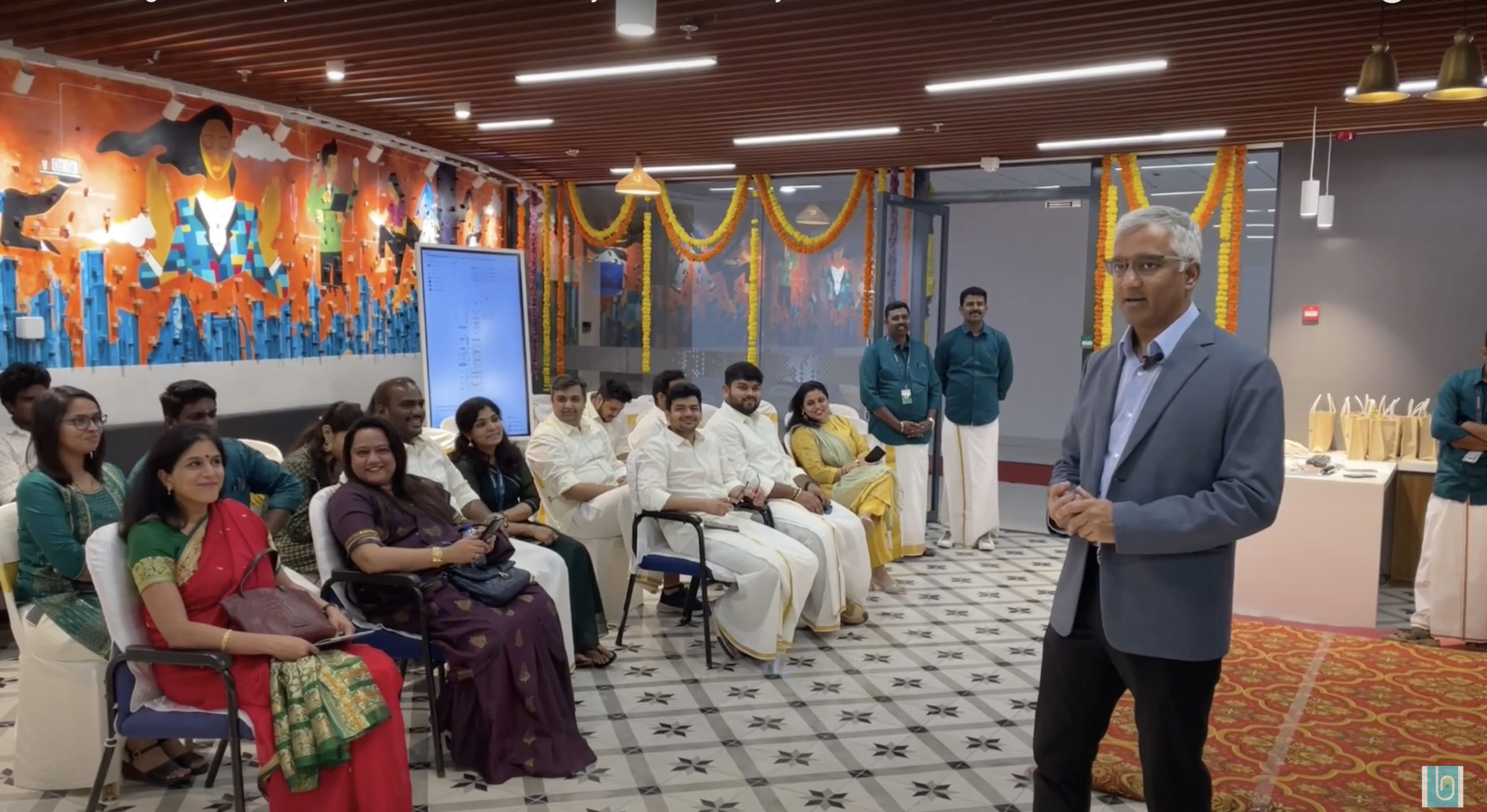
At the opening of Freespace’s office in Coimbatore, Raj Krishnamurthy stood in front of colleagues, marigold garlands and a wall full of colour. A tall digital display rose behind the seated guests. The photograph catches an appealing collision: a technology company celebrating a new address with flowers, company and ceremony. Even a business devoted to measuring buildings needs people to make a room feel occupied.
In a filmed walkthrough of the workplace, Krishnamurthy presented spaces for different kinds of activity. There were meeting booths, training areas and places to gather. Restored traditional furniture and reclaimed pieces shared the premises with displays and sensors. The office gave his ideas a physical address, complete with the sort of detail a software diagram tends to leave out.
This is a useful introduction to the founder and CEO of Freespace. His business measures how workplaces are used. His career keeps returning to the harder question of what makes them useful. Counting people can start a conversation about a building. It takes rather more work to decide what the building should offer them.
Three campuses, then the machinery of business
Krishnamurthy’s education took him through the Indian Institute of Technology Bombay, Purdue University and Santa Clara University. He earned an undergraduate degree at IIT Bombay, a master’s in nuclear engineering at Purdue and an MBA at Santa Clara. His public profile places the Purdue years between 1990 and 1992. The sequence joins technical study to the practical questions of running an organisation.
Nuclear engineering is an arresting qualification to bring to a discussion about desks. It would be easy to turn it into a tidy explanation of everything that followed. His documented career offers a more interesting mixture. Earlier employers included Applied Materials, BOC Group and UTC. He also founded Enria Limited, a consultancy in London.
His professional biographies describe experience as an innovations director at a facilities management business and as general manager of a global service organisation. Those jobs place technology beside customers, operations and commercial decisions. An invention has to travel through all of them before anyone can call it useful. The office, with its contracts, furniture and daily routines, is a particularly thorough examination room.
By the time Krishnamurthy took charge of Freespace’s sensor-focused phase, he had worked across that territory. The company would need hardware that could be installed, software people could operate and information that helped someone make a decision. The attraction of a connected building is easy to describe. Making the connection survive an ordinary working week is another occupation altogether.
2015: making the office measurable
The company’s history has two beginnings worth keeping straight. Workplace Fabric was established in 2011, using thin-client agents to measure occupancy for financial institutions. In 2015, Krishnamurthy became CEO and redirected the business toward internet-connected sensors, accompanying software and analytics. Freespace uses 2015 as its founding year. The earlier operation supplies the prehistory; his appointment marks a change in approach.
The resulting offer emphasised equipment configured before it arrived, with third-party installers able to deploy it quickly and with little disruption. This is a revealing detail. A workplace technology company can have a splendid theory and still come undone at installation. Someone has to put the device in the room. Preferably, the room can get back to work soon afterwards.
In May 2016, Krishnamurthy published an announcement titled “Workplace Fabric launches Freespace.” The business also invested in a software development and applications team in Mumbai that year. The shift demanded a combination of physical measurement and the means to interpret it. A sensor could register use; a business still needed a sensible way to act on the result.
Becomes CEO during the move into connected workplace sensors.
Presents the Coimbatore office in a filmed walkthrough.
Co-authors Work Made Easy with two collaborators.
His later writing gets down to the awkward specifics: whether a meeting room’s capacity matches the number of people inside it, how long someone occupies a phone booth, and what a heat map actually reveals. These are modest subjects with expensive consequences. A ten-person room hosting five people looks perfectly respectable until somebody asks how often it happens.
A business plan needs an audience
Another part of Krishnamurthy’s working life unfolds around aspiring entrepreneurs. Jagriti Yatra lists him as a board member and credits him with designing Biz Gyan Tree, its business-plan competition. Its biographical account also describes his interest in supporting startups. Here, the object under examination is a young enterprise rather than an office floor.
In a contribution to Jagriti Yatra’s 2014 yearbook, he wrote about innovation and enterprise-led development. He connected the prospects of young entrepreneurs with collaborative thinking and experiential learning. This interest predates the Freespace sensor pivot. Encouraging people to build businesses was already part of his public work when his own next chapter was taking shape.
It gives the career a second setting. Corporate clients ask what to do with buildings they already occupy. Aspiring entrepreneurs ask how to turn an idea into something that can operate in the world. Both questions benefit from an audience willing to examine the assumptions. A business-plan competition makes that examination part of the occasion.
There is no need to turn the two activities into a single grand philosophy. The connection is concrete enough: Krishnamurthy has spent time helping organisations use technology and helping prospective founders develop ideas. His biography contains both the established enterprise and the enterprise still being argued into existence.
The arithmetic acquires a calendar
By 2022, Krishnamurthy was explaining how hybrid working complicated familiar calculations. Office planning had relied on headcounts, ratios, floor plans and capacity. Individual preferences and time introduced a changing daily demand. An office might have enough desks over the week and still struggle when several teams chose the same day.
His account of the older calculation included “multiplication, ratios and percentages with a little geometry”. It is a wonderfully unromantic description of the foundations beneath a great deal of office life. Add a calendar, individual choices and different activities, and the neat calculation becomes a recurring management task. The desk has acquired a diary.
The distinction between an open building and an occupied one mattered too. Making space available did not establish how many people were using it. Nor did a total headcount explain which rooms they preferred. Krishnamurthy’s work asks property teams to look inside those differences before deciding what to retain, redesign or reorganise.
In his 2024 writing on real estate investment, he described measurement as an ongoing process. Policies and design changes could be examined against subsequent use. He also raised practical matters such as anonymity, installation, support and the lifetime costs of technology. For a reader expecting the future of work to consist mainly of dramatic predictions, the maintenance bill arrives with refreshing punctuality.
An ambitious promise in three ordinary words
In 2024, Krishnamurthy joined Parthajeet Sarma and John Hoffmire as co-author of Work Made Easy: A Guide to Success in Hybrid Environments, published by Westland Business. Sarma brought workplace strategy and change-management experience. Hoffmire brought a background spanning investment, consulting and teaching at Oxford. Krishnamurthy brought the perspective of a workplace technology business.
The book addresses the relationship between digital tools and physical workplaces, with practical advice for leaders, consultants and employees. Its associated materials describe a five-step process: research, recognise, ideate, pilot and implement. The order leaves some room for discovering that the first idea needs work before everybody is obliged to live with it.
The title’s promise is disarmingly plain. Ease sounds small until a working day accumulates enough minor obstacles. The authors’ project connects the usefulness of technology with the experience of the person expected to adopt it. A system can offer an impressive list of functions and still make an ordinary task unnecessarily laborious.
The Coimbatore visit gives this argument a visible counterpart. A workplace can provide different settings for different activities and preserve older furniture while introducing new tools. The interesting question becomes how those choices work together. Krishnamurthy’s business and his writing meet at that everyday point of use, where an employee has something to do and would quite like to get on with it.
What happens when AI needs a room?
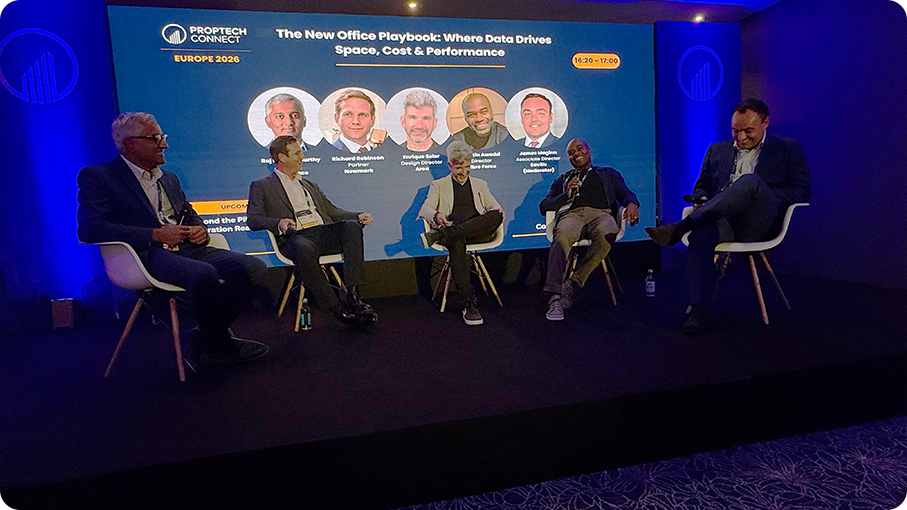
At PropTech Connect Europe in London in September 2026, Krishnamurthy joined a panel about space, costs and workplace performance. The conversation connected the spread of AI with the future of physical workplaces. His prediction was direct: “AI will increase the need for workspaces.” It is a forecast from someone whose company serves that market, and an argument to watch as working habits change.
“AI will increase the need for workspaces.”
Raj Krishnamurthy · September 2026
The view fits his continuing interest in the activities that bring people together. More automation could change what people do in offices and what they expect from them. It also leaves a difficult practical question: how to provide useful places for that work without carrying unnecessary space and its operating costs.
At the same event, he warned about the difficulty businesses face in responding to gradual change. Sudden events demand action; slower shifts can accumulate while familiar arrangements continue. For an executive working with occupancy patterns, that is a particularly relevant concern. A floor plan can remain on the wall long after the behaviour it describes has moved on.
Return to Coimbatore, where the garlands and the display occupy the same photograph. The scene makes a reasonable test for the whole enterprise. People have arrived. There is a place to gather. The technology has a job to do. Krishnamurthy’s continuing challenge is to make the arrangements useful after the opening ceremony, when everyone has gone back to work.
Keep the conversation going
Explore Krishnamurthy’s work, writing and conversations.
- Freespace · Workplace technology
- Raj Krishnamurthy on LinkedIn
- Work Made Easy · The book and its authors
- Watch the Coimbatore office walkthrough ↗
- Jagriti Yatra · The people behind the programme
- How Insights are Driving CRE Investment · His 2024 essay
- Planning provision · The 2022 interview
- The September 2026 workplace debate
- A conversation with George Lucas Pfeiffer · Audio interview