Rami Tamir had the kind of customer meeting founders like to remember. He described an idea for making business software easier to manage. The prospective buyer responded with a question: “Can I hug you?” Later, when he returned with an actual product, the reception was considerably cooler. She had imagined something else. The compliment had survived beautifully as a compliment. It had performed less well as market research.
By then, Tamir already had companies bought by Cisco, Red Hat and Oracle on his résumé. He had helped build networking equipment, a virtualization business and technology for moving applications into the cloud. None of that prevented a prospective customer from hearing his pitch and furnishing the empty rooms with her own furniture. His account of the encounter is a useful introduction to him: the experienced founder who tells the story in which experience failed to protect him.
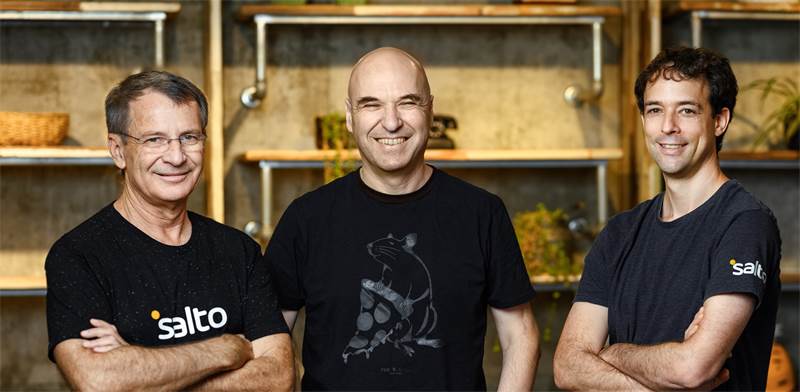
Salto, which he co-founded in 2019 with Benny Schnaider and Gil Hoffer, grew out of a familiar irritation with enterprise software. Its larger story concerns something harder to automate: noticing when a plausible explanation has stopped being true. Tamir has had repeated opportunities to practise. He keeps choosing work that supplies more.
A career chosen by following his brother
Software was not the destination of a childhood master plan. At university, Tamir followed his brother into the field. He has written that he did not know what he wanted to do; coding happened to fit his appetite for solving problems. His formal education includes electrical engineering at the Technion and an MBA through Northwestern University and Tel Aviv University.
That distinction between choosing a profession and discovering an appetite helps explain the repeated returns to startup life. In his own telling, the attraction is the concentration of problems. A young company offers more decisions, more uncertainty and more chances to be wrong than a comfortable job is likely to provide. He describes a startup as a commitment that can last seven to ten years. The invitation comes with fairly explicit small print.
His first co-founded company, Pentacom, dates to 1998. Tamir ran software development for a business working on metropolitan networking technology. Cisco acquired it in 2000. He then stayed at Cisco, leading engineering groups in high-end routing. The acquisition was followed by the work of operating inside the buyer, a pattern that would recur after subsequent deals.
The meeting where being wrong became useful
At Qumranet, founded in 2005, the first plan concerned input/output solutions for servers. Tamir later described a fragmented market and six months spent discovering that the opportunity did not match the idea. The founders could have continued collecting encouraging indicators. Instead, he and Schnaider brought the problem to their engineers.
He recalls explaining what the team had built, acknowledging the mistake and opening the discussion to possible directions. The resulting change led toward KVM, the Kernel-based Virtual Machine technology associated with Qumranet. Tamir explicitly gives the engineering team credit for the architecture and product. In a career often compressed into acquisition announcements, that allocation of credit matters.
There is an awkward managerial bargain here. A founder asks people to believe in a plan, then must sometimes ask those same people to help dismantle it. Keeping the reversal inside a small executive circle would preserve a certain appearance of authority. Opening the discussion makes the uncertainty visible. Tamir’s account suggests he considered the engineers’ access to the problem more valuable than the founders’ appearance of certainty.
“We were wrong.”
Rami Tamir, recalling the Qumranet pivot
In September 2008, Red Hat bought Qumranet for approximately $107 million in cash. Its announcement included KVM and the SolidICE desktop virtualization offering, along with the people who developed and supported them. The transaction carried an engineering team into a larger organization, as well as transferring technology.
Approximate cash acquisition price paid by Red Hat.
Three exits leave out most of the work
Tamir became a vice president of engineering at Red Hat, overseeing virtualization development. In 2011, he co-founded Ravello Systems and served as CEO. This time the technical problem sat above the underlying virtualization layer: helping enterprises take existing application environments into public clouds without having to rebuild those applications for the move.
Oracle’s later description of the service explains the appeal. Ravello used nested virtualization and a networking overlay to make a public cloud resemble the data-center environment an application expected. Companies could bring VMware or KVM workloads across with their existing arrangements intact. The machinery was intricate; the customer proposition was pleasantly unromantic. Move the application without turning the move into an application redevelopment project.
Oracle acquired Ravello in 2016. Tamir again stayed, becoming a vice president responsible for its product line. The visible milestones are tidy enough to fit on a small graphic. His own description of the years between them is less tidy. He has pushed back on the idea that the sales were planned all along. Retrospective inevitability is one of the conveniences available to people who did not have to run the company.
- 1998PentacomCisco · 2000
- 2005QumranetRed Hat · 2008
- 2011RavelloOracle · 2016
- 2019SaltoBusiness application configuration
A small CRM change with a large shadow
The irritation behind Salto was much closer to the sales desk than to the Linux kernel. At an earlier company, Tamir’s team wanted to change how it defined an organization. The product engineers completed their part in less than a week. The corresponding change in the customer relationship management system became stuck.
The person responsible could not establish whether changing the configuration would break the live CRM. Salespeople ended up maintaining the mapping manually outside the system. As the company grew, so did the inconvenience. Tamir initially thought the problem reflected an inexperienced team. He later came to see a recurring limitation in how business systems were configured and changed.
The episode has a nicely disproportionate villain: an administrative definition. A business can invest heavily in sophisticated software and still find itself negotiating with one field. The practical question is who can see the dependencies, understand the consequences and reverse a change if it goes badly. Without those capabilities, even a modest request can acquire the diplomatic complexity of a border dispute.
The engineers had to change their own interface
Salto’s proposal borrowed familiar software development practices: turn configuration into a structured representation, track versions, examine dependencies, test changes and deploy them deliberately. Its NaCl language stands for “Not Another Configuration Language.” The name suggests that even configuration engineers have encountered enough configuration languages.
But the founders’ first way of presenting that idea landed badly. Tamir has described an initial offering that asked customers to work directly with code, under the banner “Company-as-Code.” Prospects reacted poorly. One call nearly ended immediately. Further conversations produced similar responses. The engineering logic had not automatically become an appealing customer experience.
The team added abstraction layers. Tamir’s distinction was that the underlying vision could survive while the solution changed. It is a revealing admission from an engineer: the elegance that persuades a builder may impose work on a buyer. The product has to meet people at their desks, with their existing responsibilities, rather than assume they would enjoy borrowing the founders’ profession.
Money arrived. The assumptions still needed checking.
Salto emerged from stealth in October 2020 with a $27 million Series A led by Bessemer Venture Partners, Lightspeed Venture Partners and Salesforce Ventures. A $42 million round followed in May 2021, led by Accel and Salesforce Ventures. Those rounds supplied resources for expanding application support and hiring. They could not settle every question about how customers would buy.
When the 2023 downturn eroded discretionary budgets, the company shifted toward larger customers and higher prices. Tamir’s account of that adjustment offers a familiar complication for repeat founders: the market keeps changing the examination paper. An approach that shortened purchases under one set of budget conditions could become ineffective under another.
That makes his history with acquisitions less a recipe than a record of adjustments. The common activity across networking, virtualization and business applications is the work of revising a model of the world. The technical product changes. So does the person who approves the purchase.
A guitar, a motorcycle, another problem
Outside work, Tamir describes becoming intensely interested in hobbies and changing his focus roughly every six months. In 2025, he talked about track riding on motorcycles and returning to the guitar. He values the perspective that comes from having something else to think about. Even a company can become a rather small room if one never leaves it.
His technical interests continue to move, too. In 2023 he wrote about using AI to translate a desired business outcome into NaCl, followed by review and testing before deployment. Salto’s current website places AI implementation and controls for safe changes at the center of its proposition. The aspiration has a recognizable continuity with the troublesome CRM definition: make change possible, and make its consequences easier to understand.
Ask why he keeps returning to startups and Tamir offers a direct answer: “I like solving problems.” It is modest enough to sound incomplete. Then consider the sequence: an uncertain career choice, an abandoned server idea, three acquisitions, a reluctant CRM and customers who wanted a different product. There has been no shortage of problems. He appears to have chosen his occupation rather well.