Akshay Narisetti has spent much of his young career making machines cope with the world beyond a screen. He has worked on robot cars that must understand a simulated road, drones that must remain in the air and wearables that must make sense of ordinary speech. His latest machine is less theatrical. Pocket is a card-shaped recorder with three microphones and a button. Press it, have a conversation and find a transcript, summary and list of tasks in an app afterward. It is an audacious amount of engineering disguised as something you could mistake for a well-mannered doorbell.
The disguise is the point. Every extra choice at the start of a recording is a small tax on attention. Unlocking a phone, finding an app and checking a setting may take seconds, but each step asks the user to leave the room mentally while remaining there physically. Pocket proposes a tiny bargain: surrender one press now and recover the details later.
This is the product thesis Narisetti now carries from San Francisco as co-founder and CEO of Pocket, the company he started with Gabriel Dymowski in late 2024. It joined Y Combinator's Winter 2026 batch. In June 2026, Pocket announced $11 million in funding led by Accel, with Y Combinator and a group of technology founders and operators participating. By August, Narisetti said more than 270,000 devices were in the world.
Chapter oneThe robot that watched the water
The story begins with the sort of problem that rewards an impatient child: a water tank needs watching. Narisetti has traced his interest in robotics to age 12, when he built a machine to monitor one. Soon there were drones. An early attempt destroyed its own controller, an expensive little bonfire of confidence. Two months later, he had a drone in the air. Failure had made its argument; he kept the useful parts.
At SRM Institute of Science and Technology in Chennai, where he studied computer science and engineering from 2019 to 2023, the experiments became more organized. He led student work involving autonomous surface vehicles and drones. His team reached the final stage of the e-Yantra robotics competition and received two robotics kits. In one month in 2022, he earned both AWS Cloud Practitioner and Solutions Architect Associate credentials. The pattern was already visible: learn the stack, acquire the parts, try again.
Google Summer of Code supplied a bridge from student robotics into serious open-source work. With JdeRobot, he improved 3D car models for autonomous-driving exercises in RoboticsAcademy. His supervisors described him as resourceful and persistent when documentation was poor or integration became difficult. Those are flattering adjectives in software. In hardware, they are basic provisions.
Another playful project carried him much farther across the internet. Narisetti automated Google's Chrome Dino game and posted the result. The video went viral, and he said the project led to a Google interview. He later said Google approached him more than once, including interest from a VR team, but he continued building independently. The anecdote is neat enough to frame. Its more useful lesson is that a joke made with sufficient craft can become a calling card.
The device that does one thing beats the device that does a thousand things.Akshay Narisetti, on dedicated hardware
Chapter twoA phone can do it. That is the problem.
Before Pocket, Narisetti was a founding contributor to Omi, an open-source AI wearable project. Thousands of developers gathered around the idea of giving software a stream of spoken context from everyday life. He came away with one especially stubborn observation: people with the dedicated device recorded far more than people using a phone app with the same software. He put the difference at 10 times.
The obvious conclusion would be that the device had better technology. Narisetti's conclusion was more interesting: it had fewer competing intentions. A phone can record, message, entertain, interrupt and demand an update before breakfast. Its versatility is magnificent and socially awkward. A dedicated recorder arrives with a single verb.
Narisetti has compared this to the appeal of an e-reader. A phone contains a perfectly capable reading app, yet a separate screen can win because it has agreed to be boring. Pocket follows the same discipline. The company presents it as one button and three microphones. Attach it to a phone to catch calls, or carry it alone to capture a meeting. The app sorts the aftermath into transcripts, speaker labels, summaries and tasks.
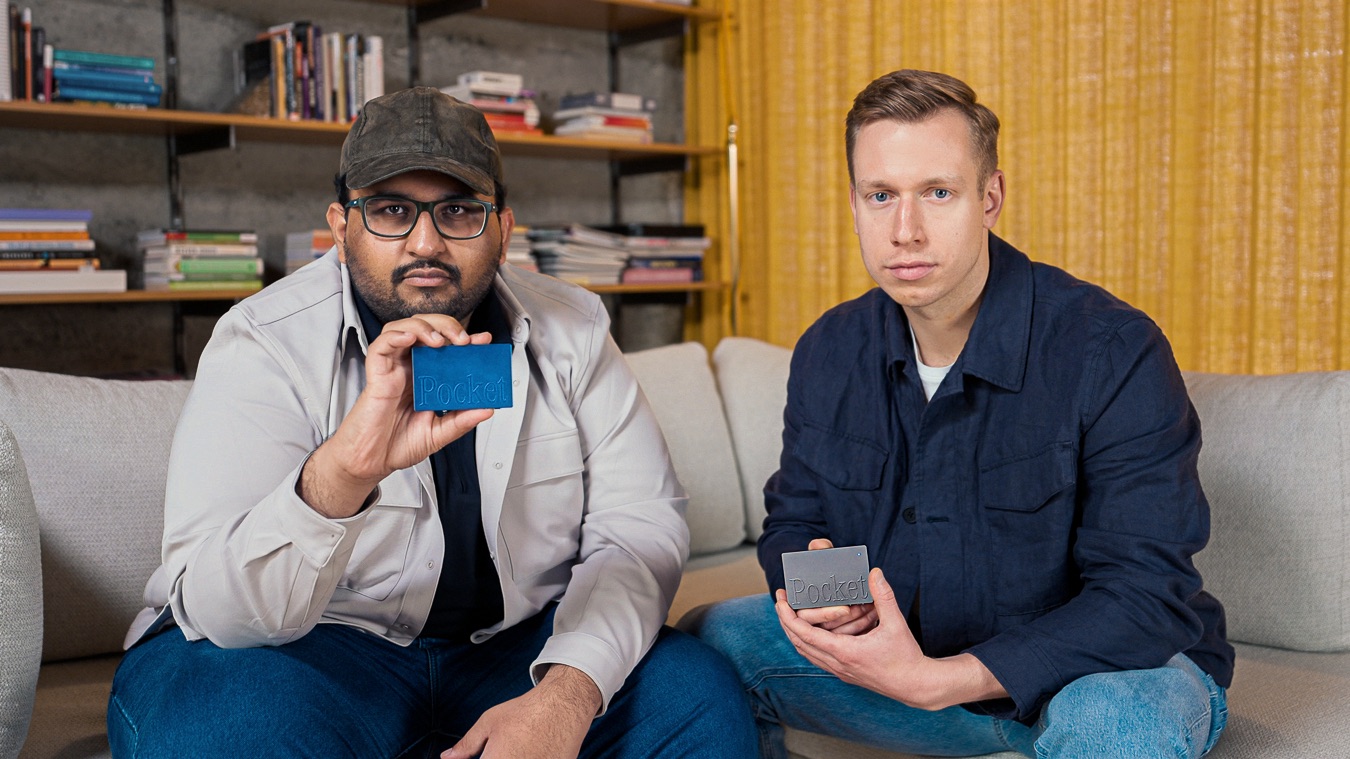
Narisetti and Dymowski found each other through The Residency, a live-in community for technical founders. Dymowski had previously built DoxyChain, a document infrastructure company. Their partnership married Narisetti's fixation on AI hardware to an operator already acquainted with enterprise systems and the unromantic obligations of a company. The pairing matters because a physical AI product is never merely a model wearing a case. It is an orchestra in which firmware, factories and freight all believe they are the soloist.
One press outside. Six systems inside.
The interface is small because the work has been moved backstage.
Chapter threeThe hard work of looking obvious
In a public reflection on building Pocket, Narisetti wrote that the small device represented thousands of decisions across hardware, software, AI, design, manufacturing and customer feedback. This is the central comedy of consumer hardware: the more obvious a product feels in the hand, the more arguments were probably settled before it arrived there.
Pocket's early numbers turned that design argument into an operational one. By March 2026, the company reported a $27 million annualized revenue run rate and more than 35,000 devices shipped. In June, it said sales had passed 130,000 units as it announced the funding round. In August, Narisetti posted that Pocket had crossed a $100 million annualized run rate, up from $1 million seven months earlier, and that more than 270,000 devices were in circulation.
A hardware curve, measured in devices
Fast growth makes the product thesis easier to admire and harder to maintain. More units mean more edge cases: a room that echoes, a voice that arrives softly, a firmware release that improves one condition and insults another. Narisetti has responded publicly to users who encountered audio problems, accepting responsibility for shipping too early in some cases and promising firmware changes. Candor is cheaper than a recall and rarer than a launch video.
The new funding gives Pocket room to hire across hardware and software, explore additional device forms and widen the product platform. Its enterprise tools already point beyond transcription toward workflows: calendar and storage integrations, webhooks, connections to work software, and structured actions that follow a conversation. The recorder is becoming an input layer for other systems.
Chapter fourContext is the larger bet
Narisetti's stated argument is that AI improves with context, while much of the context that matters exists offline. This reframes Pocket from a note-taking accessory into a small sensor for the parts of work that never enter a document. A decision made across a table can be as consequential as anything typed into a project tracker, but software cannot act on what it never receives.
The ambition carries a necessary restraint. A device built for conversation must be visible enough to understand and quiet enough to ignore. Pocket emphasizes recording indicators, and Narisetti has described privacy and transparency as core design concerns since the company's earlier prototypes. The challenge is not only to capture more context. It is to do so without turning every room into a studio and every exchange into a performance.
His earlier open-source work remains relevant here. Open projects force builders to expose decisions, accept strange contributions and watch people use a system in ways its designers did not script. Narisetti also created a microgrant program offering small checks to young hardware and robotics builders. It is an appropriately concrete form of encouragement. A few hundred dollars will not manufacture a product, but it can purchase the parts that permit a young tinkerer to destroy one controller and try again.
The thing I'm proudest of isn't the $100M. It's the team behind it.Akshay Narisetti, August 2026
That sentence is revealing because the public image of hardware loves the solitary inventor and the pristine object. Narisetti keeps returning to the group behind it. Pocket's minimal face is made by people in product, design, engineering, operations, manufacturing and support. A button may be a product decision. Getting hundreds of thousands of them to behave consistently is an institution.
Narisetti's path still feels closer to a workbench than a boardroom: a water tank, a failed drone, autonomous cars in simulation, a viral dinosaur, an open-source wearable, then a small blue rectangle held up to a camera. The materials change. The instinct does not. He is interested in what happens when software meets physical behavior and discovers that humans, like drones, decline to follow the clean line in the diagram.
Pocket's wager is that the answer can be simple on purpose. We already carry a device that can do almost anything. Narisetti is building one that asks us to do almost nothing. Press, speak, continue. The machine can take the notes. The person gets to keep the room.