Billing software has the peculiar distinction of being invisible when it works and career-altering when it does not. In 2007, Tien Tzuo knew this from Salesforce, where he had been employee number 11. K.V. Rao and Cheng Zou knew it from WebEx, where subscription operations had demanded a serious internal build. The three saw the same ugly truth: software designed for one-time purchases could not gracefully handle a customer who upgraded on Tuesday, paused on Friday, used twice as much next month and expected one intelligible invoice.
Their answer became Zuora. The name spliced together Tzuo, Rao and Zou, a bit of founder algebra that sounds more futuristic than its construction. The company started with Z-Billing, raised $6.5 million from Benchmark Capital and Marc Benioff, and began selling subscription management before Spotify was a household utility and while Netflix still put DVDs in envelopes.
The timing mattered. So did the language. Tzuo called the shift from product ownership to ongoing access the “Subscription Economy.” That phrase gave a dreary back-office problem a front-row seat in strategy meetings. Zuora later added an index, a conference series and a steady flow of manifestos. Category design met accounts receivable.

The pitch failed. The problem refused to.
The origin story has a useful bruise. Rao's early presentation to Benchmark partner Peter Fenton reportedly went so badly that Fenton ranked it among the worst pitches he had seen. The founders did not confuse a bad deck with a bad market. They returned to the evidence: Salesforce and WebEx had both spent real people and real money wrestling with subscription operations. Tzuo sharpened the story, Benioff supplied encouragement and capital, and Benchmark led the first round.
What changed their mind was not a consumer trend report. It was operational pain inside two fast-growing cloud companies. That distinction is copyable: look for work that important companies have already proved costly enough to build themselves. A failed pitch may mean the explanation is wrong, while the repeated internal workaround says the problem is alive.
What Zuora actually does after the slogan
Zuora sits between a company's promise and its ledger. A sales team defines an offer. A customer buys, upgrades, adds users, consumes API calls or cancels. The platform records those changes, calculates charges, produces invoices, routes payments, chases overdue balances and tells accounting when revenue may be recognized. Its current portfolio includes Billing, Payments, CPQ, Collections, Revenue, the Zephr subscriber-experience product, usage metering inherited from Togai, and a platform layer of APIs, workflows and connectors.
The customer list explains the product's shape: Box, Caterpillar, General Motors, The New York Times, Schneider Electric, Siemens and Zoom. These are businesses with different currencies, channels, legal entities, product families and accounting obligations. Zuora says Billing supports 50 pricing models, connects to more than 40 payment gateways and can process more than 400,000 invoices an hour. Revenue automates the five steps of ASC 606 and IFRS 15. Zephr handles paywalls, identity and personalized offers for publishers. Togai's technology ingests raw usage events and rates them into charges.
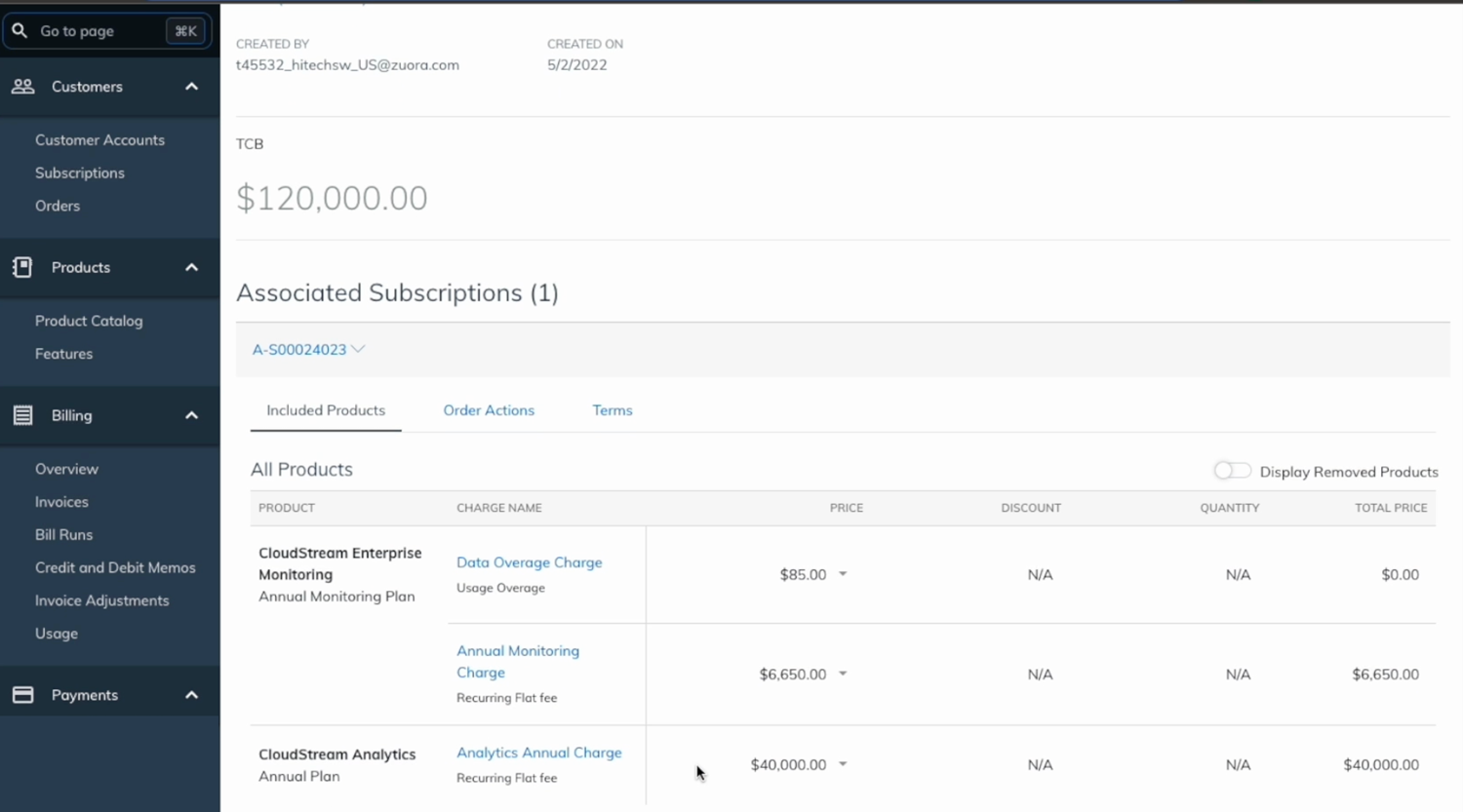
For operators, the practical benefit is optionality. They can launch a subscription bundle, add consumption charges, change a contract mid-cycle and keep the downstream accounting attached. Finance gets fewer manual reconciliations. Product teams can test pricing without asking engineers to rebuild the billing engine. Customers get clearer access, usage and payment experiences. The platform earns its keep when changes happen often and mistakes multiply across systems.
The cost is bigger than a software quote
Zuora does not publish a simple price card. Enterprise contracts depend on modules, volume, entities, integrations and service needs. The meaningful cost also includes implementation: mapping a catalog, cleaning account data, connecting CRM and ERP systems, translating contract rules and persuading sales, finance, product and IT to agree on what an “order” means. Systems integrators often enter the picture. This is financial infrastructure, not a browser extension.
When the machinery is too large
A young SaaS company with one monthly plan, one currency and straightforward accounting may get more value from Stripe Billing, Chargebee, Recurly, Paddle or another lighter tool. Zuora works best when complexity is already expensive: global entities, hybrid pricing, high event volume, frequent amendments, strict revenue rules or several channels. Without those conditions, the implementation can outweigh the benefit.
That is the competitive divide. Stripe starts close to payments and developer experience. Chargebee and Recurly sell approachable subscription operations. Salesforce, Oracle and SAP approach the problem from broader enterprise suites. Newer metering specialists such as Metronome, m3ter and Amberflo focus on usage. Zuora's claim is breadth: keep the catalog, lifecycle, meter, invoice, payment and revenue schedule connected. The tradeoff is that a broad platform asks for broad organizational commitment.
A public-market detour, then private ownership
Zuora raised roughly $250 million in venture funding before listing on the New York Stock Exchange in April 2018. The IPO sold shares at $14 and valued the company around $1.4 billion. It was a visible coronation for the category creator. The ending was less cinematic. In fiscal 2024, revenue reached $431.7 million, annual recurring revenue hit $403.1 million and dollar-based retention stood at 106 percent. Growth was real but measured, and the company cut its workforce by 8 percent.
Silver Lake had already made a $400 million strategic investment. In October 2024, it joined Singapore's GIC to offer $10 a share in cash, an 18 percent premium to the unaffected closing price and $1.7 billion in total transaction value. Shareholders approved. The acquisition closed on February 14, 2025, Zuora left the exchange, and Tzuo stayed as CEO while rolling over much of his ownership.
The round trip - public at $14, private at $10 nearly seven years later - resists the neat startup ending. Zuora created a durable category and a substantial enterprise business, but category ownership did not guarantee an ever-rising public valuation. Private ownership gives the company room to consolidate products and spend acquisition capital without a quarterly audience. It also places pressure on the next act to produce more than a refreshed narrative.

AI makes the old mess new again
Generative AI is reopening the exact problem Zuora was built to solve. Seat licenses fit poorly when one user generates a few summaries and another burns through millions of tokens. Vendors now mix subscriptions, credits, model tiers, minimum commitments, outcomes and overages. Raw events arrive by the billion. Customers want live usage visibility. Finance wants an audit trail. Product teams want to alter the formula next week.
Zuora bought Togai in 2024 to pull metering and rating closer to billing. It has since added an AI layer with supervised finance agents, anomaly detection and Model Context Protocol servers that can expose approved billing and revenue data to tools such as Claude, Cursor and internal agents. In 2026, the company achieved ISO/IEC 42001 certification for its AI management system and promoted agents for billing investigations, revenue analysis and journal remediation.
The discipline matters. A chatbot may improvise a sentence; an accounting system needs to show its work. Zuora's useful angle is governed automation grounded in transaction records, with reviewable steps and audit history. The failure mode is equally clear: an agent with broad access, weak permissions or unreliable source data can accelerate the wrong answer. AI does not rescue a broken catalog or contradictory contract policy.
The parts worth stealing
Look for teams maintaining home-built systems that never become a competitive product. Repeated private fixes are evidence of a public market.
“Subscription Economy” made Zuora easier to understand and gave customers language for their own transformation.
The Subscription Economy Index turned platform data into a recurring reason for the market to revisit the thesis.
Billing led naturally to payments, revenue, subscriber experience and metering because customers already struggled at those handoffs.
This playbook fails when the category is mostly a slogan, the underlying pain is cheap, or expansion outruns product coherence. It also fails when a company assumes complexity is inherently valuable. Customers do not buy complexity. They pay to remove it. Zuora's enduring test is whether one connected platform costs less - in money, errors and organizational friction - than a collection of focused tools.
Zuora's first insight was that recurring relationships break one-time systems. Its second act depends on a related bet: machine consumption will break seat-based systems. The invoice remains unglamorous. It is also where a business model stops being a slide and becomes money.