financial-automation
(13)
The Back Office Has Too Many Front Doors
Series wants a finance team to stop acting as the human bridge between banks, payroll, bills and contracts. Its answer is a menu of connected software, with the identity of each business entity at the center.

The Tax Return That Refused to Stay a Tax Return
Accrual began with the least forgiving calendar in accounting: tax season. After thousands of real returns, its next bet is that the client record should keep working when April is over.

The Sneaker Bank That Outgrew Sneakers
A banking startup found its first customers in sneaker raffles. When that market fell apart, Slash used the lesson - build around the customer's actual money movements - to pursue a much bigger business.

Zuora Sold the Subscription Economy. Now It Has to Bill the AI Economy.
The company that turned recurring billing into a management philosophy is private again - and betting that AI will make the meter, invoice and ledger more complicated than ever.

Rightsline Built the Operating System for Hollywood’s Messiest Spreadsheet - Now It Wants Every IP Business
A title can be available in Tokyo, blocked in Toronto and still owe three people money in London. Rightsline turned that contractual hairball into enterprise software - and a $500 million growth bet.

Nicolas Kopp Spent Years Waiting for the Numbers. Now He Wants the Books to Keep Themselves.
After helping build a bank, Nicolas Kopp chose an even less fashionable problem: the general ledger. His bet is that finance should move at the speed of the business, not the speed of month-end.

Ashley Schagrin Wants Accounting to Stop Working Around the Work
After KPMG, Dropbox, and nine years inside Pilot, the CPA-turned-operator has a clear thesis for AI accounting: automate the workaround, keep the judgment, and give people back the client conversation.

Webgility Wants Every Ecommerce Order to Tell the Truth
The San Diego software company sits between the cart and the ledger, translating a messy stream of orders, fees, refunds and inventory movements into books an operator can actually use.

Rillet
Rillet is an AI-native ERP built by accountants that automates the month-end close, recognizes revenue in real time, and surfaces SaaS metrics directly from the general ledger. Founded by former N26 US CEO Nicolas Kopp and CTO Stelios Modes, the San Francisco company positions itself as a modern replacement for legacy systems like NetSuite and QuickBooks, letting finance teams close their books in days instead of weeks. Backed by Sequoia, Andreessen Horowitz, and ICONIQ, Rillet has raised over $100M and serves 500+ scaling companies.
Astra
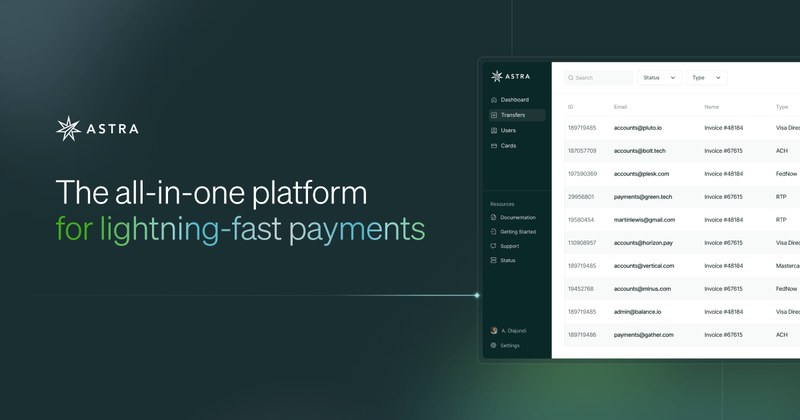
Astra is a San Francisco-based fintech that gives developers a single API to move money instantly between bank accounts and debit cards. Built on rails like Visa Direct, RTP, FedNow and ACH, its platform lets fintechs, banks and enterprises embed instant disbursements, account funding and accelerated transfers without building their own payments stack - going live in about 30 days instead of six months. Founded in 2016 by Gil Akos, Sam Morgan and Zach Nolan, Astra has processed more than $1 billion in lifetime payments and is backed by FPV Ventures, Nyca Partners and others.

Alejandro Casas Caro
Alejandro Casas Caro is the co-founder and CEO of Simetrik, a Y Combinator-backed AI-powered financial reconciliation platform that processes over 1 billion records daily for 100+ companies across 40+ countries. A technical founder who studied UX design in Barcelona, he pivoted from a failed fashion e-commerce startup to building what has become a $116M+ funded enterprise infrastructure company backed by Goldman Sachs, Tiger Global, and Mercado Libre Fund.

Simetrik
Simetrik is an AI-powered, no-code reconciliation platform that automates transaction matching, exception management, and compliance workflows for enterprises operating at high transaction volumes across 40+ countries.

John Glasgow
John Glasgow is the founder, CEO, and CFO of Campfire, the AI-native ERP platform built for high-growth tech companies. A 15-year finance veteran who passed through Adobe, Invoice2go, and Bill.com before founding Campfire during parental leave in 2023, Glasgow has raised over $100 million in funding — $35M Series A and $65M Series B in just 12 weeks — and is steering the company toward an IPO. His platform's proprietary Large Accounting Model (LAM) achieves 95% accuracy on financial workflows, and customers like Replit, Decagon, and PostHog have traded NetSuite for Campfire's AI-first stack.