A client changes her mind about how expenses should be divided across departments. Nothing has gone wrong. The books are not on fire. Yet the request quietly threatens to swallow a day: reopen old months, trace the spreadsheets, reclassify the entries, check that nothing slipped, then do it again when the next exception arrives. Ashley Schagrin knows this species of work. She has spent a career close to the places where accounting is correct in principle and awkward in practice.
In 2026, working with dozens of clients on Pilot's Meridian system, Schagrin described a different ending. She tells the in-app accounting agent about the new allocation. It reruns the numbers in minutes. The striking part is not the speed by itself. It is the removal of a tiny private tax that finance teams have paid for years: the cost of making rigid tools understand a living business.
Schagrin's path to that moment runs through institutions that teach three very different dialects of finance. She started in public accounting at KPMG, auditing public companies. At Dropbox, she moved from technical accounting to real estate and projects finance operations, then to financial planning and analysis. At Pilot, which she joined in August 2017, she passed through product operations, company operations, and R&D operations before becoming Senior Director and Chief of Staff to the CEO. The titles changed. The recurring question did not: how much of an accountant's day is spent producing insight, and how much is spent negotiating with the machinery?
An auditor learns where the seams are
There is a tidy version of accounting in which every transaction finds its account, every period closes, and the statements emerge wearing their best clothes. Audit teaches the less tidy truth. Controls have limits. Materiality requires judgment. A set of books can be reliable without pretending that every page of guidance has been obeyed with monastic perfection. Schagrin later helped shape Pilot's stage-appropriate approach to GAAP reporting with that background in view.
Her education had already mixed the numerical with the organizational. At Miami University, she studied accountancy and political science, worked in the accountancy department, and taught Foundations of Business Decision Making. She participated in the honors program and business honor societies; she also directed accounting for the university's Dance Marathon. Even the extracurricular line item came with a ledger.
Dropbox added scale and proximity to software builders. It also supplied a consequential connection: Schagrin met Waseem Daher and Jessica McKellar, two of Pilot's co-founders, while working on Dropbox's finance and accounting team. When she joined their young company in 2017, the proposition was specific. Build software accountants could use to do excellent work at scale, without forcing every client into the same box.
The test kitchen
For years, Pilot built internal technology behind its accounting practice. Schagrin calls the operation a test kitchen: the team could watch which processes consumed the most time, then learn which pieces software could reliably take over. The metaphor is apt. You do not improve a recipe by admiring the menu. You stand near the heat, notice what repeatedly goes wrong, and change the preparation.
The stubborn work lived in the exceptions. A client wanted expenses allocated by location. Another needed prior-period revenue restated. Auditors wanted workpapers in a particular format. Good accountants handled every request, but competence carried a perverse reward: the better they became at rescuing awkward workflows, the easier it was for the organization to accept those workflows as normal.
The exception tax, before and after
Meridian gave Schagrin a way to encode a client's accounting configuration once and let the agent carry it forward. The pleasure is cumulative. A correct setup does not merely save time today; it prevents the same workaround from returning next month in a fake mustache. In one public example around the product's launch, she said a ten-hour onboarding fell to two after the team answered Meridian's questions. Her verdict was disarmingly cheerful: she had never had so much fun running the month-end close.
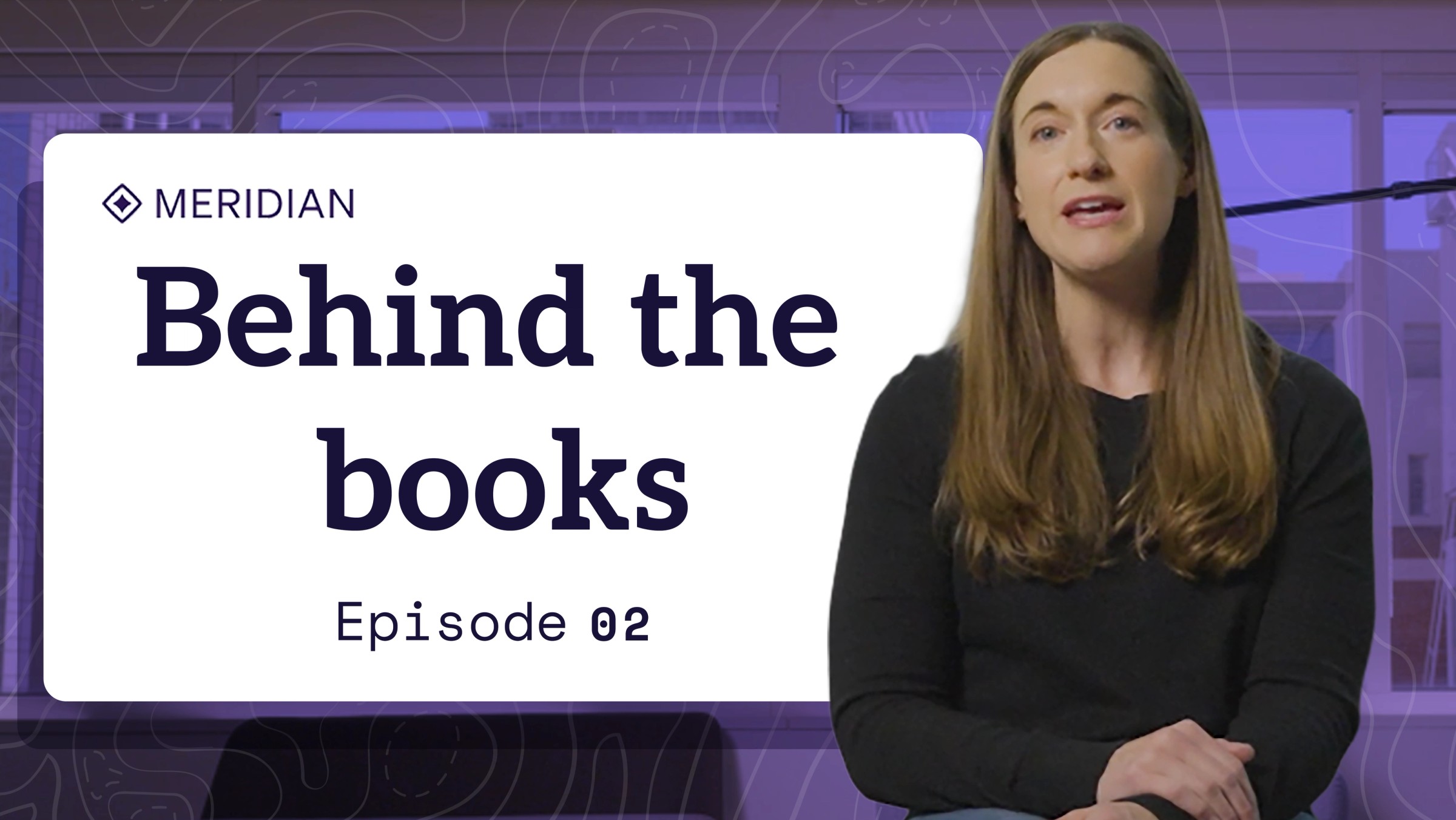
“The valuable part is the judgment and understanding what a client's numbers mean.”Ashley Schagrin
A machine for repetition, a person for the room
Schagrin's argument for AI is not that accounting no longer needs accountants. She separates the profession into layers. Reconciliation, schedules, clean ledgers, and repeated classifications are prerequisites. They demand care, but they are not the final reason a founder or finance leader wants an accountant. The value arrives when someone explains what changed, asks whether the reporting structure supports a decision, or spots a pattern before it becomes a surprise.
She places one skill above the software line: being the calming presence when a client is frustrated or scared. It is an unusually emotional phrase for an industry often represented by grids. It also reveals what her productivity argument is really protecting. A faster close matters because delay obscures the conversation. Reliable automation matters because confidence in the numbers gives the adviser room to talk about the business.
Give the agent
- Repeated classifications
- Configured close routines
- Historical reruns
- Mechanical workpapers
Keep for people
- Judgment and context
- Client relationships
- Mentoring and review
- Decisions under uncertainty
This division also changes apprenticeship. Early-career accountants still need debits, credits, ledgers, and the reasoning behind decisions. Schagrin does not wave away the fundamentals. She expects less time spent proving endurance through repetition and more time learning how experienced accountants think. Senior people, relieved of some data entry, can teach. Junior people can encounter judgment earlier. The profession keeps its grammar while revising the drills.
Controls are care in business clothes
A 2025 article by Schagrin makes the same case from a different angle. Pilot had caught a realistic spear-phishing invoice. Her recommended defense was almost comically plain: one person who knows the vendor approves the invoice; another pays it. Record the correct billing contact. Require line items. Route invoices to one place. Question strange urgency. Good operations often resemble common sense that someone had the stamina to write down.
The invoice story matters because it shows where Schagrin draws the boundary between automation and responsibility. Systems should remove needless variation, surface an anomaly, and make the next action clear. People should verify, decide, and remain accountable. The point of a process is not pageantry. It is to protect attention before a convincing fake can borrow it.
“AI just means they'll spend less time on repetitive tasks and more time learning how to think like an accountant.”Ashley Schagrin
The chief of staff who still watches the close
Chief of staff roles are often described through altitude: priorities, alignment, executive cadence. Schagrin's story is more interesting because of the depth underneath that altitude. She has audited the statements, operated inside a public-company finance team, managed bookkeeping and AP work, designed processes, and configured the newer system with clients. Her career has been a long translation exercise between what accounting promises and what the people doing it need.
That is why her current optimism avoids the perfume of futurism. She talks about a client changing an allocation. She talks about an onboarding shrinking. She talks about workpapers and month-over-month patterns. Her horizon is ambitious, but her unit of proof is a Tuesday someone did not lose to a spreadsheet.
The wider thesis follows. Accounting firms have traditionally grown by adding accountants as they add clients. Eventually cost, consistency, and burnout tighten the ceiling. Schagrin sees another route: let the system repeat what has been learned, then let accountants operate higher in the relationship. Help a client understand revenue, diversify a customer base, or improve a process. Make accurate books arrive sooner, while there is still time to act on them.
Nine years after she joined Pilot, Schagrin says the industry is finally solving the problem instead of working around it. The line contains the whole career. Audit taught her to respect reliability. Dropbox showed her the finance team's exceptions. Pilot let her turn those exceptions into product knowledge. The CEO's office gives her a view across the company, but she remains interested in the stubborn little request that once ate an entire day.
Accounting will continue to require precision. It may simply ask fewer humans to prove that precision by repeating themselves. If Schagrin's version wins, the saved hours will not vanish into a dashboard. They will reappear where the work becomes useful: in a lesson, a decision, a question, and the steadier conversation across the table.