Consider the tax return with 213 K-1 schedules. Every one points to an investment, business, trust or partnership with its own rules and loose ends. It is an excellent test for an accountant, and a rather cruel test for software. Armanino says its most complicated return on Accrual during the 2026 season had exactly that many K-1s. The number is amusing until one remembers that someone has to find the right box, the right year, the right source and the right person to ask when two documents disagree.
Accrual was built for that thicket. The San Francisco company sells an AI-assisted workspace to accounting firms. It collects client documents and correspondence, classifies the material, prepares source-linked draft returns, flags missing information and lets professionals review and correct the work. Its central division of labor is refreshingly specific: the agent prepares; the established tax engine calculates and files; the accountant judges and approves.
- Accrual serves accounting firms, including Armanino, H&R Block, Aprio and Creative Planning.
- Its first large use case was individual tax preparation, from intake through review.
- Armanino reports thousands of returns processed across six offices in its first production season.
- Accrual has announced a deal for Puzzle's accounting-firm technology to extend into monthly client accounting work.
The first thing that went wrong was context
The founders, Cosmin Nicolaescu and Siddarth Chandrasekaran, met while building financial infrastructure at Stripe. Nicolaescu later became Brex's CTO; Chandrasekaran led financial infrastructure at Stripe. Their investor, General Catalyst, says the pair even took community college accounting courses to qualify for the CPA exam. That is a useful origin story because the hard part of tax work is often invisible to anyone who sees only a completed form.
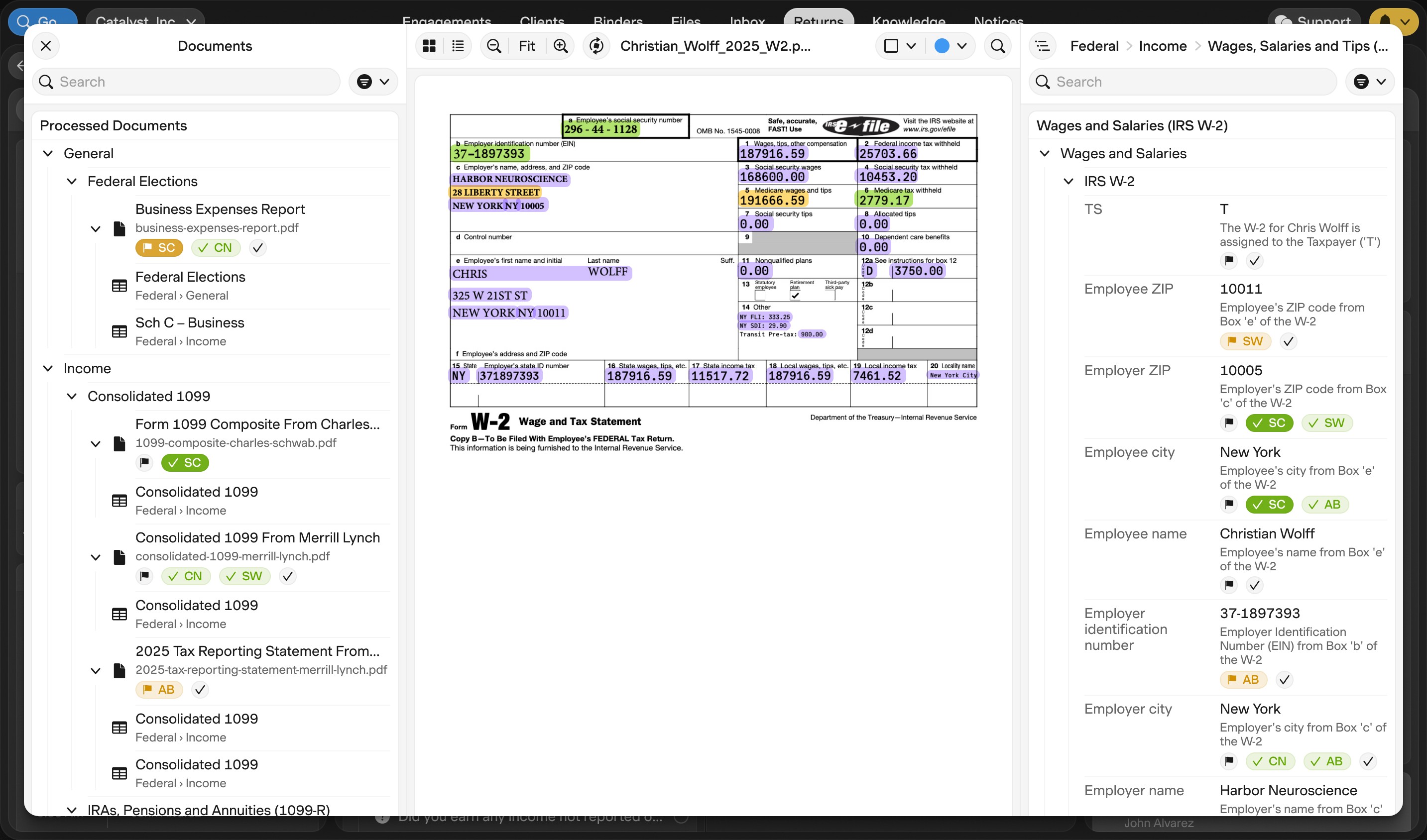
Accrual's own account of its early pilot describes an instructive failure. Accuracy fell short when the agent did not have the context a human preparer would normally receive: emails, client notes, previous workpapers and conversations. Roughly a quarter of the files needed for a return, the company says, are not tax documents at all. A missing note can turn a seemingly neat W-2 extraction into a bad conclusion. The company changed its approach to work from the full client record, including correspondence and prior-year returns, then mapped facts into structured worksheets with a trail back to each source.
That is the distinction Accrual tries to make in a crowded market. Point tools may extract a form, open a portal or move a file. A firm still has to connect those steps. Accrual wants intake, preparation, exceptions, review and delivery to live in one place while the tax engine remains the system of record for the filed return. Its API lets firms export records and connect their own systems; Accrual says access is included for every customer.
The deployment was an accounting project
Armanino gives the clearest public view of what happened when the product met a real tax season. The firm had used SurePrep, TaxCaddy and K1X across intake, extraction and reconciliation. Document sorting alone could consume 20% to 50% of a project's hours, according to Accrual's case study. Some broker statements arrived as locked PDFs hundreds of pages long. Client organizers had low completion, and portal use was sparse. The unglamorous problem was not that the firm lacked clever software. It had too many handoffs.
For the 2026 season, Armanino rolled Accrual out across six offices. The published account reports thousands of individual returns, hundreds of daily practitioner users during peak weeks and work spanning 43 states. A median draft took 15 minutes. On some complex returns, practitioners reported up to 60% fewer preparation hours. The client portal drew a reported 74% acceptance rate. These are company-published case-study figures, not a controlled comparison, but the operational detail behind them is more useful than the percentages alone.
Armanino figures reported in Accrual's May 2026 case study.
Four to six weeks before the rush, teams reconciled client data, checked email addresses, mapped tax-software profiles and configured permissions. The rollout used in-person training and local office champions. Accrual's implementation guide says Armanino and Creative Planning began with 20% to 33% of their practices, then expanded. It recommends choosing moderate-complexity work first, assigning four or five champions per office and measuring what happens to the billable workflow. This is what another firm can copy: choose a bounded set of real clients, clean the records, make participation explicit, and give practitioners someone nearby who can solve the Tuesday-afternoon problem.
“Before using Accrual, review meant checking fields line by line. Now I start with the agent's preparer notes and work through the items flagged for judgment.”Josh Karls / Tax manager, Armanino
It is also where the limits show. A firm that cannot reconcile its client data or persuade staff to use a shared process will not get the same result from the same software. A return missing crucial emails or prior-year decisions needs a person to resolve the gap. The agent can make the question visible; it cannot supply facts no one gave it. Professional responsibility stays with the signer.
April is only one month
Accrual launched publicly in February 2026 with $75 million raised across two rounds led by General Catalyst. The disclosed backing is substantial; its public list price is absent. Accrual says the tax product is priced per return, so a firm pays against a unit of work rather than a practitioner's hours. That tells us how the bill is shaped, not what any customer actually pays. API access, the company says, carries no separate fee.
In September, the company announced an agreement to acquire Puzzle's accounting-firm technology and business. Puzzle had built an AI-native ledger and month-end close tools; its direct product for startups and small businesses is slated to continue independently. The announced deal was subject to closing conditions. Accrual already has client accounting services in early access, and says the acquired technology would speed its move into monthly work.
This is a logical, perhaps inevitable, extension. A tax return is a snapshot made from records collected throughout the year. The month-end close creates and checks many of those records. An audit asks for evidence behind them. Advisory work asks what they mean. If every engagement starts by rebuilding the same client history, the firm's expensive knowledge is trapped in folders. Accrual's thesis is that source material, firm methodology and review decisions should travel with the work.
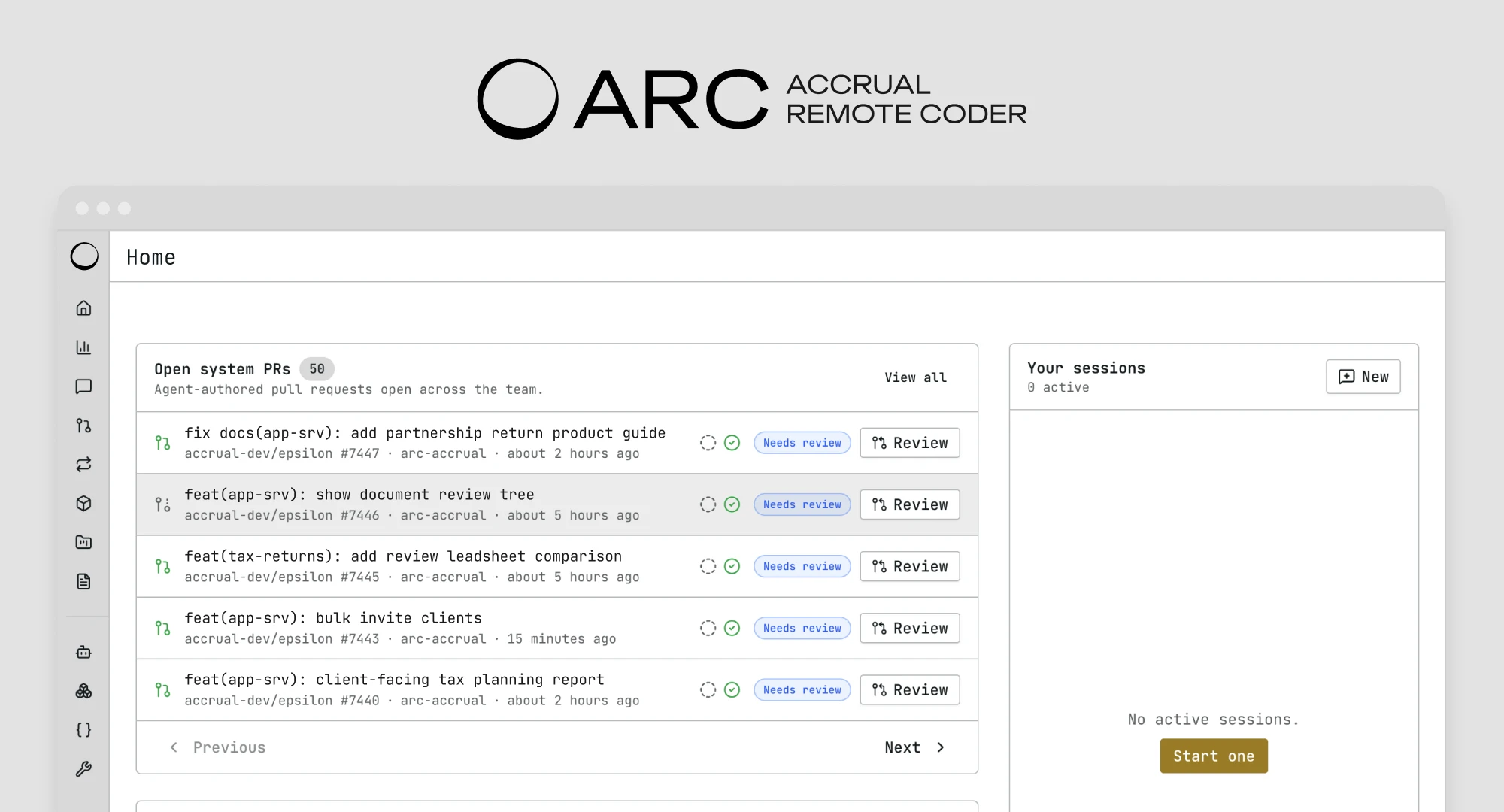
Its newer Arc product addresses the odd jobs that do not fit a standard tax workflow: reconciliations, investigations, reports and client follow-ups across connected systems. The company describes a process in which a practitioner assigns a job, approves the plan and reviews the artifact. It is a product claim with a sensible boundary: an agent can draft a workpaper, but it does not sign an opinion or know a client the way a partner does.
The advantage is a better question
A striking tax-return demo can make the profession look like a form-filling contest. The Armanino account suggests a different measure. Once the software organized evidence and drafted worksheets, reviewers could spend less time confirming each number and more time asking whether the tax treatment made sense. Even the portal mattered: getting clients to send the right material through one channel reduced the chase before preparation began.
That makes Accrual's position easier to understand. It competes with the familiar stack of portals, extraction tools and tax-workflow software, and with newer AI accounting products. Its wager is that the lasting value lies in connecting evidence to decisions across the whole firm. For now, the clearest proof is in tax. The test ahead is whether a system built under April's pressure can be just as useful on an ordinary Wednesday in November.