The world’s most expensive television show can be stopped by a cell in a spreadsheet. The cell might say that the French-language streaming rights expired last Tuesday, or that a performer receives a different cut after an advance recoups, or that a distributor owns Latin America except Brazil. Someone has to know which sentence wins. Rightsline makes the software that tries to answer before a sales executive promises the same thing twice.
It is a deeply uncinematic job. Rightsline stores contracts, assets and deal terms; calculates availability across territories, languages, formats and time windows; applies royalty rules; issues statements; feeds accounting systems; and keeps an audit trail. In plain English, it tells an IP business three things: what do we own, where can we sell it, and who gets paid?
That proposition has grown well beyond Hollywood. Rightsline says more than 300 organizations across eight verticals use its platform, including publicly named customers Amazon MGM Studios, BBC Studios, Spotify, FIFA, Merck, Electronic Arts and Hallmark. It manages more than 150 million IP assets across 28 countries and processes over $40 billion in royalties a year. In May 2026, software investor Hg led a $500 million strategic growth investment. Boring questions, it turns out, can make large businesses.
The spreadsheet fails at the exceptions
A spreadsheet is excellent at adding numbers. Rights are not really numbers. They are a moving set of permissions: who licensed what, for which platform, in which territory, in which language, between which dates, with what exclusivity, subject to which holdback. Then comes the money - advances, minimum guarantees, recoupment, revenue shares, stacking clauses, taxes, currencies and participants.
The first thing to fail is usually not arithmetic but confidence. The Australian Broadcasting Corporation described difficulty producing availability reports quickly and keeping reliable data in one place. Staff had to request information held across systems and spreadsheets. Rightsline centralized advances, invoices, approvals, delivery tracking and catalog records, while notifications reduced the email relay race.
That grid is simplified to the point of comedy. A real query can include hundreds of dimensions and inherited restrictions. Rightsline’s pitch is that the answer should be calculated from structured contracts, not reconstructed from memory every time a buyer calls.
“If I get a sale & avail request, I can run it by the avail engine and have it within an hour, whereas before it would take me a majority of my day.”Kyle Ritchie, Kartoon Studios
What it actually sells
Rightsline is not one clever calculator. It is a configurable enterprise SaaS suite. Rights Management is the system of record for catalogs, contracts, rights-in, rights-out, deal workflows and availability. Royalties Management turns contract language into calculation rules and statements. Advanced Financials handles invoicing, allocations, cash, currencies and accounting entries. APIs connect the result to ERP, CRM, document storage and analytics tools.
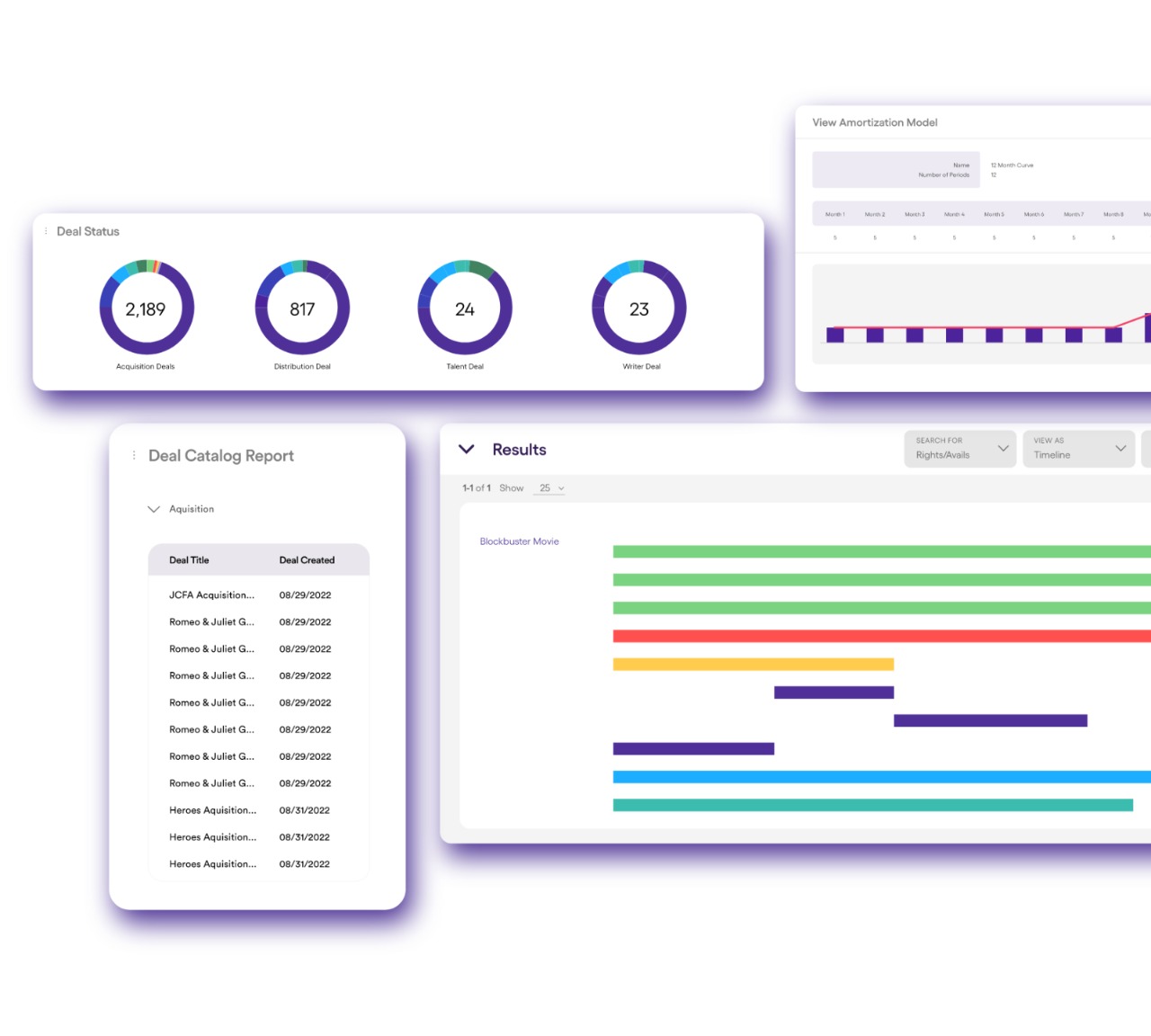
There is also a services layer. Rightsline’s managed team can interpret contracts, enter terms, digitize paper archives and operate royalty processes. That is revealing. The software’s enemy is not merely another vendor. It is unstructured history: scanned amendments, private taxonomies and years of local workarounds. A new database cannot query what nobody has encoded.
Ingest
Contracts, amendments, assets and partner data enter the system.
Model
Terms become rights, windows, obligations and calculation rules.
Operate
Teams query avails, approve deals, report sales and calculate money.
Audit
Statements, accounting entries and changes retain their history.
The build-versus-buy moment
Spotify supplies the cleanest explanation of what changes a buyer’s mind. As podcasts expanded, it needed to track deals, obligations and financial terms. The alternative was an in-house development effort. Spotify selected Rightsline, then independently expanded its initial configuration as the deals became more complicated. The same foundation now tracks music and audiobook agreements and supports units including Gimlet, Parcast and The Ringer.
The lesson is not “always buy.” It is that configurable infrastructure can beat a bespoke build when the hard part is a known domain full of recurring exceptions. The internal team keeps control of its vocabulary and workflows without owning every calculation engine, permission rule and audit feature underneath.
Kartoon Studios offers the outcome version. It wanted a cloud system to improve acquisitions, avoid contractual trouble and speed reporting. It reported production up more than 30 percent, acquisitions up 23 percent and no contractual red flags after implementation. Its acquisition deals grew from 30 to about 130. Those figures come from a vendor case study, so they are best read as a customer account, not a controlled experiment. Still, the operational mechanism is easy to understand: faster answers let a small team handle more deals.
Quote-based software, plus months of organizational archaeology
Rightsline prices by configuration, users and modules. It does not publish a list price. The company says projects generally begin within 8-12 weeks and full implementation takes about 7-9 months, depending on scope.
The larger cost is deciding which contract fields, asset hierarchies and approval rules the company will treat as truth. Software can automate a policy. It cannot settle a policy fight.
Why this is different - and where it fits
A contract-lifecycle tool stores and routes agreements. An ERP records financial events. A royalty point solution calculates payments. Rightsline’s differentiator is the connective tissue: granular rights and availability sit beside royalty calculations and accounting workflows in one configurable model. A sales deal can change an availability; a contract term can trigger an invoice; a royalty statement can roll into a ledger.
That puts Rightsline in a specialist layer between content operations, legal systems and finance. Competitors include dedicated vendors such as FADEL, Vistex, MetaComet, Counterpoint and Curve, along with custom databases and broad enterprise platforms. Two former alternatives, FilmTrack and RSG Media, became part of Rightsline in 2024. FilmTrack brought nearly 200 entertainment customers; RSG added analytics, finance capabilities and engineering depth. The roll-up made the product family broader, but integration quality - not acquisition count - will decide whether customers feel one platform or three.
The AI strategy follows the same logic. Rightsline now extracts deal terms from contracts, compares agreements, answers natural-language questions over a rights library and assists with availability validation. It says contract ingestion can reduce setup time by as much as 95 percent. The useful advantage is not a generic chatbot. It is access to structured contracts, calculation histories and domain rules. If those are wrong, the answer arrives faster and is still wrong.
What operators can copy
First, find the expensive question people answer repeatedly. Rightsline did not sell “digital transformation.” It sold a faster, defensible answer to “can we license this?” Second, model the exception, not the happy path. Generic tools look fine until a contract introduces one odd territory carve-out or a royalty rate changes after recoupment. The exception is where specialist software earns its keep.
Third, join the workflow before decorating it with AI. Rightsline spent years becoming the system of record and calculation layer. Natural-language search matters because it sits on top of operational data. Finally, let customers configure the last mile. Spotify could extend its setup; customer reviewers repeatedly mention changing fields, templates and categories without waiting for a developer.
Complexity repeats
- Hundreds or thousands of agreements share patterns
- Several teams need the same answer
- Errors create revenue leakage or compliance risk
- The company can fund data migration and ownership
The system is heavier than the problem
- A creator only wants to chase one missing payment
- Contracts are few and rarely reused
- No team owns data quality after launch
- Leadership expects software to resolve policy disputes
That last condition matters. Rightsline is enterprise infrastructure, not a royalty-recovery service or a copyright bot for individual creators. A small catalog with simple agreements may be better served by accounting software and disciplined files. The platform makes sense when the cost of uncertainty is larger than the cost of implementation.
The next act is outside the studio
Rightsline began with media, where licensing complexity is obvious enough to have opening credits. The company now aims the same machinery at publishing, consumer brands, gaming, technology, franchising and life sciences. The nouns change - characters become patents, episodes become products - but the operational question is familiar: what may this organization do with an asset, under which obligations, and how does money move?
Hg’s investment is meant to accelerate that expansion and a new generation of AI products. It follows what Rightsline called record bookings, revenue and retention in 2025 and another record quarter in early 2026. The bet is that intellectual property is becoming more fragmented, global and measurable at the same time. More licensing opportunities create more contract combinations; more combinations create more chances to promise the wrong thing.
Rightsline’s job is to make that danger feel like a query instead of a séance. The product will never be as famous as the shows, songs, games and brands running through it. That is probably the point. Infrastructure is most convincing when the spreadsheet stops being the main character.