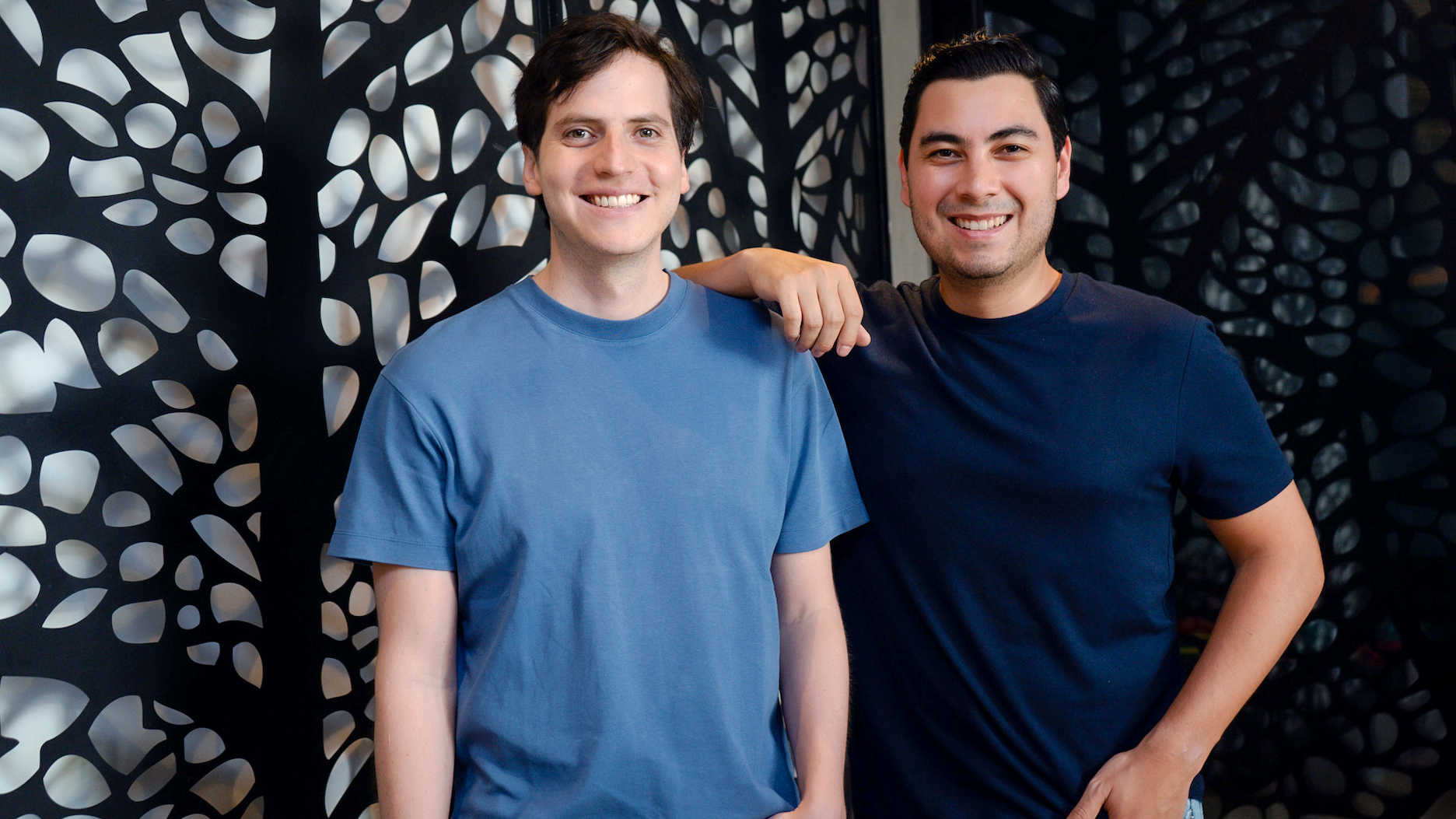
Alejandro Casas Caro (right) and Santiago Gomez, co-founders of Simetrik. Photo: The Org / Simetrik.
Fintech Infrastructure • Bogotá, Colombia • Y Combinator W18
He started with a fashion startup that got into Y Combinator and flopped at Demo Day. He ended up building the reconciliation infrastructure that Rappi, Nubank, and Mercado Libre run on - and raised $116M along the way.
In early 2018, Alejandro Casas Caro stood on a Y Combinator Demo Day stage in San Francisco and pitched Ropeo - an on-demand fashion delivery startup for Latin America. He had grown it from $5,000 to $30,000 in monthly recurring revenue during the accelerator. He finished his pitch. And then: silence.
No investors approached. No term sheets followed. For most founders, that's the story. For Casas Caro, it was the opening chapter. He took the silence as data.
Back in Bogotá, he started talking to the companies he actually knew - the ones scaling fast, processing millions of transactions, drowning in spreadsheets. Rappi, at the time one of Latin America's fastest-growing super-apps, had a problem: reconciling financial data across hundreds of integrations, payment providers, and geographies was a manual nightmare. Casas Caro didn't pitch them a product. He spent three months inside Rappi's data infrastructure, manually mapping more than 250 data points, understanding the problem from the inside out.
The Rappi founders were convinced enough to write a $2 million pre-seed check. Simetrik was born.
Before writing a line of Simetrik code, Casas Caro spent three months manually mapping Rappi's data. Not interviewing. Not surveying. Mapping. 250+ data points, by hand. That customer obsession is baked into the company's DNA.
There is an explosion of fintechs and fintech products. They have more reports and larger volumes of records, yet are still using manual processes. They need a new approach, and that is where our building blocks have a strong product-market fit.
- Alejandro Casas Caro, CEO, SimetrikEvery time money moves - a payment is made, a fee is charged, a transaction is recorded - someone has to verify that the numbers on one side match the numbers on the other. At scale, this is a different kind of problem. Rappi processes millions of transactions a day. Nubank serves 100 million customers. Reconciling all of that manually means armies of analysts, months of lag, and an unacceptable error rate.
Simetrik's bet is that financial reconciliation is fundamentally a data infrastructure problem dressed up in accounting clothes. Casas Caro, who studied UX design in Barcelona and cut his teeth as a software developer, built a no-code platform that lets finance teams connect any data source, define matching logic, and get real-time visibility into discrepancies - without writing code.
The platform now processes more than 1 billion records daily. It's used by companies across financial services, e-commerce, retail, and logistics. Customers like Mercado Libre, Nubank, PayU, and Bold use it not just for transaction matching but for financial close automation, regulatory compliance, and cash flow management.
What Casas Caro understood early - and what Goldman Sachs validated with two consecutive lead investments - is that the CFO tech stack was a decade behind the developer tools market. The same sophistication that engineers took for granted (automated testing, real-time monitoring, CI/CD pipelines) barely existed for finance teams. Simetrik is filling that gap, one reconciliation workflow at a time.
Up from $10M ARR in 2022
Headquartered in Bogotá
At time of Series A
Goldman Sachs's continued support validates the global demand for a purpose-built AI reconciliation platform. We'll scale our U.S. presence and deliver even faster time-to-value, helping finance teams cut waste, act immediately on discrepancies, and turn reconciled data into a strategic advantage.
- Alejandro Casas Caro, on the 2025 Series B extensionBefore fintech, before Y Combinator, Casas Caro spent time in Barcelona studying user experience and interactive design at IED - one of Europe's leading design schools. The instinct to understand users before building persists throughout his career: it's why he spent three months inside Rappi's data infrastructure before writing Simetrik's first line of code.
The technical and the human are not in conflict for him. The design training that might seem like an unusual detour for a fintech CEO shows up in Simetrik's product approach: a no-code platform for finance teams who are powerful in Excel but not in SQL. Casas Caro has consistently built toward the person who actually uses the software, not the engineer who integrates it.
He is a Colombian founder who got into one of Silicon Valley's most prestigious accelerators, struggled through the hardest public test of an early startup, and pivoted without drama into a company that Goldman Sachs has now bet on twice. In Latin American startup circles, the phrase "El Pivote del Siglo" - The Pivot of the Century - is used partly as a joke and partly as a genuine tribute.
The pivot from Ropeo to Simetrik was not a random restart. It was a migration from a product no one was willing to pay for to a problem nobody had solved elegantly at scale. From consumer to enterprise. From fashion to finance. From B2C to the infrastructure layer beneath the infrastructure layer.
With Simetrik now processing 1 billion records daily across 40+ countries and a U.S. expansion underway, the ambition is no longer regional. The benchmark Casas Caro cites is not other Colombian startups but the gap between what finance teams need and what enterprise software currently offers them. That gap, in his reading, is global.
Raised over $116M in total funding, with Goldman Sachs leading two consecutive rounds - a rare pattern for a Latin American startup.
Simetrik processes 1+ billion financial records daily across enterprise customers in 40+ countries.
Built Simetrik to $52.5M annual recurring revenue with 350+ employees as of 2024 - a 5x+ growth from $10M ARR in 2022.
Closed Rappi, Nubank, Mercado Libre, and PayU as customers - the defining companies of Latin American fintech and e-commerce.
Named to StartupBeat's 15 Fintech Founders To Watch (2023). Simetrik listed among top Colombian startups by investment (KPMG 2025).
Y Combinator Winter 2018 alumnus. Turned a failed Demo Day into the pivot that built a 9-figure company.
He earned two master's degrees in design at a European art school. He used the thinking to build fintech infrastructure trusted by Nubank and Rappi.
Simetrik's first customer was also its first investor: Rappi, the Latin American super-app. The check and the deal arrived from the same conversation.
1 billion records per day is approximately 11,574 records per second. Simetrik's infrastructure handles that continuously, across 40+ countries.
The Latin American startup press nicknamed his company pivot "El Pivote del Siglo" - The Pivot of the Century - from fashion e-commerce to fintech infrastructure.
Goldman Sachs has now led two of Simetrik's funding rounds. Traditional finance institutions rarely back the same early-stage company twice.