Early SaaSOptics prospects could admire a report without buying the software that made it. In a 2024 interview, co-founder Clayton Whitfield recalled the objection: they needed the report about four times a year, and already had someone who could produce it in a spreadsheet. It was a perfectly sensible refusal. A useful product had arrived at an inconvenient frequency.
- Maxio connects SaaS quoting, billing, collections, revenue recognition, and reporting.
- Its ancestry combines Chargify’s billing expertise with SaaSOptics’ finance tools.
- The lesson travels beyond finance: own a recurring task before selling the view from above.
Then SaaSOptics added invoicing. Finance teams handled invoices every day. Whitfield says that change altered the business’s trajectory. The report remained useful; the software now had a reason to be opened between board meetings.
“people get engaged intellectually in strategic stuff, but they write checks for operational stuff”
Clayton Whitfield · SaaSOptics co-founder
That distinction explains much of Maxio, the company SaaSOptics eventually helped create. The attractive part of finance software is the picture of the business. The indispensable part is the work that makes the picture trustworthy. A handsome chart has limited charm when somebody has billed the wrong customer.
Two halves of the same mess
Maxio’s two predecessors approached the problem from different directions. Chargify, founded in 2009, developed expertise in subscription billing, including usage and event-based charges. SaaSOptics concentrated on revenue recognition and the metrics that subscription businesses need. Battery Ventures led more than $150 million in combined growth investment in the pair in April 2021. The Maxio name was unveiled in April 2022.
The combination makes commercial sense. Billing asks what a customer owes and when. Revenue recognition asks how a contract’s revenue should appear in the accounts over time. Reporting asks what those transactions reveal about retention, expansion, and the health of the business. These questions are related, but their answers are not interchangeable.
Consider an illustrative annual software contract paid upfront. Cash can arrive before the service has been fully delivered. A finance team still needs an appropriate revenue schedule. Add an upgrade halfway through the term, a negotiated discount, and usage overages, and the simple annual sale becomes several connected records. The spreadsheet has acquired responsibilities nobody mentioned when they created it.
The deal has to survive the journey
Maxio sits between commercial systems and the general ledger. Its customers are B2B SaaS, AI, and subscription businesses; its users include finance professionals, revenue operations teams, and people responsible for monetizing products. The company currently reports more than 2,000 customers. Their shared difficulty is keeping a changing commercial promise legible across departments.
In practice, the platform handles recurring subscriptions, usage charges, invoices, collections, revenue schedules, and SaaS metrics. It connects with systems such as Salesforce, HubSpot, QuickBooks, Xero, NetSuite, and Sage Intacct. A company can also connect payment gateways. Maxio’s job is to carry the subscription detail through that stack with fewer manual translations.
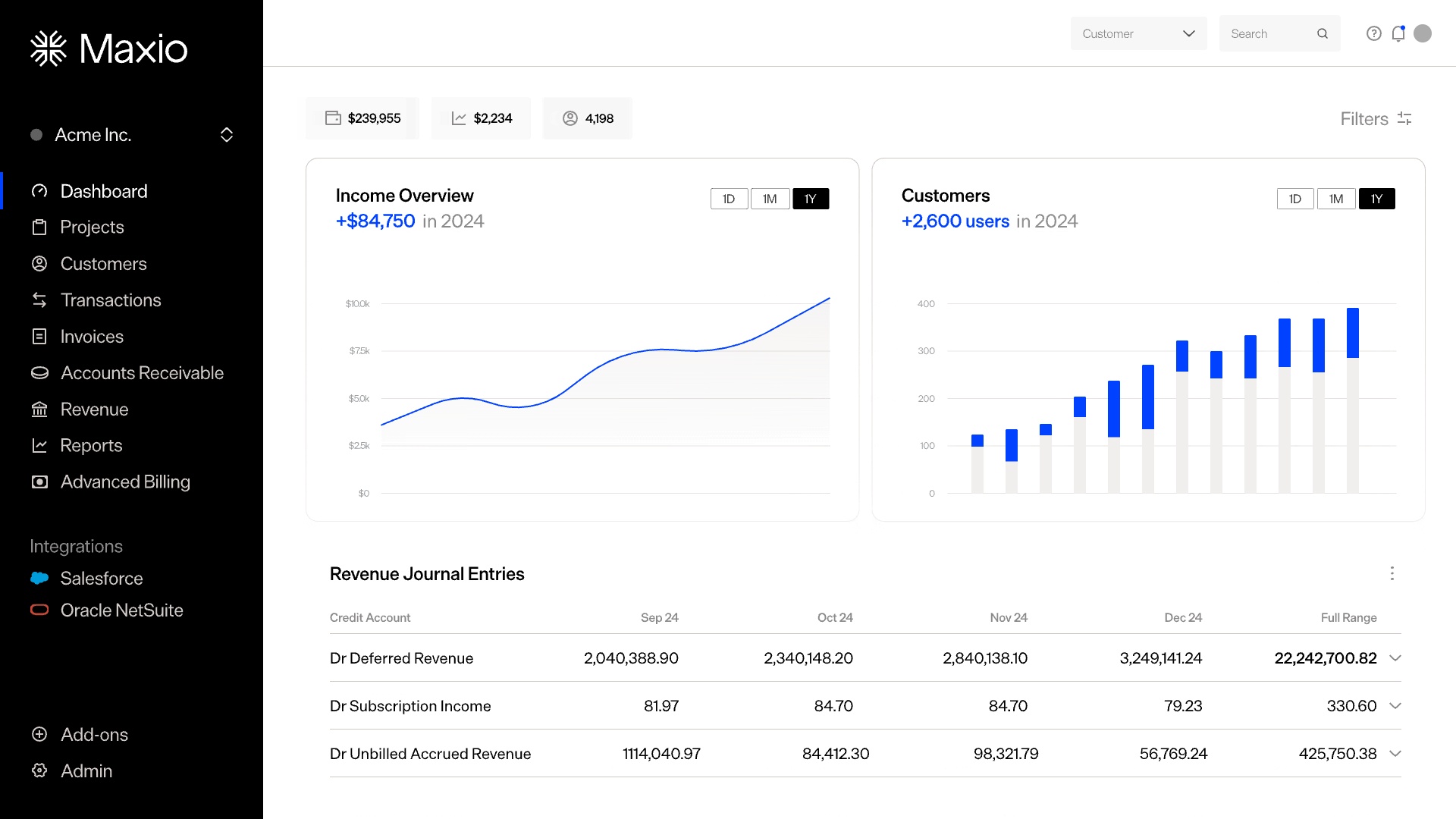
The company extended that responsibility upstream in March 2025 by acquiring RevOps.io. Maxio CPQ launched that July. CPQ stands for configure, price, quote: software for constructing deals with approved terms, pricing rules, and approval workflows. It addresses the moment before finance inherits the agreement.
Retool’s published customer account makes the case unusually tangible. Its Head of Revenue Operations, Jonathan Krangel, reported issues in about half of one set of SMB agreements. Following CPQ implementation, he found one issue in more than 150 deals. Maxio presents this as a 99% reduction in contract errors. It is a customer-reported result, with a specific process behind it: guardrails, approvals, and structured deal data.
The inference is useful even outside Maxio. If salespeople can freely improvise the document that finance must later interpret, the invoice problem starts before the invoice exists. Improving that handoff means agreeing on the record while the deal is being made.
- 01QuoteAgree the terms
- 02BillApply the price
- 03CollectReceive the cash
- 04RecognizeSchedule revenue
- 05ReportExplain the business
Two days, with an asterisk worth keeping
Stackline, an ecommerce intelligence company, describes a deliberate implementation sequence. It established Maxio’s subscription and revenue records first, configured and reconciled the contract data, then layered on NetSuite and Salesforce. That order matters. Connecting three systems is less helpful if the underlying contracts disagree.
In Maxio’s customer story, Stackline reports cutting its revenue close from one to two weeks to two days. The complete financial package takes seven days. Those are different measures, and retaining the distinction makes the result more credible. The team also says it kept headcount flat through substantial growth.
Bars illustrate the two-week endpoint versus two days. The full financial package takes seven days. Customer-reported; Maxio and NetSuite used together.
NinjaCat provides a less dramatic but wonderfully concrete comparison. It consolidated five financial systems into Maxio and one spreadsheet. Combining billing, reporting, and payments saved multiple days a month in reconciliation, according to its finance director. The spreadsheet survived. Sensible automation can tolerate a survivor.
These accounts show where value may appear: fewer repeated entries, less reconciliation, and a faster route to usable information. They are vendor-published customer stories, not controlled experiments. Stackline also changed its wider systems, so attributing every saved day to one product would turn a useful example into advertising.
The price of a handoff
As of September 30, 2026, Maxio’s pricing page lists Grow at $599 per month for businesses with up to $100,000 in monthly billings. Above that volume, Scale requires a quote. Twelve monthly payments at the listed Grow rate total $7,188, before any separately quoted services, modules, or processing costs. The proposal needs to establish the actual scope.
The relevant comparison is the current workflow’s cost. Count the hours spent entering contract changes, fixing invoices, matching payments, and reconstructing revenue schedules. Include the implementation effort on the other side of the purchase. Software can remove repeated work after a migration; the migration still requires somebody to understand the records.
Maxio competes in subscription billing and revenue operations alongside alternatives including Chargebee, Zuora, Stripe Billing, and Ordway. Its distinguishing proposition is the combination of billing flexibility and finance depth inherited from its predecessors, now extended into quoting. That is a positioning argument rather than proof that it fits every buyer better.
A small company with a simple recurring charge may have little reason to adopt this much machinery. A team with negotiated contracts, multiple pricing models, and demanding revenue reporting has more to evaluate. Ask a vendor to run your awkward examples: a mid-term upgrade, an expired credit grant, a late payment, a disputed invoice. The easy subscription will behave beautifully in almost any demonstration.
Now the customer buys tokens
AI products add another wrinkle: customers may buy a balance of credits, consume tokens, or pay for usage alongside a fixed subscription. The platform must distinguish the quantity sold, the access granted, and the amount remaining. Otherwise the customer and the finance team can tell entirely different stories about the same purchase.
Maxio’s current product expansion addresses those records. Metering captures consumption. Entitlements define access rights, usage allowances, and service commitments. Wallets track prepaid balances in credits, tokens, or dollars, with refill and expiration policies. The August 2026 product announcement declared entitlements generally available; September release notes document automatic wallet provisioning and ledger improvements.
Those release notes also expose an instructive edge case. An entitlement option had implied that existing subscribers would eventually receive a change at renewal. The September correction explains that the option creates a separate price point; original subscribers retain their existing entitlements unless moved. Even the software built to manage promises must be precise about its own.
Maxio MCP, announced in December 2025, takes a different approach to AI: it connects approved assistants to billing and revenue data through permissions, scoped tokens, and audit logging. Finance users can ask questions in natural language. That convenience depends on the financial records and access controls beneath it. A quicker answer to the wrong question remains a remarkably efficient mistake.
Copy the sequence, not the slogan
The useful lesson begins before choosing a vendor. Find the daily task that repeatedly damages the records. Agree on product names, contract terms, and the treatment of changes. Establish a reconciled subscription foundation, then connect the surrounding systems. Measure revenue close separately from the complete close, and track exceptions as carefully as speed.
Maxio’s origin offers the same advice to software founders. A quarterly report can impress a buyer while leaving the daily user’s work intact. Invoicing gave SaaSOptics a place in that work. Today, Maxio keeps expanding along the route an agreement takes through a business. The ambition is broad. The test remains pleasantly mundane: did the right customer receive the right invoice?
Follow the work
Explore Maxio, its plans, customer stories, news, and product blog.
Watch the Clayton Whitfield founder interview on YouTube or the metering, entitlements, and wallets demonstration.