The revealing detail in BillingPlatform's story is not an invoice. It is a search. DirecTV Ad Sales reportedly reviewed more than 60 billing systems while trying to replace a thicket of disparate tools. Its operation had to absorb TV and online media data, support a broad catalog of ad products, collect money, manage receivables and feed a general ledger. The old arrangement could make a new campaign feel like a civil-engineering project: two to three months and eight to 10 people.
After moving the work onto BillingPlatform, DirecTV said a campaign could be configured in a day by one person. Billing, invoicing and closing went from two weeks to less than 20 minutes. An independent Nucleus Research analysis cited annual savings between $3 million and $9 million. Those are customer-reported outcomes, not a guarantee, but they frame the category better than the usual cloud-software fog. This is not about making an invoice prettier. It is about removing the machinery that makes an invoice late, wrong, expensive or impossible to explain.
01 / The actual productA control layer for revenue
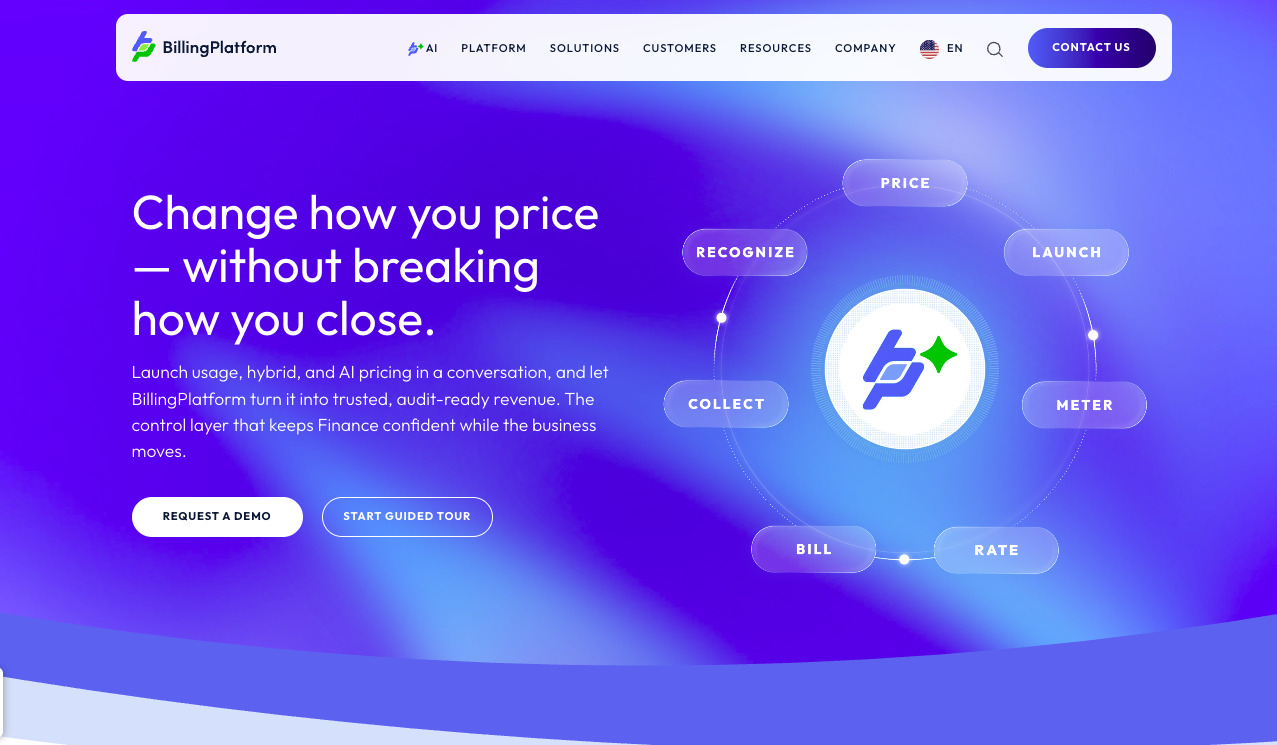
BillingPlatform sits between the systems that describe a sale and the systems that record its financial result. Upstream might be Salesforce, a product-usage stream, a contract repository or an order-management tool. Downstream might be NetSuite, Oracle, SAP, Workday, a payment processor or a tax engine. In the middle, BillingPlatform meters usage, applies rates, generates invoices, orchestrates payments, chases receivables and creates revenue-recognition entries.
The company calls this usage-to-cash or revenue lifecycle management. The phrase is clunky because the job is wide. A customer might pay a base subscription, consume credits above an allowance, earn a negotiated discount after a threshold, operate in three currencies and modify a contract halfway through the term. Finance must still produce an accurate invoice, recognize revenue under ASC 606 or IFRS 15, and show an auditor how each number got there.
BillingPlatform's architectural claim is simple: keep the lineage intact across the whole chain, on a configurable metadata model.
Its differentiator is configurability. Teams can add fields and objects, alter workflows, build document templates, model account hierarchies and change pricing logic without treating every exception as a software-development ticket. There are APIs and prebuilt connectors, but also no-code tools for operators. In a market that includes Zuora, Oracle, SAP, Salesforce, Stripe, Aria, Chargebee, Recurly and custom code, BillingPlatform is betting that breadth plus an extensible data model matters more than being the easiest tool for a basic subscription.
“We felt like we had to mold our monetization strategy and processes around the legacy provider's solution, whereas BillingPlatform was able to mold its solution around our business.”An enterprise customer quoted by BillingPlatform
02 / What broke firstThe exception queue ate the month
For customers, the first failure is usually not scale in the cinematic sense. The server does not burst into flames. Exceptions accumulate. A spreadsheet adjusts a tier that the core system cannot express. Someone reconciles payment data by hand. A newly acquired division keeps its own billing tool. Product launches a hybrid plan, but accounting still closes on a fixed schedule. Every workaround is locally reasonable and collectively absurd.
Conifer Health Services offers the cleaner example. Acquisitions left it with four billing systems across six geographically separated finance teams. Much of the work depended on spreadsheets and review, and month-end invoicing took two weeks. After implementation, the company said it automated rating and tier pricing, cut billing time by more than half and reduced the people required from nine to four. The change of mind was economic: a homegrown or fragmented system can appear cheaper until its exceptions consume payroll, delay cash and turn each new product into another manual procedure.
Other company case material points in the same direction: N-able consolidated six billing systems into one and reported more than $1 million in annual savings; Ontra reduced days sales outstanding by five days within a year; and Tipalti reported a 40 percent reduction in average close time. BillingPlatform says it now processes more than 50,000 invoices a day and over $4 billion in monthly billings for customers across software, financial services, transportation, media, healthcare and communications.
03 / Who built itEngineers first, enterprise sellers later
Nathan Shinn and Leonid Solomonik founded BillingPlatform in 2012 after long careers around high-volume information and billing systems. The early ambition, as Shinn later described it, was to do for billing what Salesforce had done for customer relationship management: turn a rigid back-office function into a configurable cloud platform. That origin still shows. Shinn remains chief strategy officer; Solomonik remains chief technology officer.


The commercial inflection came in 2017, when Columbia Capital backed the company and Dennis Wall became chief executive. A 2021 account of the period was frank: the founders realized that winning big customers required becoming a bigger company themselves. Investment went into sales, marketing, product and support. In January 2024, FTV Capital invested $90 million in growth equity, joining Columbia as a minority institutional investor. FTV said BillingPlatform had grown nearly 300 percent over the prior three years.
Leadership changed again in January 2026, when Chris Bishop became CEO. By August, BillingPlatform had added Steven Springsteel as chief financial officer, Rob Zwiebach as chief product officer and Chris King as chief customer officer. Their resumes run through Recurly, Workday, Oracle, Salesforce and Zuora - a conspicuously relevant tour of the enterprise-finance neighborhood.
04 / The money and the moatCustom quotes for custom complexity
BillingPlatform is private and does not publish standard pricing. Buyers request a demo and receive a quote shaped by modules, transaction volume, entities, integrations and implementation scope. The model is enterprise SaaS with a services ecosystem around it. More than 40 implementation, technology, payment and tax partners help deliver the work. PwC, RESPEC and Adyen were the company's 2025 partner-award winners; the broader marketplace includes Accenture, Cognizant, EY, TCS, Salesforce, NetSuite, Stripe, J.P. Morgan, Avalara and Vertex.
The partner list reveals both the moat and the cost. Billing is embedded. Replacing it touches CRM records, order capture, customer communications, payment tokens, tax rules, data pipelines and the general ledger. A platform that can connect those pieces becomes hard to remove. Yet implementation is not a weekend migration, and software does not magically repair ambiguous contracts or unreliable usage events. The bill for change includes process design, data cleanup, integration, testing, controls, training and a careful cutover.
What an operator can steal
- Draw the chain from product event to journal entry before buying software.
- Count exceptions, manual touches, close days and leakage, not just invoices.
- Model the strangest real contract during evaluation. The happy path proves little.
- Preserve traceability: every charge should explain its source, rule and accounting result.
- Give operators configuration power, then wrap it in approvals, testing and change control.
05 / The new pitchAI enters the close
BillingPlatform's product language has moved with the market: cloud billing became agile monetization, then revenue lifecycle management, and now AI-native usage-to-cash. In 2025 it launched BP Pay, the BP Copilot assistant, the RevenueIQ financial-intelligence suite, a Built on BP partner program and an offering for AI companies using consumption pricing. The company now describes a conversational layer that helps users navigate, configure, map data, investigate anomalies and ask questions of billing and revenue data.
There is logic beneath the fashionable label. AI products often charge by tokens, compute, credits, calls or outcomes. Those units vary, arrive in huge volumes and may sit beside subscriptions or commitments. The pricing problem and the accounting problem are born together. A system that can explain a recognition rule in plain language or flag a suspicious usage pattern could save real time. But an assistant is only as reliable as the event stream, contract model and permissions beneath it. Conversation does not repeal accounting.
The company's recent recognition is substantial, though much of it is announced in its own press releases: three consecutive Gartner Leader placements through 2026, six consecutive appearances on both the Inc. 5000 and Deloitte Technology Fast 500, a Forrester Leader position in 2025 and the top spot in ISG's 2025 billing buyers guide. BillingPlatform also reported more than 500 percent revenue growth over five years. It has not disclosed a valuation or audited revenue figures.
06 / The honest boundaryWhen the platform is too much
BillingPlatform makes the most sense when complexity is already expensive: many pricing models, negotiated contracts, high event volume, global entities, multiple currencies, revenue-recognition obligations and visible pain in close or collections. It also suits organizations willing to redesign the process, name data owners and govern changes. The strongest payoff comes when consolidation removes several systems or releases finance staff from repetitive work.
Usage plus subscriptions, enterprise contracts, several entities, audit requirements, heavy reconciliation and a real integration budget.
One simple monthly plan, low volume, little contract variation, a tiny finance team and no appetite for a structured implementation.
It will not work well when the real problem is upstream discipline. Missing meter events remain missing. Vague contract terms remain vague. No-code configuration without testing can merely accelerate mistakes. And for a young SaaS company with straightforward subscriptions, Stripe Billing, Chargebee, Recurly, Maxio or even a modest internal workflow may be cheaper and easier. Enterprise flexibility earns its keep only when the enterprise has something complicated worth flexing around.
That is the durable idea in BillingPlatform's story. New pricing models arrive as growth experiments and end as financial obligations. The winning system is not the one with the cleverest invoice screen. It is the one that lets a curious product team move without asking Finance to spend the next close finding out what happened.