The deal has closed. Somewhere in the paperwork is a promise: an annual fee, perhaps, plus a usage allowance, overage charges, a credit, and a date on which payment should arrive. Sales calls it a win. Finance calls it Tuesday. The contract is written in sentences; the invoice needs numbers. Between the two lies a surprisingly large software business.
Subscript lives in that interval. It helps B2B software companies turn contracts and usage data into invoices, revenue schedules, collections work and the recurring revenue charts executives use to explain the business. The attractive part is not any single chart. It is the possibility that the chart and the invoice describe the same customer, at the same moment, by the same rules.
- Subscript began as a subscription metrics product and expanded into billing, revenue recognition and accounts receivable.
- Its buyers are SaaS finance leaders facing custom contracts and hybrid pricing.
- AI can draft invoices from contracts; a person approves them before they go out.
- Its most common published annual price is $24,000, with a small onboarding fee.
- Customers describe time saved, including 20 hours a week at Zuub and ten days of billing preparation at EliseAI.
The spreadsheet survived the growth spurt
Founder Sidharth Kakkar had seen the problem before he sold a solution to it. At Freckle, the education technology company he previously built, annual recurring revenue reached $40 million. Yet the team still spent hours cleaning and reconciling subscription data. Michelle Lee, his early business operations hire there and later Subscript co-founder, knew the routine. A board question about a cohort or a product line could send people back through CSV exports and revised spreadsheets.
In 2023, the young company described itself as a subscription intelligence platform. It pulled information from CRMs, accounting ledgers and billing tools to produce waterfalls, cohort reports and metrics such as ARR, lifetime value and retention. It reported 18 early customers whose combined businesses represented more than $100 million in ARR. Those figures belonged to its customers, not to Subscript itself; the distinction is worth keeping in view.
But reporting is downstream of the sale. If a contract carries a special billing term that never enters the billing system correctly, no elegant dashboard can repair the story. Subscript's product expanded toward the source of the numbers: the customer agreement, the usage event and the invoice schedule. The first failure was the spreadsheet. The deeper cause was that each system held a different version of the deal.
One deal, several financial consequences. Diagram based on Subscript's product workflow.
Every exception has an invoice
The product now covers recurring subscriptions, usage pricing, annual contracts, multi-year deals with step-ups, milestone billing and combinations of these. It integrates with systems including Salesforce, HubSpot, QuickBooks Online, NetSuite, Xero and Stripe. Finance can use those connections to bring deal information in, calculate billing and revenue, send invoices and update payment status. Its analytics product then presents ARR, retention and cohorts from the same operating data.
Subscript's AI feature, introduced in 2024, reads a sales contract and prepares invoices from its terms. The company says no AI-prepared invoice goes out without a person's approval. That small brake matters. A contract is a legal and commercial record, and a plausible-looking invoice can still be wrong. Subscript also offers dunning and AI-assisted follow-up for late payments; both sit at the far end of the same chain that began with a signature.
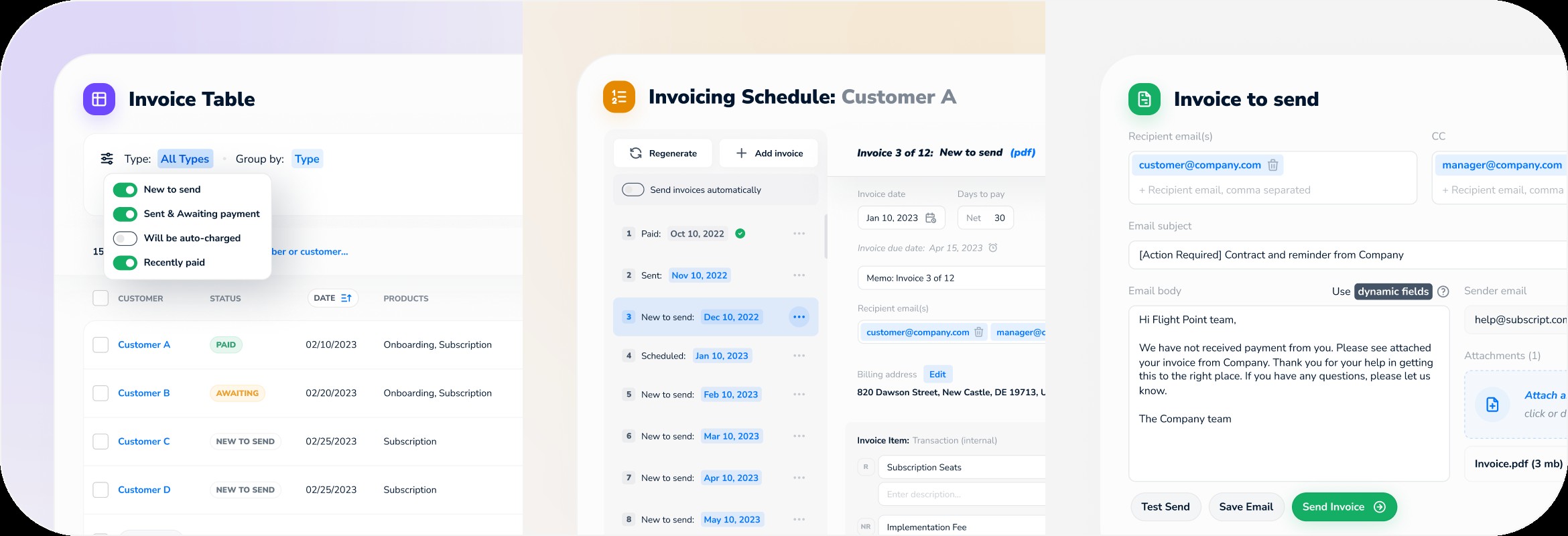
This is where Subscript positions itself against spreadsheets, homegrown tools and platforms such as Maxio, Chargebee, Zuora and Tabs. Its particular argument is that custom B2B contracts should not force a finance team to keep billing, accounting and metrics in separate worlds. The competitors have their own capabilities; Subscript's case is strongest where deals contain enough exceptions to make a standard recurring invoice a small fiction.
What a saved week is worth
EliseAI is a vivid example. Its controller described preparing invoices by moving thousands of transaction lines through Salesforce, QuickBooks Online and spreadsheets. Volume could run from 4,000 invoices in a month to 15,000 at peak. After adopting Subscript, the controller said the company could get billing out on the second day of the month instead of the twelfth. That is ten days earlier for money to begin its journey back.
Zuub presents the other kind of difficulty: monthly and annual subscriptions layered over tiered usage. It became Subscript's first customer to roll out prepaid usage billing, working with the vendor on the feature. Zuub's finance leader reported 20 hours a week saved across billing and revenue recognition. Graylog's story begins with a previous billing system that its team said remained incompletely implemented after two and a half years. Its controller later reported six to ten hours a month saved on invoices and another four to eight on revenue recognition. These are customer accounts published by Subscript, not independent time studies. They are specific enough, however, to show the job buyers are hiring it to do.
The copyable lesson is operational before it is technological: map a deal from signature to cash and ask where the same term is retyped. Check how usage is measured, who decides whether a charge recurs, when revenue is recognized and how a customer amendment changes the figures in the board deck. Then test software against a difficult real contract, not a clean demonstration account. Subscript's best customer stories begin with precisely those awkward cases.
The price of fewer reconciliations
Subscript sells annual software subscriptions tailored to each customer. Its public pricing page is unusually candid by enterprise software standards: Analytics plus Billing starts at a current minimum of $15,000 a year, lists $24,000 as the most common price, and reaches $150,000 at the high end. There is also a small onboarding fee. The exact quote depends on the business. The company says its fees are not tied solely to a customer's ARR, so a customer's growth need not automatically double the software bill.
Tailored quotes and a small onboarding fee apply. These are Subscript's published guideposts, not a universal price list.
The economic test is plain: does the cost of the software and implementation beat the hours spent reconciling, the risk of a wrong invoice, and the delay between earning and collecting cash? A tiny SaaS company with five simple, identical contracts may have little reason to buy this much system. A multi-product company with negotiated usage terms, multiple billing cadences and a hard monthly close has a different arithmetic problem.
Investors have paid attention. Pelion Venture Partners led a $15 million Series A announced in February 2025. Subscript said the round brought total funding to $21 million, with earlier backing from First Round Capital, Kapor Capital, Forum Ventures and Fresco Capital. Funding is evidence of a bet, not proof of a solved market. The more revealing signals remain the customer workflows: whether the next unusual contract can be billed correctly without opening another workbook.

The company itself has an unusual operating rule. Its team says it works fully asynchronously across 20 countries, with no internal meetings. For a seller of finance infrastructure, that is an amusing symmetry: it tries to remove the meetings caused by missing context inside customers' businesses, while removing meetings from its own. Whether the habit scales indefinitely is an open question. For now, it gives a clear sense of the company's taste for systems that remember what people would otherwise have to repeat.
The invoice is easy to underestimate because it arrives at the end. In a SaaS company, it is the place where a sales promise, product usage, accounting policy and customer relationship meet. Subscript's business rests on one sober observation: if those four disagree, the dashboard's beautiful curve is merely well-dressed confusion. Getting the invoice right is less glamorous than announcing a new pricing model. It may be what makes the model real.