At American Polyclinic in Dar es Salaam, the electricity problem had already been solved, in a manner of speaking. There were two diesel generators. When the grid let the clinic down, the generators could step in. The trouble was the bill, the maintenance, and the business of managing another machine while trying to care for patients. Buying backup had created another job.
ZOLA’s account of the clinic describes a different arrangement: a 10kVA EDGE system combining solar, storage and energy management. It reports $300 a month saved on generator fuel and a 30% reduction in maintenance and fuel expenses. Those are company-reported results from one installation. Still, they make an unusually concrete introduction to a business whose current name contains the word “intelligence.”
- The buyer: energy providers and integrators serving homes and businesses.
- The offer: connected hardware, remote control, AI tools and operating support.
- The bet: reliable electricity depends on making the provider’s business work.
The generator was already there
ZOLA iNTELLIGENCE, or ZOLAi, works on the complications surrounding the kilowatt-hour. Its customers need to sell systems, arrange payments, install equipment and diagnose faults across dispersed territories. Electricity reaches the household at the end of that chain. A weak link anywhere along it becomes the household’s problem.
The clinic example matters because it changes the question. Having an electricity source is only part of the task. Coordinating sources, paying for them and keeping them available can become a substantial operation. ZOLA sells technology to the businesses taking on that operation. The end user may want a working refrigerator; the provider needs an entire service business to deliver it.
Generator-fuel savings reported in ZOLA’s American Polyclinic case study. Installation cost and payback are separate questions.
One product met a thousand different lives
The history begins before the present company identity. Off Grid Electric, founded in 2011 by Erica Mackey, Xavier Helgesen and Joshua Pierce, initially supplied solar home solutions in Tanzania. It became ZOLA Electric. The company dates ZOLAi’s founding under Bill Lenihan to 2023, then publicly introduced the ZOLA Intelligence evolution in 2025.
Along the way, the customer’s ambitions grew. Lights and phone charging were one problem. Televisions were another. Urban households and businesses wanted more power, different appliances and equipment that could coexist with an unreliable grid. A product designed around one rung of consumption could not cover the whole ladder.
That was the early assumption that gave way: one system for a broad market. Lenihan’s explanation in a 2021 interview was practical. The range needed to connect different customer needs through modularity and control. The useful lesson for other builders is to watch what customers try to do next. An entry product can succeed while its boundaries become the next obstacle.
There was another forcing event. In a later Inspired Insider interview, Lenihan described the pandemic as accelerating the move toward a technology business. Manual coordination had become a constraint. Software and automation offered a way to support providers without reproducing every local operating task inside ZOLA itself. The platform emerged from that operational pressure.
“The world doesn’t need more back-up systems. It needs primary power, and that’s where we come in.”
Bill Lenihan / October 2021
The battery has colleagues now
The current range reflects those different jobs. FLEX is a connected solar-and-storage system for essential appliances. FLEX MAX adds solar and grid charging, a 640Wh lithium iron phosphate battery and 300W AC output. EDGE addresses larger requirements by coordinating solar, grid, generator and battery sources, with components designed for expansion and replacement in the field.
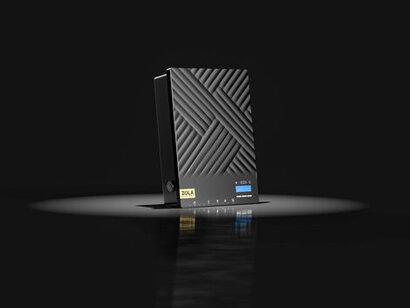
Above the equipment sits the control layer: telemetry, remote configuration and firmware updates. Above that sit tools for the humans running the network. ZOLA describes Growth, Fleet and Finance agents addressing proposals, remote diagnosis and credit assessment. Its pitch brings the sales desk, service team and financing workflow into the same conversation as the battery.
This puts ZOLAi between several familiar markets. It overlaps with energy-access businesses such as Bboxx and d.light, while also competing with a provider’s decision to assemble separate hardware, monitoring and business software. Its distinction is the combined stack and partner model. Local providers handle delivery and customer relationships; ZOLA supplies technology and support behind them.
The knowledge was in people’s heads
One revealing detail appears in ZOLA’s engineering writing. Years of operations had produced valuable information, but rotating teams did not necessarily share a coherent understanding of it. Building the Zi Assistant therefore involved constructing a knowledge base, consulting subject experts and revising documentation through feedback loops.
The assistant offered written and spoken help in users’ preferred languages. Engineers described starting with OpenAI models and Pinecone, while leaving room to switch models. Here is something another company can copy: organize operational knowledge, test it with the people who understand the equipment, and keep correcting it. Choosing a model comes inside that process.
The last mile has a balance sheet
Building the underlying business required capital. In September 2021, predecessor ZOLA Electric announced $90 million, evenly divided between equity and debt. The investors included TotalEnergies Ventures, DBL Partners, Helios and Vulcan; FMO and SunFunder supplied debt. That financing supported technology development and expansion. It is historical funding, rather than a disclosed price tag for today’s platform.
Partnerships show how the approach travels. EDF worked with Off Grid Electric in Ivory Coast. In 2023, Wetility and rugby player Tendai “The Beast” Mtawarira joined a South African collaboration around FLEX MAX. In August 2026, Google selected Zola Intelligence for its North American energy AI accelerator.
The constraints remain physical and financial. Storage must fit the load. Solar needs an adequate resource; remote management needs connectivity. Equipment still needs installation and repair, and providers need customers who can sustain payments. ZOLA’s own services include training and financing introductions because software cannot supply those conditions by itself.
The company now reports more than 500,000 installations and roughly 3 million people reached. The proposition underneath those numbers is pleasingly specific: make the work around electricity manageable, so the clinic can get back to being a clinic.