The machine at the center of Blue Pillar's story is not futuristic. It is a generator behind a hospital, a pump at an island lift station or an electric meter that has been quietly doing its job since everyone still carried a BlackBerry. These machines often work. The problem is that their data is marooned in proprietary protocols, disconnected panels and site visits. Operators can see the asset only by standing beside it, and software companies cannot optimize what they cannot read.
Blue Pillar built the translation layer. Founded in Indianapolis in 2006, the company connected mixed makes, models and vintages of industrial equipment to an edge gateway, normalized the signals and sent useful information to dashboards, alarms, reports and outside applications. Its public language called this an Energy Network of Things. The less polished description is more revealing: Blue Pillar made stubborn old machines talk.
That work led from hospital campuses and backup-power rooms into higher education, municipal water, distributed generation and energy services. Blue Pillar said it operated in more than 1,000 critical facilities and had connected more than 100,000 multi-vendor assets. In October 2022, Generac acquired the company for an undisclosed price. Today, Blue Pillar's web address lands on Generac Link Manager, a fleet-connectivity product pitched around the same core idea: one platform, every asset.
The expensive problem hiding in the equipment room
Industrial connectivity sounds abstract until someone has to drive to a wastewater station on Sunday. West Dundee, Illinois, relied on a paper chart recorder and daily rounds for some monitoring. The village's new setup, built through Waterly's WaterClick platform with Blue Pillar underneath, shared current water data with nearby authorities, helped explain billing anomalies and reduced the need for weekend checks. The reported savings exceeded $3,000 a year in labor, plus vehicle time, mileage and $150 worth of chart paper. Payback came in under six months.
On Put-in-Bay, an Ohio village in Lake Erie, the wastewater superintendent had considered connecting a critical lift station to the central SCADA system. The available choices looked complicated and expensive, so the site remained dependent on visits and information from residents. A distributor proposed Blue Pillar after exchanging a few emails and photographs. The system was installed and communicating in less than a day for under $2,400. The village added backup-generator monitoring while it was there.
The hospital case was stranger. Twelve old meters in a substation held the data needed to manage costly peak-demand charges, but the surrounding system had been abandoned for more than a decade. The meters spoke SEAbus, an obscure Siemens protocol. Replacing them would have cost about $50,000. Blue Pillar reported getting the network running in a day for $2,500, with mobile consumption data, alerts, history and an API into the customer's Microsoft Azure data lake.
The product was not the dashboard. The product was the shortcut around replacement.Blue Pillar's practical advantage, in one sentence
What the company actually sold
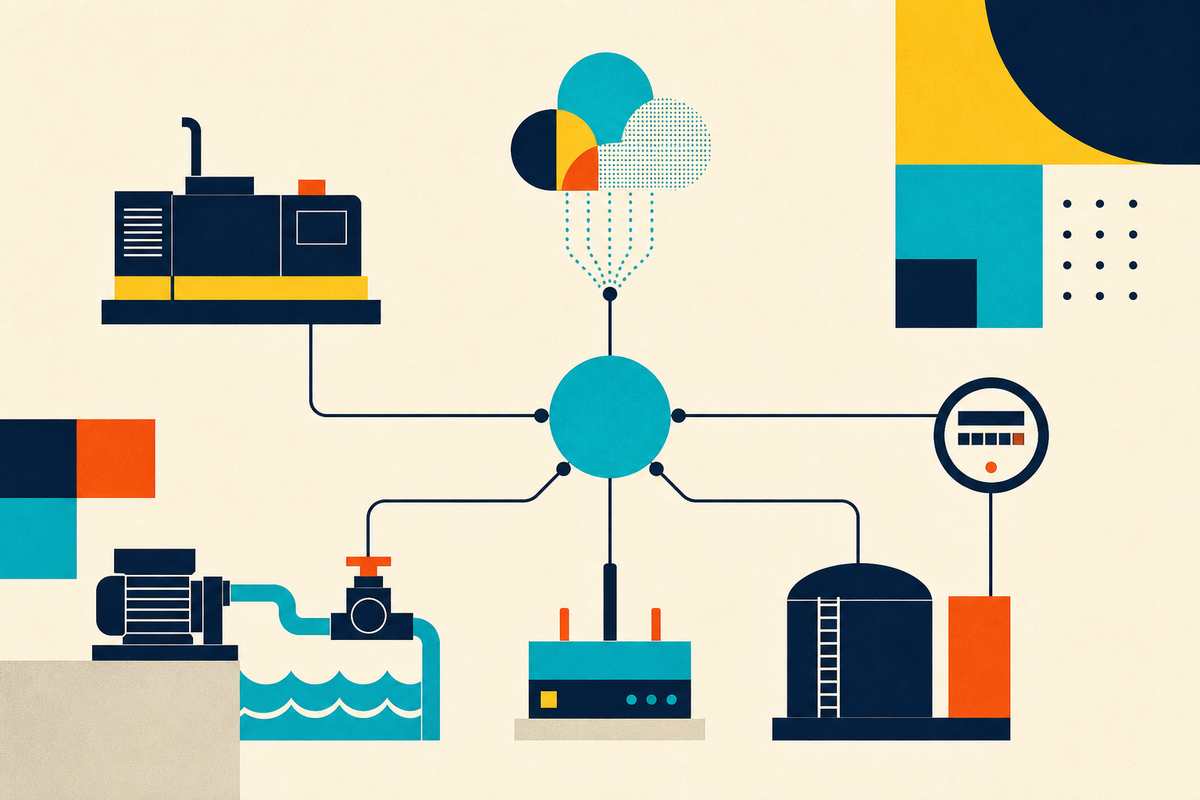
Blue Pillar's platform, historically branded Aurora, sat between physical equipment and the applications that needed its data. At the site, edge hardware communicated with generator controllers, meters, switchgear, pumps and sensors. Reusable templates handled different protocols and device types. The platform then provided remote configuration, secure communications, live visualization, trending, alarms, reports and APIs.
The company also sold deployment and managed services. That distinction matters. A conventional SaaS product can blame a bad implementation on the customer. Industrial IoT cannot. A mislabeled wire, missing protocol document or weak cellular connection becomes part of the product experience. Blue Pillar's accumulated field knowledge - which controller needs which adapter, what a plausible signal looks like, how to commission without interrupting a critical facility - was part of what customers purchased.
Its business model combined B2B software, edge hardware, integration and continuing service. Exact enterprise prices were not public, but the small municipal examples show how Blue Pillar attacked the lower end of a market often burdened by five-figure proposals. For larger customers, the value was not merely a cheaper dashboard. It was an extensible connectivity layer across a site or fleet.
One hospital's route to the same meter data
Public case-study figures. They compare the estimated sub-meter replacement with Blue Pillar's reported project fee, not standardized list prices.
The go-to-market trick: let partners own the last mile
Blue Pillar was useful to facility operators, but its more scalable customer was often another provider. Outlier Energy, for example, used the platform to connect combined-heat-and-power microgrids in Washington, DC and Utah to its own market-facing software. A previous custom developer had spent two years failing to deliver the sites. Blue Pillar said it completed the onsite work in less than a day and at a fraction of the contracted price. Outlier kept the customer relationship and market intelligence; Blue Pillar handled the awkward connectivity beneath it.
The same pattern appeared with Cleanwatts, which paired its energy-management operating system with Blue Pillar's asset layer; with distributors such as Covalen in water and wastewater; and with generator specialists DVL Group and Generator Source. This partner model placed Blue Pillar inside a solution rather than forcing it to be every solution. Its API could feed an energy trader, an ESG reporting tool, a utility program or a customer's data lake.
That position differentiated the company from three alternatives. Traditional SCADA projects offered deep control but could be costly and custom. Equipment makers offered monitoring for their own fleets but not necessarily a room full of competitors' hardware. Generic cloud platforms offered powerful building blocks but left protocol work and field commissioning to someone else. Blue Pillar's pitch was equipment agnosticism plus a repeatable deployment method.
What failed first - and what changed the buyer's mind
Across the company's strongest stories, the first failure was visibility. The pump still pumped. The meter still metered. What failed was the surrounding method: paper charts, weekend rounds, an obsolete communications network or bespoke software that never reached production. That is why Blue Pillar could enter with monitoring before asking a customer to hand over control. A reliable trend line and a useful alert were less threatening than a grand automation program.
Buyers changed their minds when the proposal stopped looking like infrastructure surgery. Photos could be enough to scope a small municipal job. Installation could take days, not seasons. A $2,500 test could stand beside a $50,000 replacement estimate. Once one asset was visible, adding a generator or another pump looked incremental rather than transformational. The modest first step created the expansion path.
“Blue Pillar made this look easy. It was so simple and affordable.”Mike Mewhorter, Put-in-Bay wastewater superintendent
The Generac logic
Generac and Blue Pillar already served overlapping commercial and industrial customers. Generac made power equipment and was expanding into storage, virtual power plants and grid services. Blue Pillar supplied the connective tissue: monitoring and control across distributed assets, including hardware Generac did not manufacture. The acquisition, completed October 3, 2022, allowed Generac to embed connectivity in its power-generation products and use it in grid-services projects.
The price was not disclosed. Blue Pillar had raised substantial outside capital: $7 million in 2012, about $14 million in 2015 and another $10 million in 2017, plus other financing. Contemporary reporting put total investment around $34 million after the 2017 round. The exit therefore reads less like an overnight windfall than the end of a 16-year apprenticeship in difficult infrastructure.
There is a strategic lesson in the buyer. A horizontal software company can struggle to own distribution in conservative industrial markets. A large equipment manufacturer already has products in the field, dealers in the market and customers who care about uptime. Blue Pillar became more useful when placed inside that channel. Generac, meanwhile, gained years of protocol coverage and deployment experience that would have been slow to reproduce.
What another builder can copy
First, look for valuable installed assets whose owners cannot justify replacing them. Second, treat onboarding as core product work: templates, adapters, remote configuration and commissioning checklists are features. Third, sell one measurable outcome before the platform vision - fewer truck rolls, an avoided demand charge or a working alarm. Fourth, give partners clean APIs and room to keep their own brand and workflow. Finally, build a library from every strange device. The tenth odd protocol is a burden; the hundredth begins to look like a moat.
Best conditions
Equipment is expensive and long-lived, downtime matters, protocols are fragmented, manual checks are common, and integrations can be reused across many sites.
Where it breaks
The case weakens when assets already have secure cloud connections, every site is uniquely engineered, connectivity is unreliable, or safety-critical control requires a full certified system.
This approach also demands patience. Hardware margins, site visits and support obligations can make growth look less elegant than pure SaaS. Security cannot be decorative when the connected object is a generator or pump. And "equipment agnostic" is an expensive promise: every supported vintage creates a testing and maintenance tail. A retrofit platform works only when reusable software and templates eventually outrun that complexity.
Blue Pillar's lasting idea is not that every machine belongs on the internet. It is that many consequential machines already exist, already work and still cannot participate in modern energy systems. Connecting them can be cheaper than replacing them, faster than commissioning a traditional project and useful long before anyone attempts autonomous control. The company's name has receded into Generac's portfolio, but the problem it chose has only become more visible: the energy transition is arriving at facilities built in several different technological centuries.