Bill Lenihan was teaching children rock, paper, scissors when the motorcycle arrived. He had come to Tanzania to look at an energy business. A car breakdown and a walk had complicated the visit. At the home he was meant to see, the electricity system was gone. It had been repossessed after a payment problem. The team checked its records and arranged a replacement. About two hours later, a technician appeared with the equipment in a backpack.
The technician installed the panel and battery, connected the television, and brought the house back to light. Children gathered. The visit stretched into the evening. Lenihan remembers watching a household become a gathering place, and deciding he wanted to join the business. Before making a career decision, he had found himself waiting for a service call. It was an unusually useful job interview.
That evening contains the question that still occupies him: how do you make electricity dependable after the equipment has arrived? A working installation requires somebody to sell it, finance it, fit it, maintain it and respond when something goes wrong. The panel gets the photograph. The service operation gets the telephone call.
Before Arusha, there was a pool
Lenihan grew up in Whittier, east of Los Angeles, with two sisters. He remembers a large public high school and a diverse place to grow up. Swimming came early. Water polo followed in high school, offering something he found more enjoyable and more oriented around a team. He took those sports to college at UCLA.
UCLA’s water polo history lists Bill Lenihan among its 1989-91 players. In the university’s later account of former athletes, his entry had acquired a different vocabulary: managing director, private equity, Wharton. A college sports record can be a wonderfully economical biography. One moment there is a team roster; a few pages later, everybody seems to have a business card.
He earned a BA, cum laude, in business and economics at UCLA, then an MBA at the University of Pennsylvania’s Wharton School, concentrating on strategic management and finance. His working life began at Credit Suisse in mergers and acquisitions. Private equity firms were among the clients. He became interested in the combination of assessing a business, valuing its risks and considering how its operations might improve.
A spreadsheet meets a Monday morning
Wharton’s alumni network helped him reach Goldman Sachs’ private equity practice. He later moved from New York to San Francisco and worked at Fremont Partners, associated with the Bechtel family’s capital. The firm’s emphasis on operating businesses appealed to him. Fremont Partners subsequently became Calera Capital. Lenihan spent nearly 15 years in private equity before making the transition to operations.
At Calera, he led investments in consumer and industrial businesses. Then came Switch Lighting, where he became executive vice president of international. An operating partner had invited him to join. The experiment had an appealing logic: experience running a business could make him a better investor if he eventually returned to investing.
He discovered that the move required an education of its own. “I learned very quickly what I didn’t know,” he recalled. Strategy still mattered, but so did organizing people, assigning targets and getting a team to execute. An investor can recognize a promising pattern across companies. A manager has to decide what happens inside one company on Monday morning.
“I learned very quickly what I didn’t know.”
Bill Lenihan, on becoming an operator
There is a particular humility in that admission. A distinguished financial résumé does not arrange an installation schedule. Knowing where a company ought to go and getting people there are separate kinds of work. His subsequent career would repeatedly bring those disciplines together: the investor’s concern with whether a model can survive, and the operator’s concern with whether it actually functions.
The trip became a decade
His first visit to Arusha was in 2014. He was helping Off Grid Electric with strategic planning and considering joining it. He saw connected combinations of batteries, solar panels and computers replacing kerosene lighting and powering phones and radios. He joined ZOLA Electric in 2015.
The early trips were frequent, at times as many as five a year. When he returned to Arusha in 2022 after the interruption to travel, he publicly credited Johnson Kiwango and the Tanzania team. His account emphasized an expanding range of customers: rural and urban, residential and commercial, with or without a grid connection. His view of the problem had grown beyond the original rural installation.
In 2016, a UN Global Climate Action Awards interview introduced him as Off Grid Electric’s president and CFO. The company used mobile payments to let customers prepay for solar electricity services. That combination of distributed equipment and financial access helps explain why a former private equity investor could find so much to occupy him in a solar business.
He became ZOLA Electric’s CEO in 2019. At the time of the announcement, the company said it served more than 200,000 homes and businesses across five African countries. Lyndon Rive became chairman, Peter Rive took an advisory role, and Xavier Helgesen became president and CTO. The reorganization put Lenihan at the center of an enterprise that had moved a considerable distance from its first market.
A ribbon in Lagos, and the bill behind it
At the opening of ZOLA’s Nigerian Experience Centre in Ikoyi, Lagos, Lenihan stood among colleagues and partners with a pair of scissors at the ribbon. The photographs have the familiar furniture of a launch: balloons, branded shirts, a ceremonial pause. Beside that ceremony was a practical partnership. Sterling Bank was working with ZOLA on financing access to its systems.
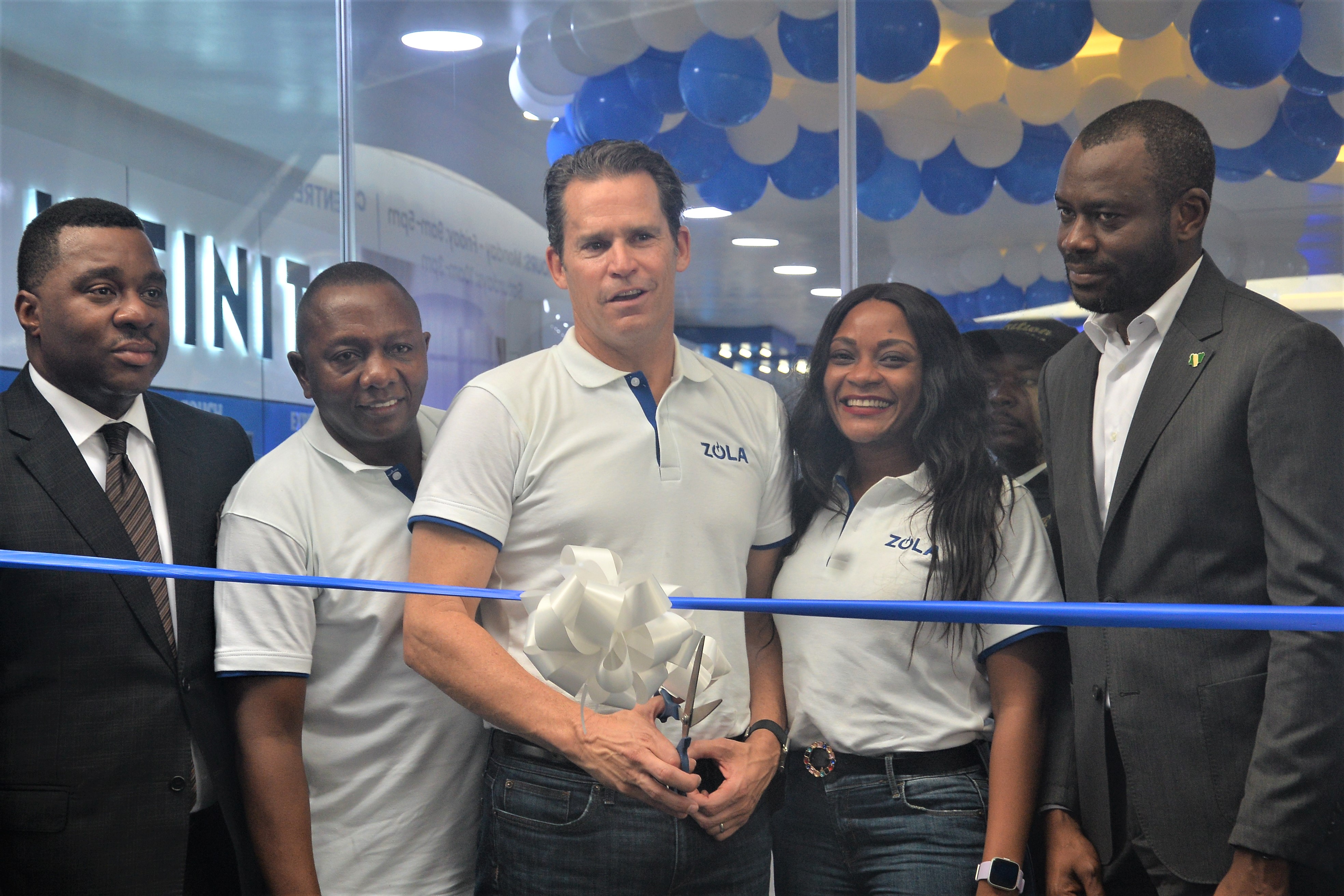
The company also introduced its Infinity solution to an initial group of customers who had preordered it. Here was a different setting from the rural home in Tanzania: an urban retail presence, a bank, customers seeking a larger power solution. The underlying management problem remained recognizable. Someone had to connect a customer’s needs with equipment, a payment arrangement and continuing service.
Financing also creates obligations. A 2022 investigation into the off-grid solar industry examined payment burdens and repossessions, including at ZOLA. A former executive described pressure to prioritize expansion; Lenihan disputed that characterization and defended the company’s credit checks. Those competing accounts matter because the promise of access has to survive the payment schedule. A system can be technically capable and still leave its owner facing a difficult bill.
Lenihan’s technology argument has consequently involved a range of energy needs. In 2021, he discussed storage, real-time information and the limits of the available product set. He acknowledged that the products did not yet solve the whole problem. Reliable power asks rather more of a business than a successful delivery receipt.
The customer journey becomes the product
ZOLA iNTELLIGENCE dates its founding under Lenihan to 2023, building on the experience of Off Grid Electric and ZOLA Electric. Its enterprise platform combines equipment, controls, data and software for energy service providers. The intended customer is a business responsible for delivering power to other people. This makes the work around an installation part of the product itself.
Lenihan has described how years of customer information and knowledge of field operations became material for a new technology business. The pandemic accelerated the pressure to automate. The ambition was to make operational experience usable by other providers, rather than reproduce every manual task each time a business entered a market.
The model has three layers. Hardware supplies and stores energy. Controls coordinate the equipment. Applications support the customer’s passage through sales, financing, installation, maintenance and renewal. Keeping those layers connected is the proposition. Otherwise a provider can acquire a collection of capable devices and still spend its days negotiating between them.
The sales work is correspondingly specific. Lenihan describes prospective customers such as telecom businesses and energy distributors moving into services. These are organizations with existing customers, operating capacity and balance sheets. Teaching a company to deliver an ongoing energy service entails a change in its own habits as well as the addition of new equipment.
The company now reports more than 500,000 installations and roughly three million people reached across more than ten countries. Those figures describe the technology’s reported footprint. For Lenihan, the next challenge is making implementation work repeatedly, across providers and places, without letting the service unravel between the sale and the renewal.
- 01 / HARDWAREGenerate & storeSolar, batteries, inverters
- 02 / CONTROLCoordinate the systemConnected equipment & operating data
- 03 / APPLICATIONSKeep the service movingSales → finance → installation → service → renewal
The work after the announcement
In August 2026, Google selected Zola Intelligence for its North American energy AI accelerator. It was one of twelve companies in that cohort, within a group of twenty-eight across North America and Europe. Google described its work as embedding automation and AI agents in finance and operational workflows alongside smart hardware. The program offers technical mentorship and access to Google tools.
The selection places Lenihan’s current work in an energy conversation increasingly concerned with coordination: how software helps physical systems and the people operating them make decisions. It also returns him to a familiar intersection. Capital, operations and technology have followed him from private equity into distributed electricity, although the daily stakes now look very different from a transaction closing.
The motorcycle in his Tanzania story remains a useful measure of that ambition. A customer needed a working system. Someone checked a record. Someone brought equipment. Someone climbed onto a roof. Children could watch television again. Between an investment thesis and a light coming on sits an astonishing amount of ordinary work. Lenihan has spent the years since that visit trying to make a business around getting it done.