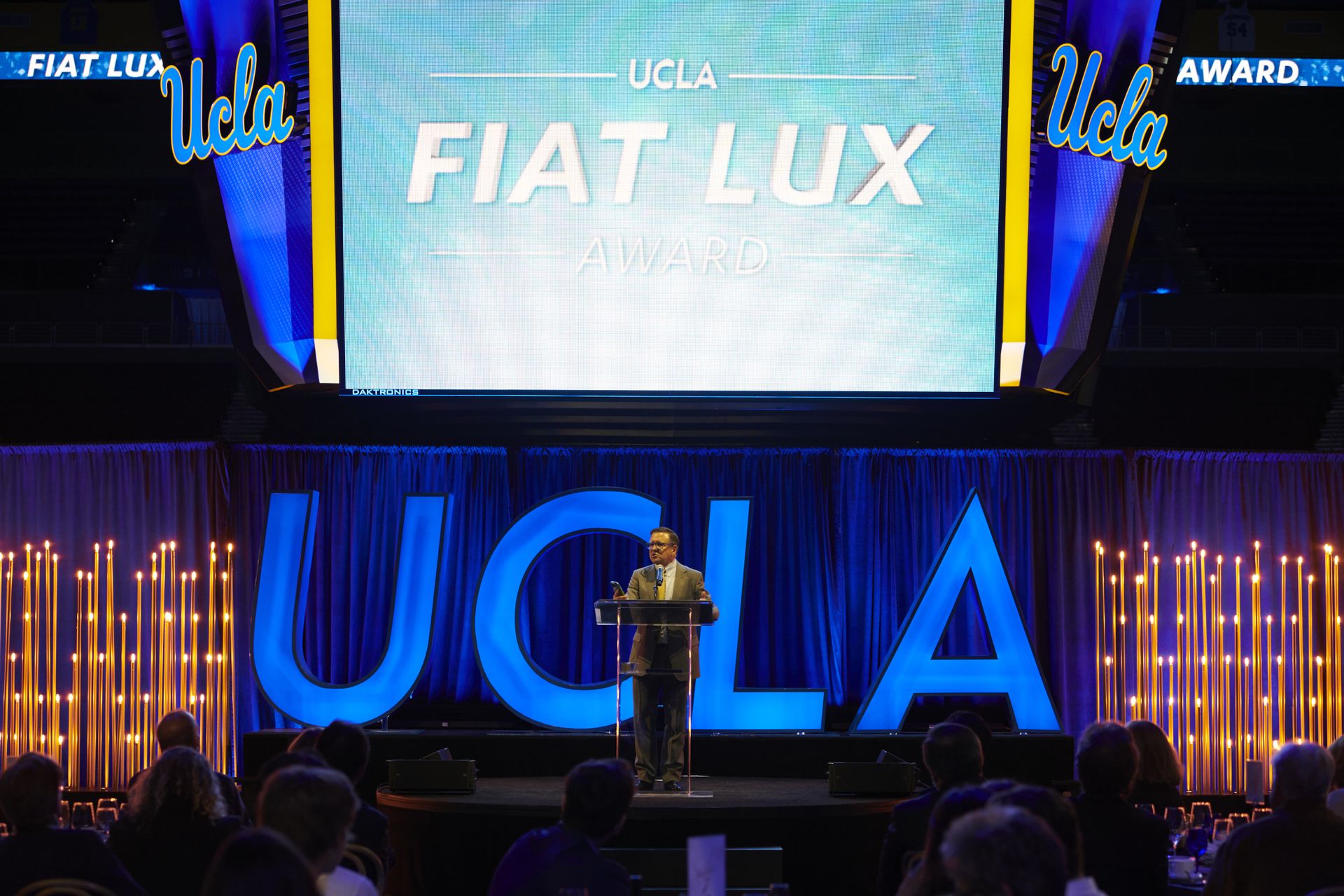
At Pauley Pavilion in October 2023, Tony Pritzker accepted UCLA’s Fiat Lux Award, took the stage and tossed his prepared notecards over his shoulder. A university was honoring a donor. The donor preferred to talk about the people doing the work. “It’s teamwork,” he said. He finished the evening by helping lead the room in UCLA’s eight-clap. For someone whose name is attached to endowed chairs, an environmental award and campus buildings, it was a pleasantly untidy entrance into the official record.
There is a useful clue in those abandoned cards. Pritzker’s public life repeatedly brings him into rooms where someone else knows the technical details: an industrial manager, a university researcher, a conservationist. His contribution has often been to help those people keep going. Money matters enormously in that arrangement. So do attention, judgment and the willingness to remain interested after the celebratory photograph has been taken.
An apprenticeship in things that have to work
Anthony Nicholas Pritzker belongs to the family behind Hyatt. His father, Donald, helped build the hotel business; his siblings are Penny and JB Pritzker. The surname supplies a ready-made introduction, sometimes so ready-made that it crowds out the individual. Tony’s working biography is more industrial than a hotel lobby might suggest. There are tanks, pumps, aircraft restraints and manufacturing businesses in it. An equipment-rental company provides fewer glamorous dinner-party stories than a hotel empire. It does provide an education in whether a business actually functions.
He studied at Dartmouth, with an engineering background, then earned an MBA at the University of Chicago. The combination offers a fairly literal description of the work that followed: understand the system, then understand the enterprise around it. His career included group-executive responsibilities at Marmon, the diversified industrial business associated with his family. He also served as president of Baker Tanks and chairman of AmSafe Partners. These were operating responsibilities, with products and customers attached.
Years later, describing his beginnings in the family’s industrial businesses, he emphasized helping acquired companies operate better. That is a revealing starting point for an investor. A company can look appealing in a presentation and still require difficult, ordinary work. The person who has had responsibility for running one is at least acquainted with the distance between the two. Pritzker’s investment career grew from that operating apprenticeship.
The owner’s clock
Pritzker Private Capital’s middle-market investing history reaches back to 2002. Today its public team page identifies Pritzker as co-founder and chairman. The firm concentrates on manufactured products and services, with a North American focus. Its stated proposition is patient ownership supported by professional investing and operating teams. Founders considering a sale are being asked to think about the character of their next owner as well as the number on an offer.
The distinction has practical weight. PPC says owners may remain involved and retain a meaningful stake; management teams receive room to operate alongside strategic and financial support. Its capital structure is intended to permit a flexible investment horizon. Those are the firm’s commitments, rather than a guarantee that every investment will succeed. They do, however, show the kind of conversation it wants to have with a founder who has spent decades building a company.
Consider the range of businesses with which Pritzker works: ProAmpac in packaging, Kenco in logistics, C.H. Guenther & Son in food and Bardstown Bourbon Company. These names lead into the physical economy, where growth involves facilities, equipment, distribution and people. A shipping schedule is remarkably indifferent to an investor’s preferred narrative. Experience in operations gives Pritzker a vocabulary suited to that world.
“It’s really about getting good people”
Tony Pritzker, on direct investing
In April 2025, a separate business, Pritzker Alternative Strategies, announced its launch. Chaired by Pritzker and led by Paul Carbone, it backs private-equity funds and related opportunities in the United States and Europe. The division of labor is explicit: Pritzker chairs its board in a non-investment capacity and does not sit on its investment committee. Delegating responsibility is easier to praise than to document. Here, the boundaries are written down.
A swimmer’s reason to care
His environmental interests have a personal starting point. Growing up in Northern California and later living in Los Angeles gave him a connection to the outdoors. He swims, hikes and mountain-bikes. Santa Monica Bay was somewhere he used, which made its condition a matter of immediate concern. Through Heal the Bay, where he served on the board, he learned from environmental advocate Mark Gold. A swimmer’s preference for clean water became a sustained involvement in conservation.
His account of that work is organized around specific tasks: establish the science, educate teachers, bring children to the coast and enlist government. In his telling, a clear destination lets people judge whether they are advancing. The ambition can be large while the next action remains quite concrete. It is an engineer’s way of describing civic work, and a more demanding one than simply announcing concern.
UCLA’s environmental institute describes his involvement as extending beyond financial support. As the inaugural chair of its advisory board, he helped develop an institution that brings different disciplines into environmental problem-solving. That role makes a bridge between two parts of his biography. Industrial businesses need people who can organize specialized knowledge. So do universities trying to carry research into the world outside campus.
What an endowment buys
In 2013, the Anthony and Jeanne Pritzker Family Foundation gave UCLA $20 million for several endowments. Of that, $15 million went to its Institute of the Environment and Sustainability, including support for faculty chairs and urban sustainability. It was a gift structured around continuing work. A chair helps a university recruit and retain someone; an endowment gives a program a financial foundation beyond a single fundraising season.
$15mEnvironment & sustainability
$3mFoster youth support
$2mHammer family programs
The same gift included $3 million for students with experience in foster care. Its purpose was unusually attentive to the small expenses that can derail a university education: textbooks that cost more than expected, supplies for a project, a suit for an interview. The foundation also supplied incoming students with duffel bags containing campus essentials. A pillow and laundry supplies rarely make a benefactor’s grand theory of education. They matter considerably when you are moving into a room without them.
Another $2 million supported children’s and family programming at the Hammer Museum. The intended beneficiaries included students and families with limited exposure to the arts. Hands-on activities and outreach gave the gift a point of entry beyond the museum’s existing audience. Taken together, the allocations suggest an interest in access: to research careers, to a college education, to cultural life. Each door needs a different kind of key.
From a smokestack to a building block
His engineering connections have produced particularly tangible projects. In 2017, the foundation gave $1.5 million to UCLA researchers competing in the Carbon XPRIZE. The team, led by Gaurav Sant, was developing a way to use captured carbon dioxide in construction materials. The appeal is easy to understand in the context of Pritzker’s career: a large environmental problem translated into an industrial process that could be tested.
The work continued. UCLA’s CarbonBuilt team won a $7.5 million Carbon XPRIZE grand prize in April 2021. In 2022, Tony and Jeanne pledged another $2 million to UCLA Engineering to establish a sustainability chair and support faculty excellence. Sant became the inaugural Pritzker Professor of Sustainability. The sequence matters: early research support, a tested technology, then support for the people and institution developing the next set of ideas.
A prize that keeps introducing people
The Pritzker Emerging Environmental Genius Award began in 2017. Its $100,000 prize recognizes environmental innovators under 40. The first winner, Dan Hammer, worked on making satellite imagery useful for environmental journalism. In a conversation with Hammer after the award, Pritzker asked how the project could sustain itself and reach an audience. The questions had the recognizable shape of an investor trying to understand what would allow an idea to travel.
The subsequent winners demonstrate how broad the search has been. In 2018, Miranda Wang was recognized for developing a process to turn otherwise difficult-to-recycle plastic into reusable chemicals. In 2019, Hindou Oumarou Ibrahim’s work brought Indigenous knowledge into mapping natural resources in Chad. These were different disciplines and different kinds of authority. The common ground was a practical environmental contribution.
In 2022, the prize went to Kenyan entrepreneur Dysmus Kisilu, whose Solar Freeze business used solar-powered cold storage to help small farmers preserve produce. Repurposed shipping containers became a way to reduce waste and give farmers more choice over when to sell. It is a useful example of what this award can notice: an intervention whose significance becomes clear when you follow the consequences through somebody’s working day.
Dan Hammer connects satellite imagery and environmental reporting.
Dysmus Kisilu’s Solar Freeze helps small-scale farmers.
Zuzana Buřivalová wins the tenth annual prize.
On October 8, 2026, the tenth award went to conservation scientist Zuzana Buřivalová. Her work uses recordings of tropical forests to turn soundscapes into evidence for conservation decisions. Pritzker presented the prize. The ceremony also recognized finalists Doris Njagi and Suzanne Pierre, each receiving $15,000. A decade into the award, the gathering had become a network as well as a competition.
There is a satisfying progression here, from industrial operations to university endowments to a scientist listening carefully to a forest. Different work, different expertise, substantial amounts still to do. Pritzker’s place in that progression is often beside the specialist, helping assemble the conditions in which the work can continue. At Pauley Pavilion, the prepared speech ended up behind him. The rest of the team remained in front.