Gary Winnick had a useful joke about retirement. He tried it at 37 and lasted through lunch. It is a small story with a large appetite behind it. Here was a financier for whom having enough money did not settle the question of what to do next. There was always another company, another source of capital, another market whose furniture could be rearranged.
His most consequential rearrangement lay beneath the ocean. Global Crossing, founded in 1997, financed fiber-optic connections that helped carry the traffic of an increasingly online world. Five years later, the company entered bankruptcy. The cables and the capital had different destinies. That separation runs through Winnick’s life: the ability to recognize demand, the ability to sell a vision, and the much less forgiving business of paying for it.
He died in November 2023, aged 76. By then, his public identity included private investing, museum trusteeship, a family foundation, and a Bel-Air estate with a name fit for a novel. The story is crowded. Winnick seldom seemed interested in making it smaller.
The salesman’s route to the ocean
Born in New York City in 1947 and raised on Long Island, Winnick graduated from C.W. Post College in 1969. Before the telecommunications venture, there was furniture selling. Then came bonds and Drexel Burnham Lambert, where he worked with Michael Milken’s high-yield operation. Selling capital offered a different scale of transaction, but persuasion remained central to the job.
High-yield finance brought money to businesses outside the comfortable boundaries of conventional corporate borrowing. Winnick learned his trade amid that activity. In 1985, he established his own investment firm, the business later known as Pacific Capital Group and Winnick & Company. His working address was Beverly Hills; his interests reached into real estate and other industries.
It helps to remember this background when considering Global Crossing. Winnick arrived at telecommunications through financing. He knew investors, understood transactions, and had experience persuading people to back projects. Those abilities could start a company before the company had much history of its own. They also meant that the eventual reckoning would involve people who had trusted the financier as much as the proposition.
The Atlantic becomes a proposition
The early cable idea took shape among Winnick’s partners. In 1996, David Lee explored an opportunity involving AT&T’s undersea cable business. Barry Porter and Abbott Brown were part of the circle that became Global Crossing. Their opening advantage was a network of financial relationships. Investors familiar with earlier Winnick transactions were willing to listen to a new story about the Atlantic.
That story had the charm of a large, visible obstacle. The internet promised immediate contact; an ocean remained an ocean. Connecting markets required expensive physical construction. Global Crossing offered investors participation in the infrastructure beneath the screen, where growing communications demand might become a business.
The company went public in 1998. By the following year, the surge in its share price had made its founders conspicuously wealthy. Employees had received options before the flotation, extending the excitement well beyond the boardroom. Winnick even gave options to his housekeeper and rabbi. The boom could make a household feel like a small investment bank.
At moments like that, paper wealth acquires the manners of permanent wealth. A rising share price supplies an answer to almost any awkward question. How valuable is the company? Look at the market. How good was the decision? Look again. The trouble begins when tomorrow stops agreeing with today’s price.
A cable cannot pay its own debts
Global Crossing filed for bankruptcy in January 2002 with about $12.4 billion in debt. The build-out had collided with a telecommunications market that could no longer sustain its expectations. More available capacity did not automatically produce enough paying demand. The commercial difficulty remained even where the engineering had produced something useful.
For employees and shareholders, the collapse meant losses rather than an abstract debate about infrastructure. Winnick had sold hundreds of millions of dollars in company stock before the bankruptcy, making the difference between his outcome and theirs a central public issue. The founder could point to what had been built. Investors could point to what they had lost.
Investigations and lawsuits followed. Questions focused in part on transactions in which telecommunications companies sold network capacity to one another while also purchasing capacity. Such arrangements raised concerns about revenue disclosures. Winnick faced congressional questioning and denied wrongdoing. His defense placed the collapse in the context of an industry-wide downturn.
In December 2004, SEC commissioners declined to bring civil disclosure charges against him, overturning an enforcement staff recommendation. Separate civil litigation produced settlements. These are distinct outcomes, and the distinction matters. An investigation’s conclusion does not restore an employee’s savings, while financial losses alone do not establish a criminal offense. The history requires more care than either a victory lap or a verdict by adjective.
The long life of a short-lived boom
Bankruptcy changed Global Crossing’s ownership and finances. It did not make every connection disappear. The reorganized company continued operating, and Level 3 completed its acquisition in October 2011. The combined operation had a presence in 45 countries and extensive intercity, metropolitan, and subsea fiber routes.
This survival makes Winnick’s story harder to package. A business can leave behind infrastructure that other owners use. Its original investors can still have suffered badly. The continuing usefulness of a network cannot be booked retrospectively as money returned to the people who financed its first version.
Winnick remained proud of Global Crossing. Pride in construction is understandable; so is anger about the financing. Both responses attach to the same company. The useful historical question concerns how those achievements and consequences came to share a balance sheet, and how quickly confidence outran the cash available to support it.
“In this town, you have to be a billionaire to get reservations. Finally, I’m getting them.”Gary Winnick, 1998
The names that stayed on the buildings
Winnick’s interest in giving preceded Global Crossing. As a boy watching the television series The Millionaire, he imagined being the benefactor who wrote the check. He later connected his philanthropy to the Jewish tradition of tzedakah and to the fundraising conversations he heard around his mother. Generosity had a domestic history before it had a foundation office.
Gary and Karen established the Winnick Family Foundation in 1983. Its commitments included education, literacy, art, culture, animal welfare, and Jewish institutions. Giving took forms that people could encounter without knowing anything about bond markets: a library, a place for children to learn, a museum visit.
His relationship with the Simon Wiesenthal Center also stretched back before his telecom fortune. A large pledge in 2000 supported plans for a Jerusalem institution concerned with tolerance. In discussing the proposal, he pressed for a focus on coexistence among Jews, Christians, and Muslims. The donation carried a view about what the institution should try to accomplish.
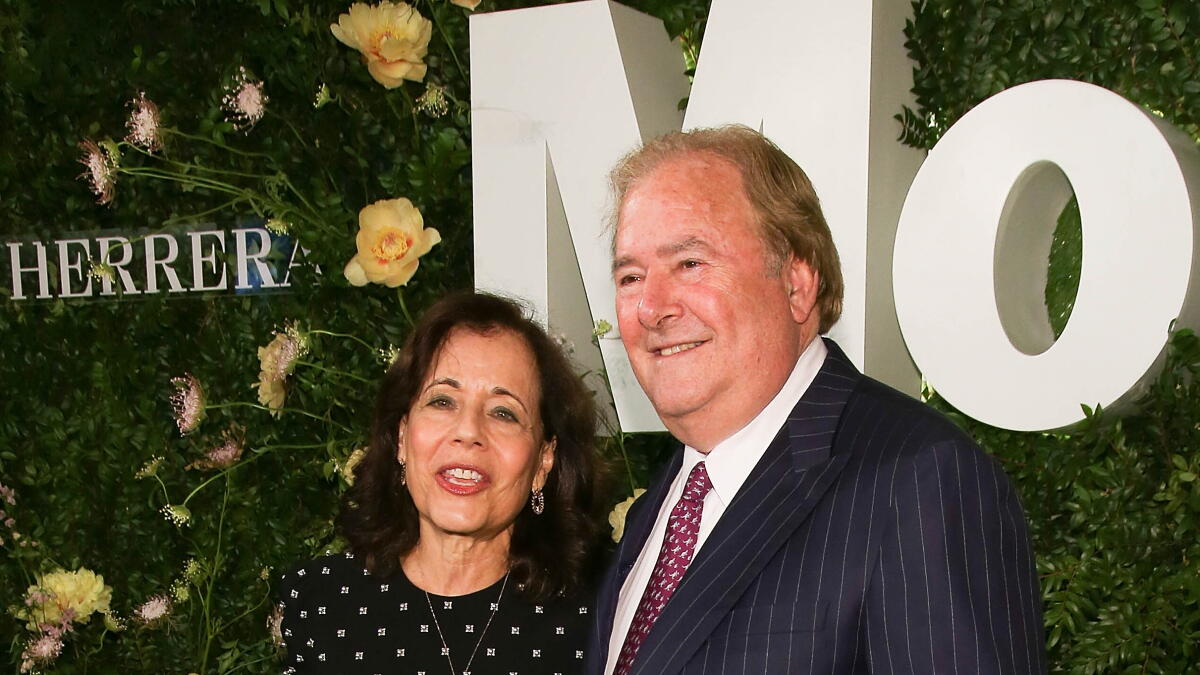
At the Museum of Modern Art, he served as a trustee from 2000 to 2023 and sat on the painting and sculpture committee. He and Karen collected art as well as supporting the museum. His interests extended beyond the industries in which he invested; cultural institutions offered a different way to participate in public life.
Philanthropy belongs in the account without becoming a device for closing the argument about Global Crossing. A gift can benefit its recipients while a donor’s business remains controversial. Institutional gratitude and investor disappointment can coexist. Winnick’s name attached to places that carried on with their work long after the stock-market excitement had passed.
Still looking for the next asset
His later investing brought him back to younger businesses, including Pluto.TV and venture firm Crosscut Ventures. He also wrote about experienced executives whose careers had been prematurely treated as finished. In a 2011 blog post, he recalled meeting retired ARCO chairman Lodwrick Cook, recognizing his continuing drive, and hiring him. Cook became a partner in the Global Crossing venture.
That account suggests why retirement proved unappealing. Winnick liked putting people and opportunities together. He regarded a substantial career as a resource that could be used again. His own progression through several kinds of investing gave that conviction a personal basis.
In 2022, his attention returned to telecommunications through WCO Spectrum. The proposal involved buying wireless spectrum licenses and leasing them back to operators. Radio frequencies, unlike submarine cables, offered no impressive object to point at. But licenses could still carry financial value, and Winnick wanted that value treated as a separate asset class.
The pursuit brought conflict with T-Mobile over educational institutions’ spectrum holdings. The companies made opposing allegations in litigation. After Winnick’s death, WCO deferred comment while his family addressed estate matters. His later telecom project remained unsettled, another reminder that recognizing an asset and successfully acquiring it are separate stages of a deal.
The house and the balance sheet
Casa Encantada became the most visible object associated with Winnick’s wealth. He and Karen bought the Bel-Air property for $94 million in 2000. In June 2023, they listed it for $250 million. A house can look reassuringly solid beside a fluctuating share price. It can also serve as collateral.
After his death, reporting described substantial borrowing secured by family properties and a dispute with lender CIM Group. By July 2026, Casa Encantada had sold at a foreclosure auction for $130 million. That later chapter complicates any attempt to treat a historical wealth ranking as a final account of his finances.
Winnick’s family remembered a direct, persistent storyteller. His business record gives that storyteller difficult material: investors persuaded, infrastructure constructed, losses incurred, institutions supported. The characteristic motion is forward, toward another use for capital and another reason to stay at work.
The ocean cables offer a fitting way to remember the complexity. They were physical connections financed through promises about future demand. Some of those promises failed on the timetable required by the debts. The connections carried on. Winnick’s life leaves both histories in view, with no convenient retirement between them.