The internet has a plumbing problem. A fiber strand can carry astonishing amounts of traffic, but the gear at either end must turn electrical signals into light, steer that light, correct its errors and turn it back again. For years, those jobs meant many separate optical parts, each built, tested and connected on its own. Infinera's founders looked at this crowded machinery and decided the answer should be smaller than the box: make the light-handling functions together on a chip.
The short version
- The wagerBuild photonic chips and the network systems around them.
- The buyerCarriers, cloud operators and anyone moving enormous amounts of data over fiber.
- The outcomeNokia acquired Infinera in 2025 in a deal announced at $2.3 billion enterprise value.
This was an unusually expensive way to simplify things. The founders, Jagdeep Singh, Drew Perkins and David Welch, needed a chip design, a way to manufacture it and a product customers could actually install. Their first photonic integrated circuit used indium phosphide, a material that can bring lasers, detectors and other optical functions onto one substrate. In an early account of the company, the founders waited for engineers to test the first device in a small Cupertino office. It worked better than they expected. A working chip, however, was only permission to begin the hard part.
The box had to justify the chip
Telecom operators do not buy an elegant material science thesis. They buy capacity they can provision, power they can afford and equipment they can repair at three in the morning. Infinera therefore became a systems company as well as a semiconductor maker. It developed optical engines and put them in transport platforms, line systems and later coherent pluggables. Its software helped operators plan and manage those networks. Support and professional services completed the sale.
The modern catalog gives the idea a physical shape. GX is a compact modular platform with sleds that operators can configure for different optical jobs. ICE6 supports up to 800 gigabits per second per wavelength in the GX portfolio; ICE7 raises that figure to 1.2 terabits per second. ICE-X puts coherent optics in pluggable modules. XTM handles packet-optical metro transport, where mobile, broadband and business traffic meet. Transcend is the automation and management suite. The products serve routes between data centers, across cities, over long haul networks and under oceans.
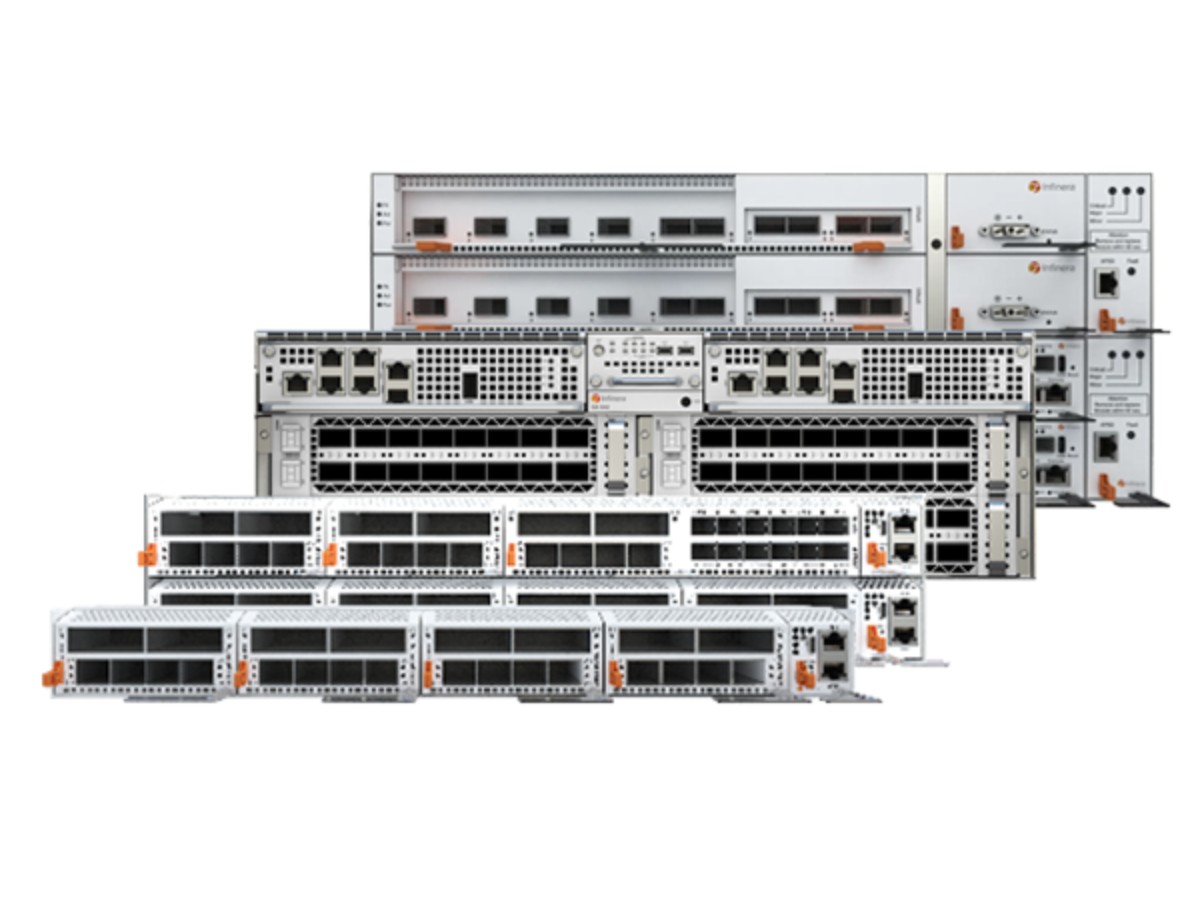
That vertical route is its distinctive bet. A rival can buy optical components and assemble a system. Infinera has tried to improve the chip, the engine and the chassis together, then make those improvements matter to the operator's cost per bit. It can also place a GX transponder over a third-party line system, which matters because no carrier wants to rebuild an entire network just to gain capacity on one route. The value is not a single speed record. It is more traffic on a route with tolerable power, space and operating demands.
The first constraint was money
A custom optical chip and its manufacturing process require patience, tools and capital before customers see a finished system. In August 2003, Infinera raised $53 million in a Series D round led by Mobius Venture Capital; contemporary reporting put the total raised by then above $130 million. That is a useful corrective to any tale of a clever garage invention. The company had to fund semiconductor work and network equipment development in parallel. Its later 2007 public listing gave that wager a larger balance sheet.
“In order to build a permanent company, you need to have a big problem to solve.”Jagdeep Singh, Infinera co-founder, in 2002
The first chip was a success, so the early threat was the distance between proof and deployment. Carriers buy cautiously: a failure can interrupt a city, an enterprise circuit or a submarine route. Building something smaller was not enough. Infinera had to make it reliable, interoperable and economical at scale. It also had to survive the spending cycles of its customers. Those cycles showed up starkly in its last full independent year.
Cloud demand changed the customer map
Infinera's 2024 revenue fell from $1.614 billion to $1.418 billion as the optical market slowed. Its GAAP net loss was about $150 million. Yet internet content providers - the large companies building and operating the cloud - generated about $528.5 million, slightly more than a year earlier. That was a different kind of signal. The customer needing a faster fiber route was increasingly a cloud operator connecting enormous data centers, alongside the familiar telecom carrier.
Revenue, last two independent years
Nokia saw both the technical asset and the customer map. In its June 2024 deal announcement, Nokia said the combination would add about 75% to the scale of its optical networks business. Infinera had a strong North American position, while Nokia wanted more of that market. Internet content providers already made up more than 30% of Infinera sales at the time of the announcement. Nokia also wanted the expanded chip, digital signal processor and photonic integration expertise. The proposed price was $6.65 per share, or $2.3 billion in enterprise value. The acquisition closed on February 28, 2025.
That price did not buy an instant answer to every network problem. Nokia projected more than €200 million in annual net comparable operating profit synergies by 2027, with roughly €200 million of one-time integration costs. Those were targets, not results. The integration has to make two portfolios and customer organizations work together. It is still a very tangible example of what Infinera's founders set out to do: make a hard piece of network infrastructure valuable well beyond the chip itself.
A wavelength is a business decision
After the deal, the technology did not disappear into a corporate archive. In May 2025, Pakistan's Cybernet selected Nokia's 1830 GX platform with ICE7 optics for a backbone planned to connect more than 25 cities. The design calls for 1.2 terabits per second per wavelength and more than 50 terabits per second of long haul capacity in its initial phase. That is the practical use case: a provider serving homes, enterprises and other carriers can expand a national route without treating every burst of demand as a reason to lay another cable.
The lesson is narrower than “make everything yourself.” Infinera's approach made sense where the bottleneck sat in optical performance and where enough large customers could pay for the engineering. A small network operator rarely needs to invent its own laser; even a large one may prefer standards-based parts when flexibility beats a tightly integrated system. The copyable move is to identify the expensive constraint - here, cost and power per bit across fiber routes - and own enough of the chain to change it. Then check whether customers will pay for the result, not merely admire the science.
Infinera began with a piece of indium phosphide small enough to invite disbelief. It ended as part of a much larger network business because the little piece altered the economics of very large distances. The internet still needs racks, cables and patient operators. Light just lets more of it pass through.