Sony had a television service to rebuild and a problem familiar to anyone who has tried to hire engineers against a deadline. The work was ready. The people were not. In 2019, PlayStation executive Chris Hebert described the predicament in five words: “We couldn’t hire fast enough.” The company turned to Zemoga, a product engineering firm with its delivery operation in Colombia.
- Zemoga supplies designers and engineers who work inside enterprise product teams.
- Its Colombian delivery base supported clients including Sony, Morningstar and Walmart.
- S4Capital acquired it in 2021; today the business points to Monks Technology Services.
The initial assignment was bounded: rewrite Vue applications across a couple of platforms, spend a year working together, then assess the relationship. Hebert later told Nearshore Americas that the work went well enough for Sony to shift essentially all development for those applications to Zemoga, including PS4 work. Sony’s own engineers were being pulled toward the next console. The outside team could expand while the inside team moved elsewhere.
Sony ran out of hiring time
That is a more useful introduction to Zemoga than the phrase “digital transformation.” Its customers already have products, customers, responsibilities and unfinished work. They need extra engineering capacity without spending the entire development window assembling it. A partner must understand an existing system, join its routines and keep shipping when priorities change.
Zemoga sells that combination through custom product work and managed capacity. Its services span product design, user experience strategy, web and mobile development, backend engineering, quality assurance and maintenance. The commercial unit is often an ongoing team. For a buyer, the practical question becomes how much responsibility that team can absorb, and how reliably it can work with the people already there.
“We couldn’t hire fast enough.”
Chris Hebert, Sony PlayStation · 2019
Colombia was the operating model
Founded in 2002 by DJ Edgerton and Alejandro Gomez, Zemoga connected US client relationships with Colombian delivery talent. A 2010 company announcement documented Gomez moving from Bogotá to run a new Walnut Creek office, serving Pottery Barn, Toyota and the Mozilla Foundation. Edgerton maintained the New York presence. The arrangement put commercial access near customers while keeping a substantial production base in Colombia.
By the September 2021 merger announcement, Zemoga had almost 400 technology specialists and delivery centers in Bogotá, Cali, Medellín and Barranquilla. The proposition belonged between hiring an internal team and commissioning a discrete project. Compared with another engineering consultancy, the distinctive evidence was the depth of its client integration and its investment in delivery infrastructure.
A room full of inconvenient screens
Consider the device lab announced in Bogotá in July 2019. It contained more than 150 physical devices, including televisions, consoles, tablets, phones and streaming hardware. A streaming interface has to survive the particular screen, input method and hardware on which someone actually watches it. The laptop on which the software was written is only one witness.
real devices.
Plenty of places for a bug to hide.
Zemoga said it consulted Sony and Walmart about their requirements before designing the facility. It brought design, development and testing into a shared working environment. Its launch announcement cited rental alternatives costing $3,000 to $7,000 a month, depending on usage. That was a comparison with outside facilities, rather than a price for Zemoga’s services.
The lesson is pleasantly concrete. Put the tools for discovering mistakes within reach of the people making the product. Shorten the journey between a design decision and evidence that it behaves badly on somebody’s television. Zemoga’s investment made its quality argument visible in hardware.
The client moves in
Morningstar offers another view of the model. A small front-end engagement developed into broader design, engineering and management work across business units. The successor company’s case study describes teams supporting retirement-plan software and investment portfolio tools. Morningstar Plan Advantage instances were deployed for financial services firms including UBS and Raymond James.
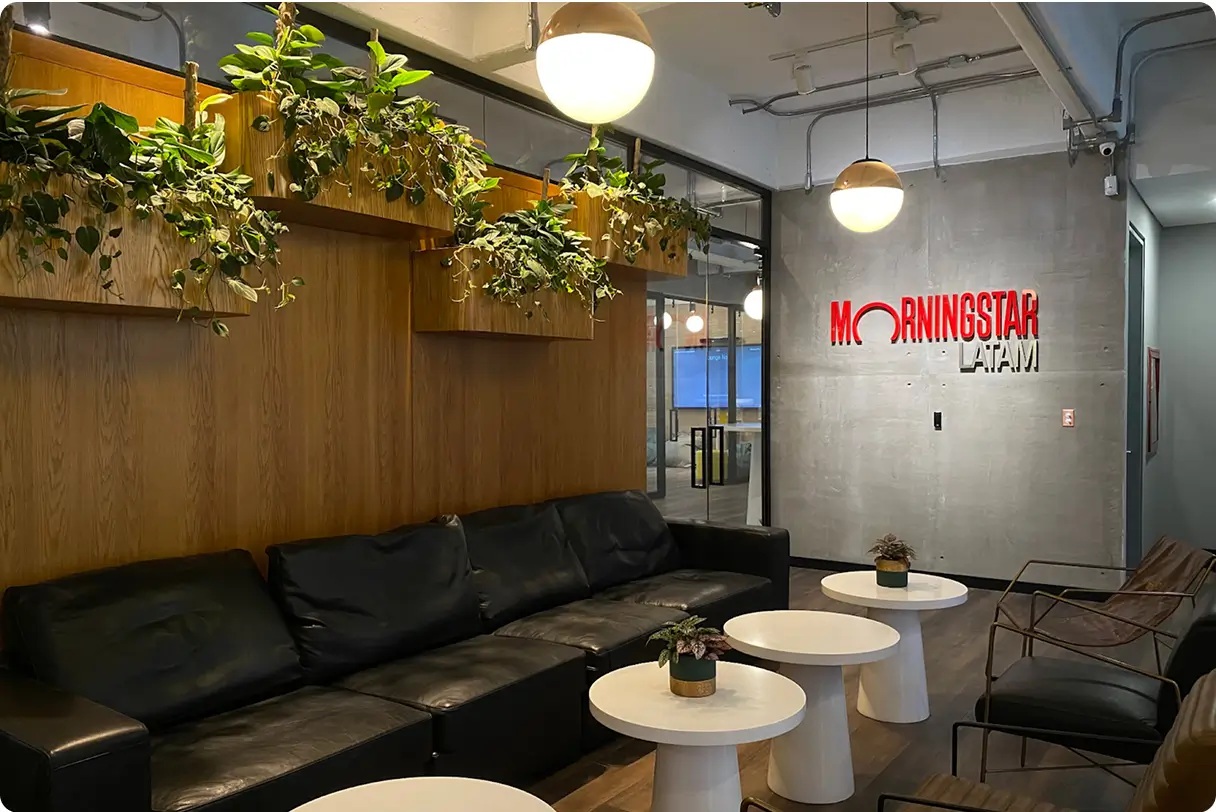
Monks also described a shared Bogotá workspace reflecting Morningstar’s identity alongside Zemoga’s office. The photograph makes an abstract arrangement tangible: an outside supplier can become part of a client’s everyday working environment. The inference for buyers is straightforward. Continuity matters when a product keeps changing after its launch party.
The app worked. The economics did not.
Vue supplies an essential complication. In October 2019, Sony announced that the service would close on January 30, 2020. It cited intense pay-TV competition and expensive content and network agreements. Positive testimony about application development could coexist with a decision to abandon the business.
That distinction matters when evaluating any product engineering partner. More capable delivery cannot make content rights cheaper or guarantee demand. An embedded team also needs access to decisions, business context and the client’s existing systems. Without those conditions, the intimacy promised by the model becomes harder to achieve. Buyers still own the question of whether the product deserves to exist.
A buyer can copy the sequence without copying the supplier. Give a partner a specific responsibility, identify the internal people who can unblock it, and review actual delivery before expanding the assignment. Ask how designers, developers and testers will share discoveries. Establish who will maintain the application when the first release is over. These are practical deductions from the client stories, rather than a guarantee attached to the Zemoga name. They make the purchase easier to evaluate than a promise of transformation.
The £63.9 million doorway
For S4Capital, Zemoga opened a different door. The September 2021 combination established a third practice around technology services. S4Capital’s subsequent financial statements recorded £63.9 million in total consideration. This included several payment components, rather than a single cash cheque. The strategic attraction was access to enterprise technology buyers alongside marketing and sales executives.
In 2023, Zemoga joined the businesses grouped within Formula.Monks. The wider group adopted the Monks name in 2024. Today, Zemoga’s website and LinkedIn page direct visitors to Monks Technology Services. The old name remains a useful case study: start with a real capacity problem, earn a broader assignment through delivery, and stay close enough to understand the next one.