A homeowner sees a loan application. Crombie sees more than thirty APIs, hundreds of validations, and a thicket of lending rules. In its account of building NFTYDoor’s digital workbench, the Argentine software company describes an average closing time of six days. The deceptively small word is “workbench.” Somebody has to persuade the banks, data providers, and decision rules to agree before the borrower can move forward.
- Custom software and AI engineering, with a focus on fintech and retail.
- Work includes lending platforms, ecommerce, cloud migration, and system integrations.
- The recurring idea: improve the connections before adding more complexity.
That is a useful way to understand Crombie. Its portfolio has little surface consistency: mortgages, sportswear, PDFs, dairy deliveries. Underneath, the assignments rhyme. A company has assembled useful technology. Then the business grows, or changes direction, and discovers how much human effort is required to keep the pieces talking.
A checkout has a long backstage
Consider PUMA. Crombie’s engagement included moving infrastructure from AWS to Google Cloud, integrating Klarna payments in the United States, and enabling personalized shirts in India. These are very different jobs that all end up inside the same shopping experience. The customer encounters a page; the engineering team encounters geography, payments, infrastructure, and peak demand.
Crombie reports a 25% improvement in product-detail-page rendering and loading speeds, alongside a 44% reduction in troubleshooting and functionality-delivery time. Treat those as the company’s reported project results. They describe an engagement with a globally distributed team, where adding capacity and coordinating work mattered alongside technical changes.
Faster product-page rendering and loading
Shorter troubleshooting and feature-delivery time
The underlying expertise is broad but practical. Crombie offers user research and prototypes before implementation, web and mobile engineering, and continuing product development. Its modernization work covers refactoring older applications, cloud migration, containers, and automated deployments. A client can bring an unfinished product, an overloaded team, or a functioning system that has become awkward to change.
Fix the plugin. Then widen the door.
iLovePDF arrived with a smaller-looking problem. Its WordPress plugins had fallen out of sync with the repository and developed compatibility and structural issues. The assignment began with repair. It expanded into integrations with automation platforms, bringing document tools into workflows that users already had.
There is a pleasing business lesson here: maintenance can determine distribution. If a plugin misbehaves inside somebody else’s software, a feature list becomes beside the point. Crombie’s case study reports download growth above 500%; the more instructive detail is the sequence. Restore the connection, then give people more places to use it.
La Serenísima faced a more abrupt change of circumstances. During the pandemic, the Argentine food company needed a direct route to households alongside its distributor model. Crombie connected ecommerce with billing and logistics. Its account describes a two-month delivery. A storefront only becomes useful when the order can make the rest of the journey.
Start small enough to learn
For Skylight Lending, which finances solar panels and home improvements, Crombie says it produced an MVP in three months before expanding the platform. Borrowers, installers, vendors, and lenders needed to participate in one process. The case study reports 80% workflow automation and growth from five states to twenty-six over three years.
Those figures describe different things. Geographic expansion is a business outcome; automation describes the workflow. Neither establishes that software alone caused growth. What a reader can copy is the order of operations: validate an initial version, then expand the functions around a working model. That is a more manageable brief than asking a team to automate an entire business on arrival.
The integrator needed an integration
Crombie has experienced a version of this problem itself. PeopleForce’s account of its HR implementation describes information scattered across Google Sheets and other tools, duplicated records, and increasingly difficult coordination. The implementation began in 2023. Here was a software company confronting the administrative consequences of growing its own team.
The choice followed comparisons of functionality, usability, and scalability. Training and implementation support mattered too. That episode makes Crombie’s advice more tangible: sometimes buying a shared platform is the sensible engineering decision. Its advertised Blend Model follows that logic, combining standard systems with custom capabilities built around them.
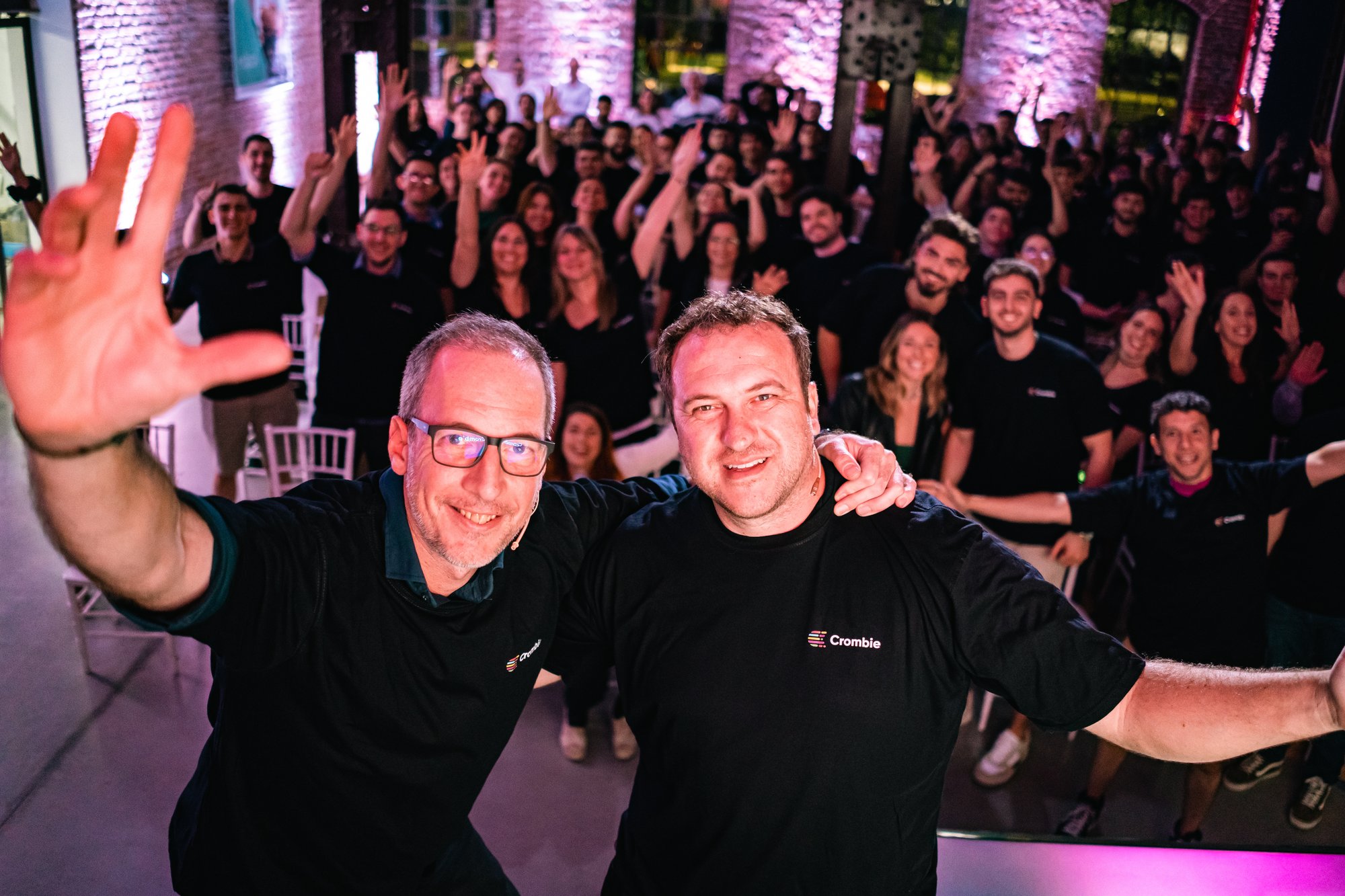
The people side has some measurable texture. Great Place to Work Argentina’s published 2024 study says 74% of Crombie employees considered it an excellent workplace. Its free Code Academy trains developers, QA specialists, and functional analysts in Santa Fe. The program advertises six months of coursework, four hours a week, with prior knowledge and English among the entry requirements.
Before the agent, an agreement
Crombie’s current AI offer includes conversational agents, decision automation, and the infrastructure needed to run them. Its data practice builds pipelines, governance, and model operations. That combination matters because an agent connected to inconsistent information can reproduce the inconsistency at speed.
In August 2026, Crombie explained its Spec-Driven Delivery framework: an agreed functional specification stays in use through design, development, testing, and release. Specialized agents assist analysts, developers, and QA; people retain responsibility. The premise is modest enough to be useful.
“first, we agree with the client on what to build; then, we build it.”
Crombie, on Spec-Driven Delivery
Crombie sells B2B engineering services through project work and team support. Clutch lists an indicative $25-$49 hourly range and a $25,000 minimum project. A 2020 client review describes a $3,000 platform-development engagement. Historical figures describe different scopes and periods. A buyer should define the workflow, integration responsibilities, and acceptance criteria before treating a directory rate as a budget.
That also clarifies the fit. A standard product that already handles the job may be sufficient. Custom integration becomes compelling when the workflow creates value worth maintaining. It still needs accessible systems, clear ownership, and people able to decide how exceptions should work. Draw that map first. It is the useful part of Crombie’s story you can take into your next software meeting.