Six people stepping away from daily operations might sound like a staffing problem. In Venkatachalam Dekshinamurthy’s account of 10decoders’ progress through 2023, it was something to celebrate. Six of fourteen members of the group he called his Dream team had moved completely out of business-as-usual work to help the company scale. A founder’s retrospective usually makes room for things acquired. Here was a useful detail about responsibilities relinquished.
Venkat, as he is also known, thanked Manikandan Balakrishnan and Meenakshi Soundararajan for helping the leaders make that transition. The credit went to colleagues, and the milestone concerned how they spent their time. Beneath the customary year-end enthusiasm sat a practical question: how does a company make room for its next stage while the present one continues to demand attention?
It is a good place to begin his story. The founder and CEO of 10decoders has an engineering background that includes TCS and Bank of America. His public work moves between software architecture and organizational choices. In one setting, the problem is an API. In another, it is deciding who should still be handling the everyday work.
The engineer before the management essay
His technical archive supplies an appealing antidote to the executive biography. In February 2019, he wrote about hosting multiple websites with Firebase. That November, he considered Google App Engine’s standard and flexible environments. These are subjects with little patience for ornamental language. A deployment either behaves as intended or invites a rather less cheerful conversation.
In March 2020, the subject was improving Couchbase community server performance, drawing on his use of the database for Spring Boot REST APIs. By August, he was writing about deploying multiple API versions in serverless microservices, including Node-based Lambda services. A cloud migration article followed in March 2022.
The sequence gives his later strategy writing some useful texture. He had been publishing about the machinery itself: hosting choices, database performance, service deployment. Readers can follow the change in scale from a specific implementation question to the organization that must live with its technical decisions. His interests became broader without requiring the earlier questions to become unimportant.
There is also a modest pleasure in finding an executive’s archive full of questions other engineers might actually type into a search box. The titles promise assistance with a problem. Their ambition is measured in something a reader can do afterwards.
A company with more than one builder
10decoders dates its founding to 2015. Its leadership account pairs Venkat, the CEO, with founder and CTO Edrin Thomas, and names colleagues responsible for delivery, research and go-to-market work. The distribution is useful context for those later posts about leaders changing their responsibilities. There are several kinds of work to grow into.
The company describes operations across India, the United States, the UAE and the United Kingdom, with delivery centers in Chennai and Madurai. It also describes programs for recruiting talent outside major cities and helping women return after a career break. These are company initiatives, and their relevance here is concrete: the organization around Venkat includes choices about where people can build a career and how they can enter one.
A founder’s title occupies little space on a page. The organization beneath it takes considerably more arranging. That distinction helps explain why the quieter milestones in his posts deserve attention alongside the celebrations.
Success, with somebody else holding the keys
In March 2023, 10decoders made recognition unusually tangible. The company celebrated Manikandan Balakrishnan, Meenakshi Soundararajan and Abinaya Soundararajan with cars, acknowledging their contribution to its progress. Venkat shared the occasion with a message about the enjoyment of celebrating success among friends, family and colleagues.
The gesture could easily consume the whole anecdote. Cars are more photogenic than a sensible allocation of responsibilities. Yet the names make it worth pausing. The company story includes people doing distinct work around the founder, rather than a supporting cast blurred conveniently into the background.
His later reflections keep returning to recognition. At the December 2024 Achiever’s Day, he described colleagues acknowledging one another’s efforts, leaders discussing lessons and plans, and the emotion of seeing that exchange. The instruction at the end was compact: “repeat, refine and scale”. It has the cadence of an engineer who has discovered that teams, too, need another iteration.
“repeat, refine and scale”Venkatachalam Dekshinamurthy, December 2024
Recognition and delegation belong together in this account. One makes a contribution visible. The other makes space for a different contribution next. That pairing offers a more interesting leadership question than whether a founder is busy. What work are other people now able to own?
A year-end list with room for refusal
Venkat’s review of 2023 included a consulting practice beginning to engage clients, engineering solutions intended to shorten delivery time, and an onsite and offshore model becoming routine. He also described an Indian partner ecosystem and plans to develop the approach in the United States.
Then came his decision to highlight turning down activities that did not fit the company’s vision. Among all the familiar additions on a corporate list, refusal had earned a place. The calendar, that merciless editor of every strategy, presumably appreciates a shorter manuscript.
There is no need to turn the statement into a legend about particular deals. Its value lies in the priority he chose to express. Alongside building and expanding, he wanted to record a boundary. Readers can recognize the tension: an attractive opportunity can still consume the people and time intended for something else.
The same retrospective included a family gathering and a reunion, after eight years, with someone he called the company’s godfather. Those personal touches sit beside the operational changes. His account of a company year had room for both the work and the people gathered around it.
AI enters the conversation, with questions attached
His posts also place him in conversations beyond the office. In July 2023, he described an Orlando workshop and dinner where discussion turned to generative AI and its relationship to business plans. The combination is pleasantly ordinary: ideas, colleagues, a meal. Technology often makes its entrance through a conversation before it becomes a budget line.
In March 2024, he was looking ahead to a Charlotte gathering about adopting generative AI, explicitly including risks and strategies in the invitation. The interest was in collaboration and practical adoption. That framing matters because a demonstration can attract attention long before an organization has decided how to use it responsibly.
His April 2024 essay on responsible AI addressed that organizational work directly. He described assigning roles, recording how AI decisions were made and establishing a team to audit models for potential bias. He also discussed training and knowledge sharing. These are the duties that arrive after enthusiasm has taken its seat.
The argument gives responsibility a place in the organization. Someone must document the data and algorithms. Someone must review the model. Someone must keep learning as the technology changes. Read as a leadership position, it extends his concern with who owns a piece of work and how that ownership becomes visible.
Giving data a job description
By August 2024, he was writing about treating data as a product. The idea brings a practical expectation to information: it should be organized for use, connected to business needs and improved with care. Accumulating it is only part of the task. A collection becomes useful when people can understand it and act on it.
His proposed approach involved clear objectives, executive support, cross-functional teams and leadership participation. He included product management, engineering, business knowledge and change management in that picture. The topic was technical, but the required cooperation reached beyond a technical department.
This is a recurring feature of his public thinking. A system’s usefulness depends partly on the arrangements around it. People need access, responsibilities and a common purpose. Even an excellent technical choice has to survive contact with an organization’s habits. Data does not become helpful merely because it has been invited to a meeting.
The connection with his leadership posts is suggestive rather than mysterious. Whether discussing teams or information, he is interested in work becoming usable by others. That is a reasonable lens through which to read the progression from his earlier engineering articles to his later business commentary.
The plan returns to the room
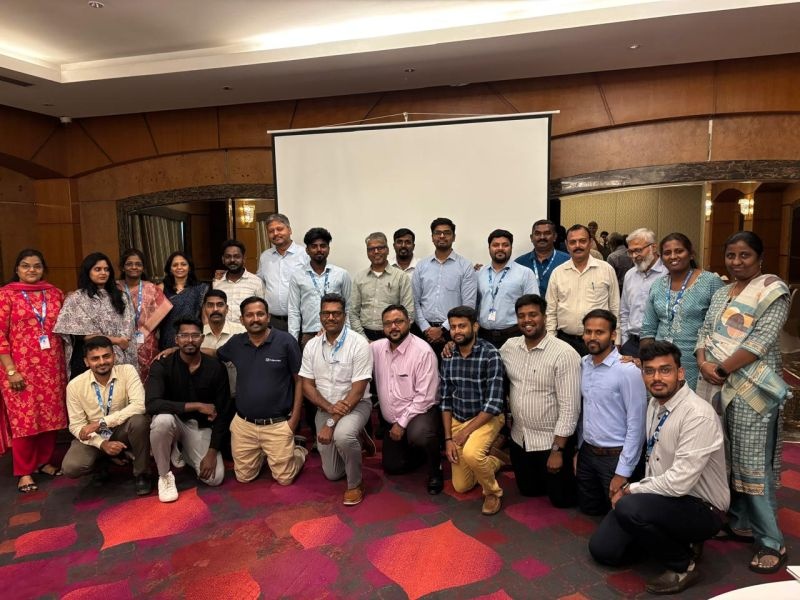
In April 2025, Venkat shared a quarterly leadership offsite that reviewed the year’s plan and its opening months. His account linked vision, culture, strategy, goals, actions and results. He described leaders reconsidering their actions, celebrating progress and respecting one another’s viewpoints. The photograph is a group portrait, an apt accompaniment to a story about shared responsibility.
He included Tamil verse in that post, as he had in his earlier year-end reflection. It gives the business vocabulary a personal register: the same executive who writes about cloud infrastructure also reaches for language outside the slide deck. The detail is small enough to feel human.
The offsite brings the story back to the six leaders stepping out of routine operations. Delegation creates room; review asks what people have done with it. There is no dramatic finish to that work. A quarter passes, the group meets, and the plan faces the results. For a founder whose writing began with practical software questions, that continuing examination seems an appropriate place to leave the page open.