A boiler, a student workshop and a startup pitch do not usually appear in the same company description. At YTG, they belong to the same argument: environmental ambition needs people who can turn it into something that works. The Cairo organization, also known as Youthinkgreen Egypt, has built its work around that connection. Its current offer reaches from sustainability education to industrial water audits, with green entrepreneurship occupying the territory between them.
That is an unusually wide brief. It also gives YTG a useful place in Egypt’s sustainability market. A young founder may need help identifying a customer. A development organization may need local research and a training partner. A manufacturer may want to understand where water, energy or materials are being wasted. YTG offers services for all three, bringing an education-led history into increasingly technical business conversations.
The classroom was the starting point
Established in 2013, YTG grew out of youth environmental education and the international youthinkgreen movement. Its public biographies identify Abdelrahman Fahmy and Marwan Salah as co-founders. Fahmy, listed as chairman and executive director, comes from mechanical engineering; Salah, a board member, describes experience in automotive engineering and marketing. Those backgrounds help explain the organization’s interest in both the technical idea and the work of getting other people to adopt it.
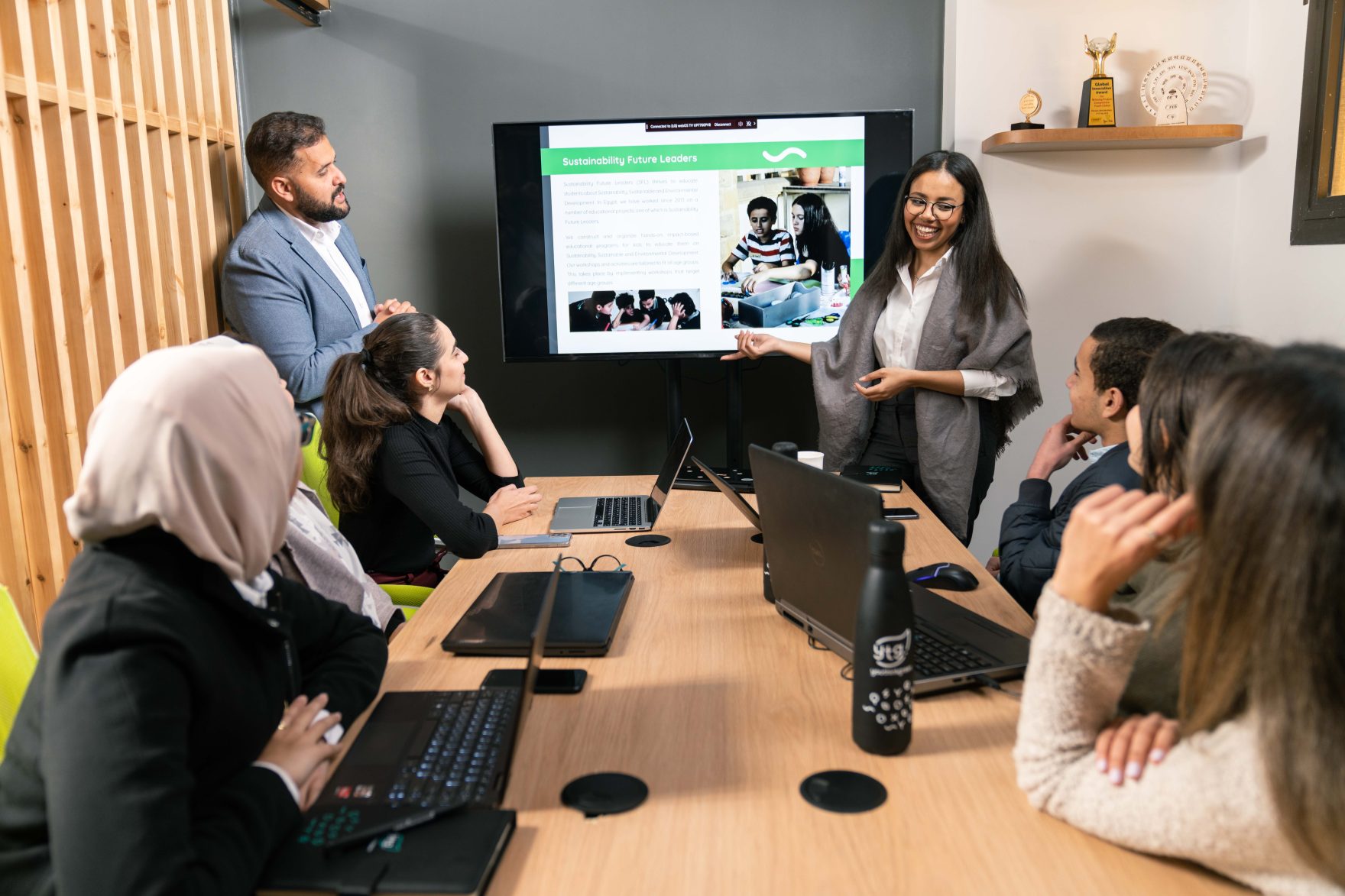
The early emphasis was practical learning. A World Bank report describes its sustainability and entrepreneurship incubator in May and June 2017, supporting young people developing environmentally oriented solutions to local problems. That combination remains visible in the present service menu: workshops, field visits, gamified activities, film screenings and discussions. The classroom can be a seminar room, but it can also be somewhere participants encounter the problem for themselves.
YTG’s stated values include empowerment, authenticity and quality. Its public materials translate those words into an approach built around local experts, partner organizations and learning by doing. For a school, university or corporate team, the service is a designed learning experience. For YTG, that experience can also introduce people to a longer journey through entrepreneurship or institutional change.
First, find someone who needs the idea
The most revealing description of YTG’s startup work is a small one: a three-day ClimateLaunchpad bootcamp completed by eight teams. Its nine modules moved from purpose and market selection through financial modeling, climate impact and customer discovery, then into pitching. The order matters. Before asking an investor to believe in a business, founders were asked to investigate whether customers had a reason to care.
The program’s own account records two difficulties. Teams needed follow-up and direct support to conduct meaningful customer discovery. They also arrived at different stages of development, requiring individual mentoring. These are recognizable teaching problems, and useful details for anyone organizing a similar program. An identical timetable does not make every team equally ready for the next exercise.
YTG’s response was to add guidance around interviews and tailor the mentoring. The reported results included clearer target markets and more realistic financial projections. Those are modest, appropriate outcomes for a bootcamp. The practical lesson is easy to borrow: require founders to test an assumption outside the room, then make time to revise the business around what they learn.
Purpose, market
and value proposition
Customer interviews,
finances and impact
Pitch coaching
and refinement
A local brief, an African stage
The startup work extends beyond short courses. The African Development Bank’s 2022 mapping of Egypt’s entrepreneurship landscape describes YTG’s Sustainability and Entrepreneurship Youth Program as a four-month undertaking with the Egyptian National Cleaner Production Center. Its brief was specific: guide participants toward businesses addressing industrial waste. Choosing a real waste problem gives an aspiring entrepreneur something more concrete to investigate than the broad instruction to “go green.”
That mapping reported more than 2,000 beneficiaries and over 100 cleantech startups supported, alongside 50 partnerships and 60 percent women’s engagement. These are historical reported figures, useful for understanding the organization’s reach at the time. They measure participation and support, which is a different question from whether each resulting business survived or delivered an environmental saving.
In 2022, YTG hosted ClimateLaunchpad’s African Regional Final. The competition gave local delivery work a regional stage and connected selected founders to a wider network. A Climate-KIC program spotlight also recorded 55 Egyptian applications and 19 teams trained under a GIZ-sponsored initiative launched in 2021. Together, these records show YTG doing the recurring work behind a competition: attracting ideas, preparing teams and helping them communicate.
From 55 Egyptian applications in the GIZ-sponsored ClimateLaunchpad program spotlight published in 2022.
A historical cohort measure, not a company-wide success rate.The packaging has to make business sense
YTG’s role becomes particularly tangible in its Lab of Tomorrow sustainable food packaging case study. Plastic persists for sensible commercial reasons: it is affordable, durable and convenient for storage and transport. Asking a food producer to change packaging therefore opens a purchasing discussion as much as an environmental one. The alternative has to fit the product, the production process and the price.
As a co-initiator and project lead, YTG describes helping bring businesses, specialists and institutional partners into that discussion. Research and stakeholder interviews informed three opportunity areas: affordable packaging for exporters, alternatives for food and hospitality businesses, and more efficient use of packaging resources. An innovation sprint and subsequent incubation support followed. The distinctive contribution was connecting the environmental challenge to businesses with a reason to solve it.
The same case identifies conditions that can obstruct adoption: expensive materials, limited local production, dependence on imports and inadequate recycling or testing infrastructure. A clever substitute can struggle under those conditions. The useful takeaway is to investigate supply and willingness to pay while developing the idea. Treating affordability as somebody else’s problem simply postpones the purchasing decision.
Textiles, refrigeration and sugar beet
Another assignment took YTG into three industries that rarely share a headline. In its account of work supporting the Wuppertal Institute’s 2023 research, the organization describes examining greening opportunities in textiles, refrigeration and sugar beet value chains. It conducted expert interviews, facilitated focus groups, performed desk research and submitted findings for the project’s final report.
This is a different kind of product: locally informed evidence that another institution can use. It illustrates why a consultancy with a community and entrepreneurship network might be valuable to a research partner. Technical analysis needs people who understand the sector, can identify relevant participants and can test whether a proposed opportunity makes sense in the local setting.
YTG’s wider institutional offer includes monitoring and evaluation, value-chain optimization, business innovation advice and matchmaking between smaller businesses and corporations. These services place it between several markets. Depending on the assignment, a buyer might otherwise engage an engineering specialist, an ESG adviser, a research consultant or an entrepreneurship support organization. YTG’s distinguishing proposition is the combination of these activities with education and local engagement.
The next lesson comes with a utility bill
Its current technical service line brings that proposition directly into factories. YTG advertises work on water efficiency and wastewater, energy systems, renewable energy and waste heat recovery, carbon accounting, and environmental, social and governance assessments. Examples include examining steam systems, compressed air and water flows. The commercial argument starts with operations: establish where resources go before deciding what to change.
The advertised process begins with a free snapshot walkthrough, followed by a baseline diagnostic and a feasibility study. Technical options, capital expenditure and expected returns enter the discussion before implementation supervision. For a prospective client, the sequence offers a useful way to scope the engagement. A walkthrough identifies possibilities; the more detailed work must establish which ones justify investment.
“Think Global, Act Local!”
YTG’s public motto
The payment structure is equally revealing. YTG describes a self-financed route in which the client pays for consulting and retains the savings, and an optional energy service company arrangement in which YTG funds the project and receives a share of savings. The latter is an advertised commercial model. Its appeal depends on a credible baseline, an agreed method of measuring savings and a project whose economics support the arrangement.
Who pays, and what happens next?
YTG’s business crosses the boundary between beneficiaries and buyers. Students and founders may receive training funded through a partner; a manufacturer may commission technical work directly. The AfDB mapping identifies fees, corporate clients and international organizations among its funding sources. This helps explain how an organization associated with social enterprise and youth empowerment can also sell professional consulting services.
The latest published work keeps those activities close together. In June 2026, YTG published a Green Transition Phase II report covering 2025-2026 with United Energy of Egypt. Its public introduction describes education, solar energy, waste reuse and industrial efficiency across classrooms, farms, factories and communities in Borg El Arab and Wadi El Natrun. An April 2025 collaboration with Cairo Climate Talks had already put climate startups into a discussion about Egyptian exports.
For readers considering YTG, the most useful starting point is a specific brief: a team that needs training, an industrial process that needs investigation, or a business idea that needs testing. Its work is most legible at that scale. The interesting connection between the classroom and factory floor is the repeated demand to learn something before committing resources. Find the problem, ask the people affected, check the economics and give the next decision better evidence.
Keep following the work
Explore YTG’s programs, case studies and public conversations.