The most honest thing about soil carbon is that you cannot see it. A field may look lush, a farmer may have planted cover crops, and a corporate sustainability report may contain a photograph of both. None of that tells you how much carbon sits underground, whether the amount changed, or whether the change will survive an auditor with a calculator.
Yard Stick PBC sells the answer to that awkward question. Give the company the boundaries of a project and its team designs the sampling plan, goes into the field, measures soil, processes the readings and returns carbon-stock data through software. It is part hardware company, part soil-science consultancy, part field operation and part data platform. Calling it SaaS misses the mud on the boots. Calling it a probe company misses almost everything customers actually buy.
The customer is usually not the farmer holding the deed. It is the intermediary holding the program budget: a carbon-project developer, food brand, dairy cooperative, commodity buyer, research program or company trying to reduce emissions inside its agricultural supply chain. Farmers and ranchers provide the land and often change the practices. Yard Stick provides the measurement system that decides whether those changes moved the number.
Three verbs and a great deal of dirt
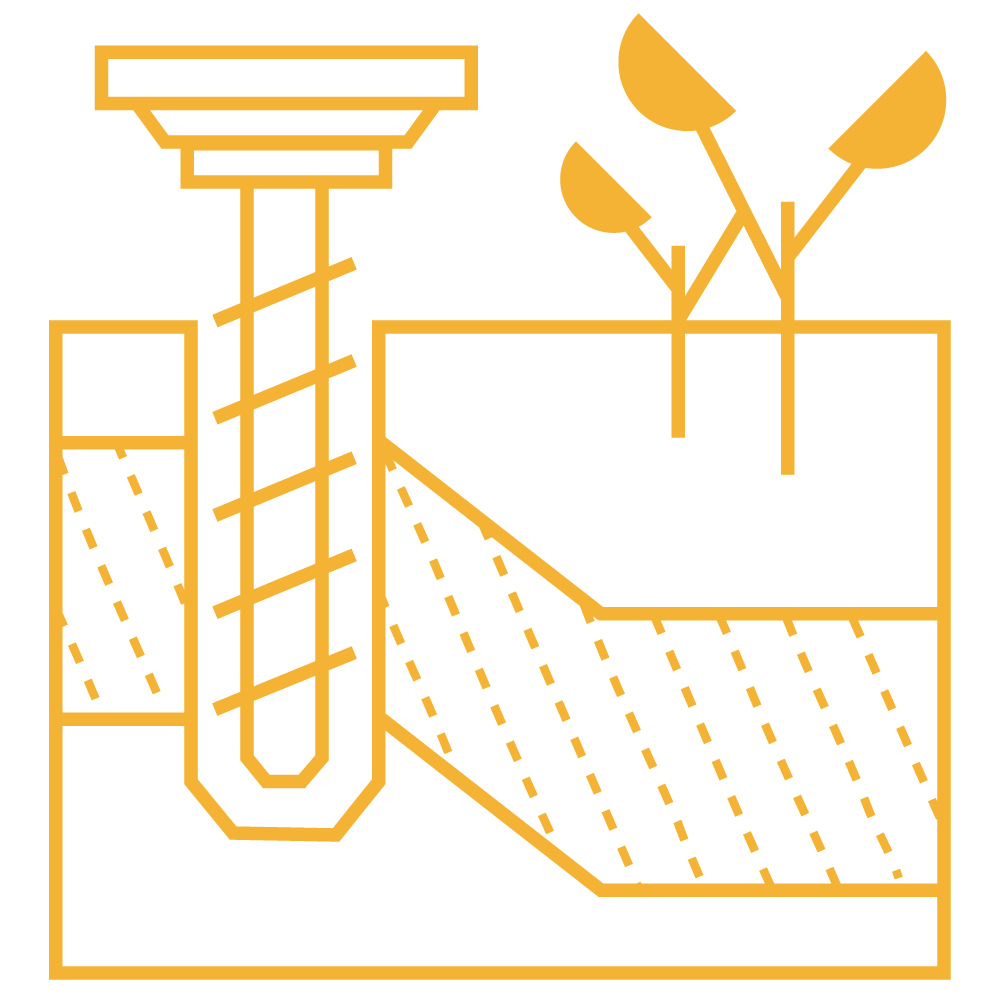
Yard Stick has reduced its pitch to Plan, Measure and Analyze. Plan is a web workflow. A customer uploads farm and field boundaries and selects a methodology, such as Verra's VM0042 or Climate Action Reserve's Soil Enrichment Protocol. The system stratifies the landscape and chooses sampling locations intended to be agronomically sensible and statistically defensible. This matters because soil is maddeningly variable. A handful of convenient samples can describe a field about as well as three tourists describe New York.
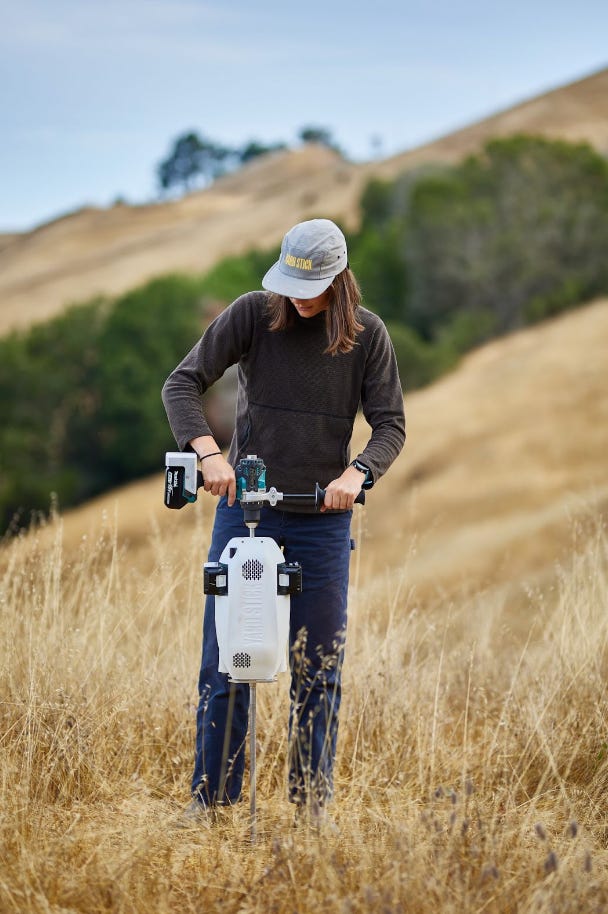
Measure is the memorable part. The handheld probe uses visible and near-infrared spectroscopy. It shines light into soil and records what is absorbed and reflected across wavelengths - essentially a spectral movie. Models translate that response into an estimate of organic-carbon concentration. The company describes field collection down to one meter, including between standing crops, without turning every observation into a core that must be bagged, shipped and burned in a laboratory.
Analyze is where field observations become a business record. Customers can watch project progress, calculate carbon stocks and changes, and share data with growers, registries, third-party verifiers and end buyers. The software is not decorative. Large soil programs involve scattered parcels, shifting protocols and measurements collected far from good internet service. Yard Stick's field system can work offline and synchronize later. A ranch without Wi-Fi is an operating condition, not an edge case.
“More VC does not make soil carbon change faster.” - Chris TollesThe origin
What failed first was not the science
The device grew out of research associated with Soil Health Institute and its chief scientific officer, Cristine Morgan, who had spent roughly 15 years developing the underlying measurement approach. The research had no natural commercial home. ARPA-E's SMARTFARM program supplied funding, market pressure and a path toward deployment. Yard Stick emerged as the vehicle that a research institution was not designed to become.
Chris Tolles and Kevin Meissner are the two co-founders listed by the company. Tolles came from an unexpected angle: a Rhode Island School of Design degree in furniture making, followed by work commercializing science and a previous consumer-products startup. The founders met through the My Climate Journey community during the pandemic. Yard Stick took legal form at the beginning of 2021. Its early lesson was useful beyond climate: neglected research may need a service company more than it needs another paper.
The first product assumption to fail was the obvious hardware reflex. Customers did not want to buy spectrometers, train staff and become soil-science operations. They wanted the measurement finished. Yard Stick therefore kept its own equipment and permanent U.S. field teams. The service is typically priced per acre, sometimes per sample site, because acres are how program operators model their economics. The company reported more than $17 million in multi-year contracts in late 2023, though it does not publish a menu price.
The cost claim, indexed
Illustrative index based on Yard Stick's public claim of a 70-90% reduction. This is not a published price list or an independent cost audit.
Its $10.6 million Series A in 2023, led by Toyota Ventures Climate Fund, moved the operation from beta toward commercial deployment. Microsoft Climate Innovation Fund, The Nature Conservancy, Lowercarbon Capital, Breakthrough Energy Ventures and Pillar VC also participated. Public announcements put total venture funding above $16 million. Separate public support included an $18 million USDA Partnerships for Climate-Smart Commodities award intended to support measurement across six projects.
The differentiationA neutral referee that charges by the acre
Soil carbon can be measured through laboratory cores, inferred with models, mapped from remote sensing, or estimated using combinations of all three. Automated coring businesses such as Agricarbon attack the logistics of direct sampling. EarthOptics and other sensor companies work near the soil. Perennial, Regrow, CIBO and Boomitra lean into digital mapping, models or satellite inputs. Yard Stick's position is that remote signals and models still require credible ground truth, and that in-situ spectroscopy can produce much more of it for the same budget.
The sharper distinction is financial. Yard Stick says it does not take a cut of carbon-credit sales. Tolles has compared that arrangement to a phlebotomist earning a percentage of a patient's blood-pressure medication. The joke lands because the conflict is real: a measurer paid more when a project reports more carbon has acquired a reason to find happy carbon.
That neutrality also lets the company serve work outside offset markets. Organic Valley, named publicly as a customer, measures soil as part of reducing emissions within its dairy supply chain. Research programs want to test low-carbon beef, biochar or different farming practices. A project can fail to add carbon and the measurement can still be valuable, provided everyone was paying to learn the truth.
Where the probe does not wave a wand
Cheap readings do not rescue a weak sampling plan. Spectral models need representative calibration. Field crews need access. And carbon may change too slowly to detect on a startup's preferred timetable. Yard Stick measures the outcome; it does not make an implausible farming intervention work.
What changed minds: six farms and a combustion lab
The company's most important technical update arrived in January 2025. A peer-reviewed study in Geoderma, co-authored with Soil Health Institute researchers, compared probe readings with conventional combustion-based laboratory analysis across six Illinois farms. The researchers reported that the probe accurately estimated soil-organic-carbon stocks to 45 centimeters. That is narrower than the company's general statement that its equipment can collect data to one meter, but it is the kind of public, testable result climate hardware needs.
A later corrigendum expanded the competing-interest statement. Three authors were Yard Stick employees and equity holders; two Soil Health Institute authors served as uncompensated scientific advisers. The correction is worth knowing because credibility is the product here. The useful reading is neither dismissal nor celebration: the trial supports a specific method at specific sites and depth, while broader performance still depends on soil types, calibration, protocol and project design.
Yard Stick's market grows if carbon developers need better verification, but also if food companies need defensible Scope 3 data and researchers need faster field measurement. It shrinks if buyers accept cheaper models without much ground truth, if carbon-credit economics stop funding direct sampling, or if a project's expected soil change is too small to justify repeat visits. This is infrastructure for claims that must survive scrutiny. Where no one requires proof, the spreadsheet will always be cheaper.
The stealable bitsA climate playbook with mud on it
Find stranded science
Years of serious research can still lack a company willing to own deployment, sales and service.
Sell the completed job
Customers asked for trusted numbers, not another device to maintain or specialist team to hire.
Use their unit
Per-acre pricing maps cleanly onto the budgets and economics of large agricultural programs.
Stay outcome-neutral
Declining credit-sale upside makes independence part of the product, not a sentence in a policy.
Publish the hard claim
A field comparison against laboratory analysis carries more weight than another animated explainer.
Build on nature's clock
Some customers may wait years for measurable change. Contracts and expectations must survive that pace.
The model is least portable where an intervention changes quickly, field access is impossible, or measurements cannot be calibrated across local soils. It also depends on an institutional buyer with enough acreage and enough reason to pay for rigor. A single farmer curious about one paddock is not the center of the target. Neither is a project that wants a dashboard more than an answer.
Yard Stick's wager is that the soil-carbon market will eventually reward the boring parts: sampling, calibration, repeat visits, disclosures and an invoice that does not improve when the result does. If that happens, the handheld probe may be the photogenic object, but the real product will be restraint. In a market crowded with climate promises, being paid to report what the dirt says is a surprisingly sharp position.