The Story
Microbes, Millions, and a Career Nobody Plans For
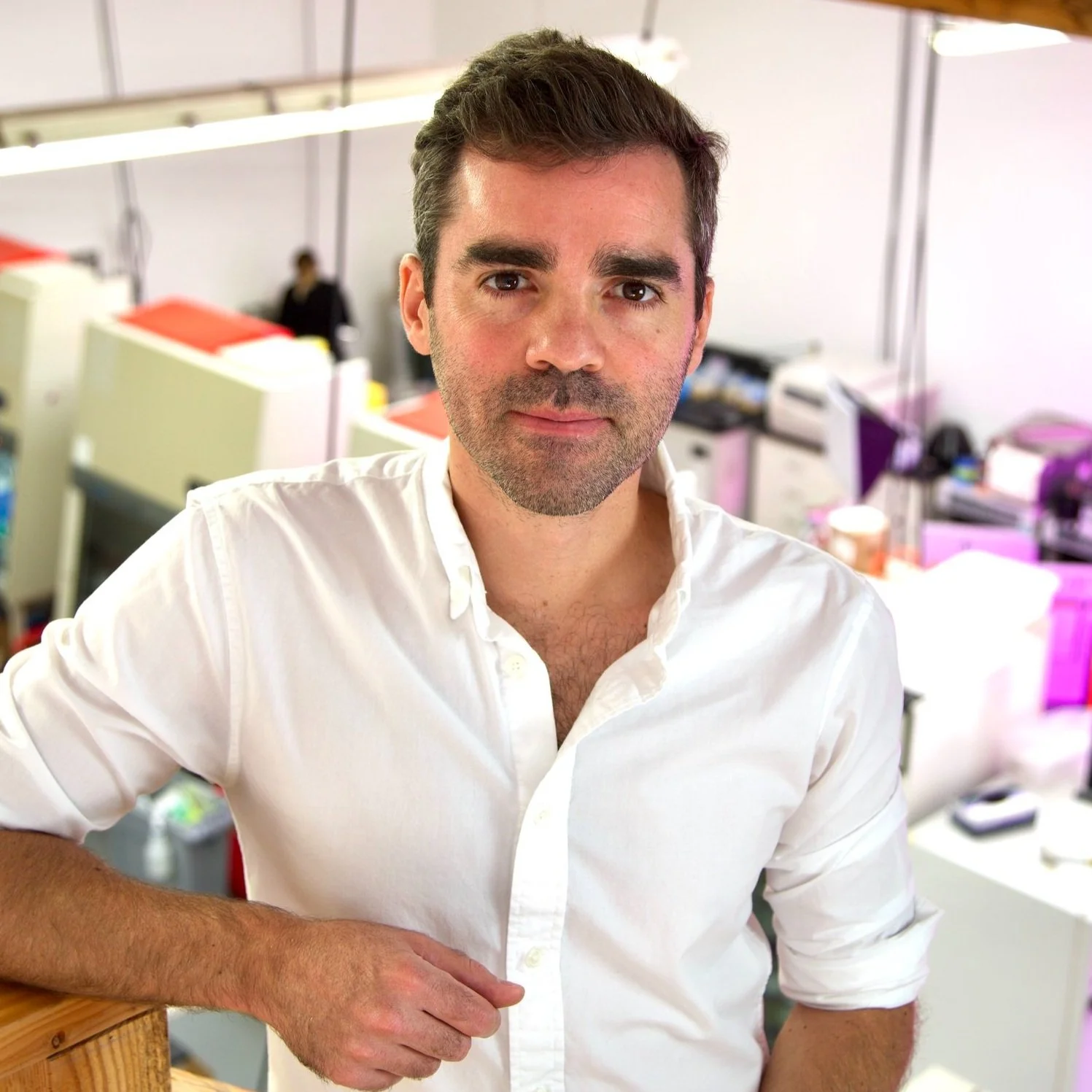
It takes a certain kind of contrarianism to look at a trillion-dollar chemical agriculture industry and conclude that the answer is smaller. Much smaller. Gonzalo Fuenzalida-Meriz built Andes on the premise that beneficial soil microorganisms - organisms that have been fixing nitrogen and weathering minerals for billions of years - can replace synthetic inputs, generate measurable carbon removal, and do both simultaneously at farm scale.
The path there was indirect. Gonzalo studied business administration, finance, and economics at the Pontificia Universidad Católica de Chile. He joined Banchile Inversiones as a Senior Wealth Manager in 2010, managing portfolios for high-net-worth clients. By most external metrics, it was a successful career. By his own account, it was a miserable one.
"I was in a very well paid [career], but I honestly was a very unhappy person. My Sundays are beautiful now. I love what I do."
- Gonzalo Fuenzalida-MerizThe inflection point was personal, not professional. The birth of his child - a moment he describes as seeing a miracle - triggered an instant reordering of priorities. The things he thought mattered stopped mattering. He left banking.
From Santiago to Alameda: The Long Way Around
His first move into biotech was in 2013, when he founded Ango - Austral Biologicals in Chile, followed by co-founding Epiphany in 2017. Neither was Andes. Both were stepping stones into the science and business of biological solutions, building instincts that wouldn't fit in an MBA curriculum.
Andes came in 2018. The company landed in Alameda, California - a former Navy base turned innovation district across the bay from San Francisco - and Gonzalo arrived with a conviction: that microbial technology was ready for something bigger than niche applications. The question was how to make it commercially legible at agricultural scale, and how to prove the carbon removal science rigorously enough to satisfy institutional buyers.
The former required working directly with major crop input distributors - Wilbur-Ellis, Corteva, Nutrien. The latter required something that didn't exist yet.
Building the Methodology That Didn't Exist
Most carbon removal projects work from pre-existing carbon accounting frameworks. Gonzalo's team had a problem: the specific mechanism Andes uses - microbial weathering of soil silicate minerals, which converts atmospheric CO2 into stable inorganic carbon that can persist for thousands of years - had no recognized methodology for quantification or verification.
So they built one. In partnership with Gold Standard and measurement firm EcoEngineers, and with scientific review from experts in geochemistry, soil science, environmental microbiology, and agriculture, Andes developed the world's first Microbial Carbon Mineralization (MCM) Methodology. Published in July 2023. Validated against ISO 14064 international standards in September 2023.
The methodology covers quantification, monitoring, reporting, and verification for carbon projects using microbial seed treatments. It makes Andes' carbon credits legible to institutional buyers and corporate sustainability programs in a way that didn't exist before. Research partners from Lawrence Livermore National Laboratory, Rice University, and the University of Colorado Boulder provided independent scientific validation for the underlying mechanisms.
"Transparency and rigor in carbon removal is of utmost importance."
- Gonzalo Fuenzalida-Meriz, Carbon HeraldThe Business Model Built Around the Farmer
Carbon credit schemes have a reputation problem in agriculture. Farmers are asked to change practices, absorb risk, fill out paperwork, and receive payment years later for outcomes they can't verify. Gonzalo structured Andes specifically to invert this dynamic.
Andes' Microprime platform - microbial seed coatings applied to corn, soybean, canola, and wheat seeds - is provided to farmers at zero cost. The microbes include nitrogen-fixing strains that demonstrably reduce synthetic fertilizer requirements, and mineral-weathering strains that convert CO2 into stable soil inorganic carbon. The farmer pays nothing and gains something concrete: yield increases of five to six bushels per acre and documented net income improvements of 20-30%.
The carbon credits generated belong to Andes, who sells them to corporate buyers managing Scope 3 emissions and sustainability commitments. The entire commercial structure is designed so the farmer's incentive and the climate's incentive point in the same direction.
"When we started the carbon program at Andes, we wanted to make it very simple for farmers to help us in the process of deploying this microbe and generating carbon dioxide removal... we provide that farmer, free of charge, with the microbes."
- Gonzalo Fuenzalida-MerizThe Scale Challenge
Andes deployed across 27,000+ acres by 2023. The ambition is gigatonne-scale CO2 removal - which means hundreds of millions of acres. Gonzalo has been candid about where the bottleneck sits: not in the science, not in farmer adoption, but in MRV - monitoring, reporting, and verification.
Measuring carbon outcomes across millions of heterogeneous farm plots, with different soils, climates, crops, and management practices, is a systems problem as much as a scientific one. The MCM Methodology is the foundation, but the measurement infrastructure still needs to scale. It is the problem Gonzalo spends considerable effort on, and it is the problem that will determine whether Andes achieves its stated ambition or stops short of it.
"Our biggest challenge to grow has to do with MRV, with the ability of measuring across millions of acres."
- Gonzalo Fuenzalida-MerizA Business Background Running a Science Company
One of the interesting structural facts about Andes is that its CEO is not a scientist. Gonzalo's academic background is in finance and economics. He built his understanding of microbiology through years of working in biological startups, hiring deeply technical people, and developing the judgment to translate between commercial requirements and scientific possibility.
This may explain why Andes' framing is unusually farmer-centric and economically coherent for a climate tech startup - and why the business model was designed from first principles rather than adapted from an existing category. The company's partnerships with Bayer, Cargill, Corteva, and Nutrien suggest that the agribusiness majors see Andes as a credible operating partner, not just a science project seeking distribution.
Gonzalo's vision, stated plainly: use biological tools to fix what industrial agriculture broke. The microbes were always there. The system just hadn't found a way to pay them.