The company selling farmers a fungus on a seed - and, with it, a way to turn ordinary cropland into a carbon bank that pays.
The subject A wheat seed does not look like climate infrastructure. Loam Bio is betting the most important machine in the field is the one you can't see - the microbe riding along on the seed.
Here is a fact that sounds like it should be more complicated than it is: plants pull carbon dioxide out of the air for a living. They have been doing it, free of charge, for a few hundred million years. The problem, from a climate-accounting perspective, is that most of that carbon does not stay put. A plant grows, a plant dies, microbes eat it, and the carbon goes right back into the atmosphere. The soil is less a vault than a revolving door.
Loam Bio's whole idea is to jam the revolving door. The company, founded in 2019 in Orange, New South Wales, develops naturally occurring microbial fungi that get coated onto crop seed - wheat, barley, canola, pulses. When the plant grows, the fungi help route more of that captured carbon into the stable, mineral-bound form that resists decomposition. The industry word for it is "recalcitrant," which is a good word, because it means the carbon is stubborn. It stays down there. Potentially for centuries.
What makes this interesting as a business, rather than a science-fair project, is that Loam figured out the carbon is only worth something if you can prove it exists. A ton of carbon you cannot measure is a ton of carbon nobody will pay for. So the company built two things at once: the biology that grows the carbon (CarbonBuilder), and the bookkeeping that verifies and sells it (SecondCrop). One without the other is a hobby.
The founding story is almost aggressively agricultural. Five people - farmers Mick Wettenhall and Tegan Nock, agronomist Guy Webb, filmmaker-turned-cattle-breeder Frank Oly, and UK climate expert Guy Hudson - came together in 2019, reportedly after a conversation that started in the back of a farm ute. The underlying research is older still, tracing to work at the University of Sydney that began around 2011. Deep tech, it turns out, moves at the speed of dirt.
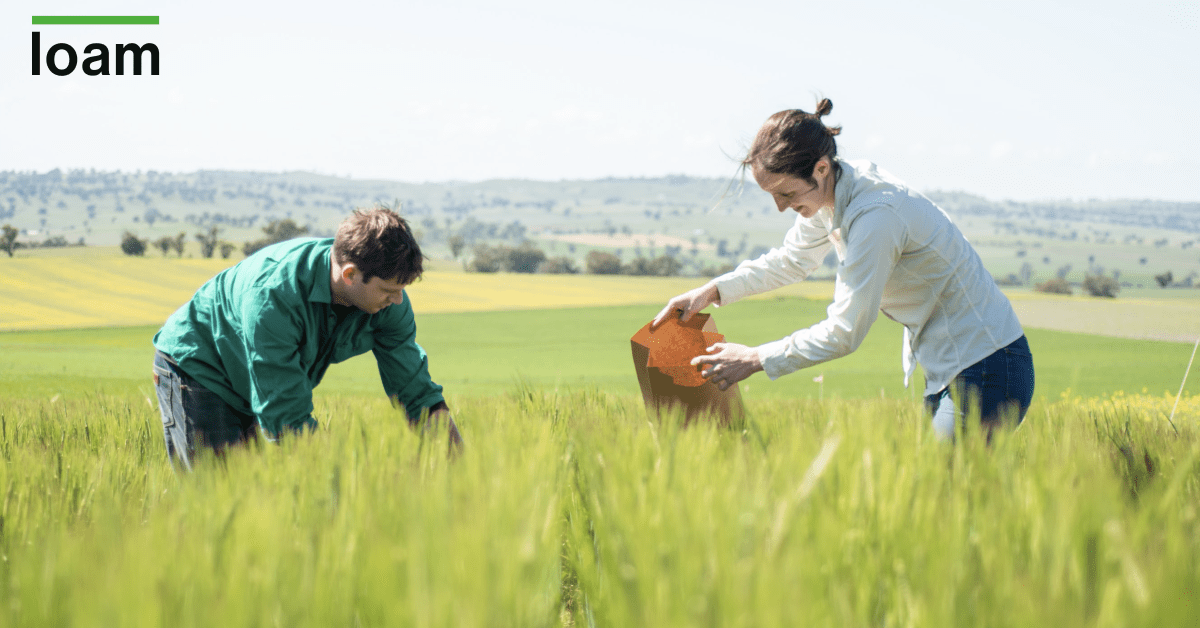
"Loam Bio is transforming croplands into carbon sinks by harnessing microbial science."
If you are a grain grower, Loam's pitch is unusually concrete: keep planting the crop you already plant, add one step at sowing, and open the door to a second income stream from carbon you were leaving in the ground anyway.
A biological seed treatment of naturally occurring microbial fungi. Applied to the seed, it helps the growing plant convert atmospheric CO2 into stable, long-lasting soil carbon - while supporting soil health and crop resilience.
A precision air-injection application system that deploys the living CarbonBuilder inoculum accurately at sowing, so the biology gets exactly where it needs to be in the furrow.
The program that turns stored carbon into money. Loam helps growers register, measure, verify and sell soil carbon credits - stripping out much of the upfront cost and paperwork that usually keeps farmers out of carbon markets.
Over three rounds, Loam has raised more than US$119M. The cap table reads like a climate-investor guest list - and includes some famous names betting on soil.
The Series A was led by Time Ventures, the fund of Salesforce founder Marc Benioff. The Series B was co-led by Lowercarbon Capital (Chris Sacca) and Wollemi Capital, with Horizons Ventures, Acre Venture Partners, Main Sequence, the Clean Energy Finance Corporation and Grok Ventures joining. Atlassian's Mike Cannon-Brookes has also backed the company. When Benioff, Sacca and Cannon-Brookes all show up for the same fungus, it is worth paying attention.
Loam was built by people who actually work the land, joined in 2026 by an American operator brought in to scale it globally.
In 2026, US-based agtech veteran Rob Hranac - a UC Berkeley-trained civil and environmental engineer with more than a decade in soil carbon, measurement and enhanced rock weathering - was appointed CEO to lead the company's commercial expansion. Co-founder Guy Hudson moved to executive chairman. The signal is clear: Loam wants to re-prove its science in American dirt.
Work on microbes and soil-carbon sequestration starts at the University of Sydney under Professor Peter McGee.
Five farmers and scientists spin the technology out of the Soil C Quest nonprofit, initially as Soil Carbon Co.
Early capital arrives from backers including Grok Ventures, Main Sequence and the Clean Energy Finance Corporation.
Marc Benioff's Time Ventures leads a ~US$30M round to advance the microbial carbon technology.
A ~US$73M round co-led by Lowercarbon and Wollemi; CarbonBuilder, FurrowMate and SecondCrop go to market.
Rob Hranac appointed CEO to drive global commercial growth as Guy Hudson becomes executive chairman.
"Loam" is rich, fertile brown soil. The brand is a nod to the literal ground the company is trying to improve.
Its "recalcitrant" carbon is the stable kind - it can stay locked in soil for centuries to millennia, not a single growing season.
The founding conversation reportedly happened in the back of a farm ute when a UK climate expert met an Aussie agronomist.
Loam Bio began life as Soil Carbon Co before rebranding.
The technology was spun out of Soil C Quest, a charity focused on soil carbon and farm profitability.
The research predates the company by eight years, starting in 2011.
It develops naturally occurring microbial fungi applied to crop seeds so plants store more stable, long-lasting carbon in soil - and it helps farmers turn that stored carbon into verified carbon credits.
CarbonBuilder is Loam's biological seed inoculum. Coated onto wheat, barley, canola and pulse seed, it helps plants convert atmospheric CO2 into stable soil carbon that resists decomposition.
More than US$119M across seed, a ~US$30M Series A (2021) and a ~US$73M Series B (2023), from investors including Lowercarbon Capital, Wollemi Capital, Horizons Ventures and Marc Benioff's Time Ventures.
Headquarters are in Orange, New South Wales, Australia, and the company is expanding into the United States, where its incoming CEO is based.
Through the SecondCrop program, growers can measure and verify the extra carbon stored in their soil and sell it as carbon credits - a second income stream from the same crop, alongside improved soil health.