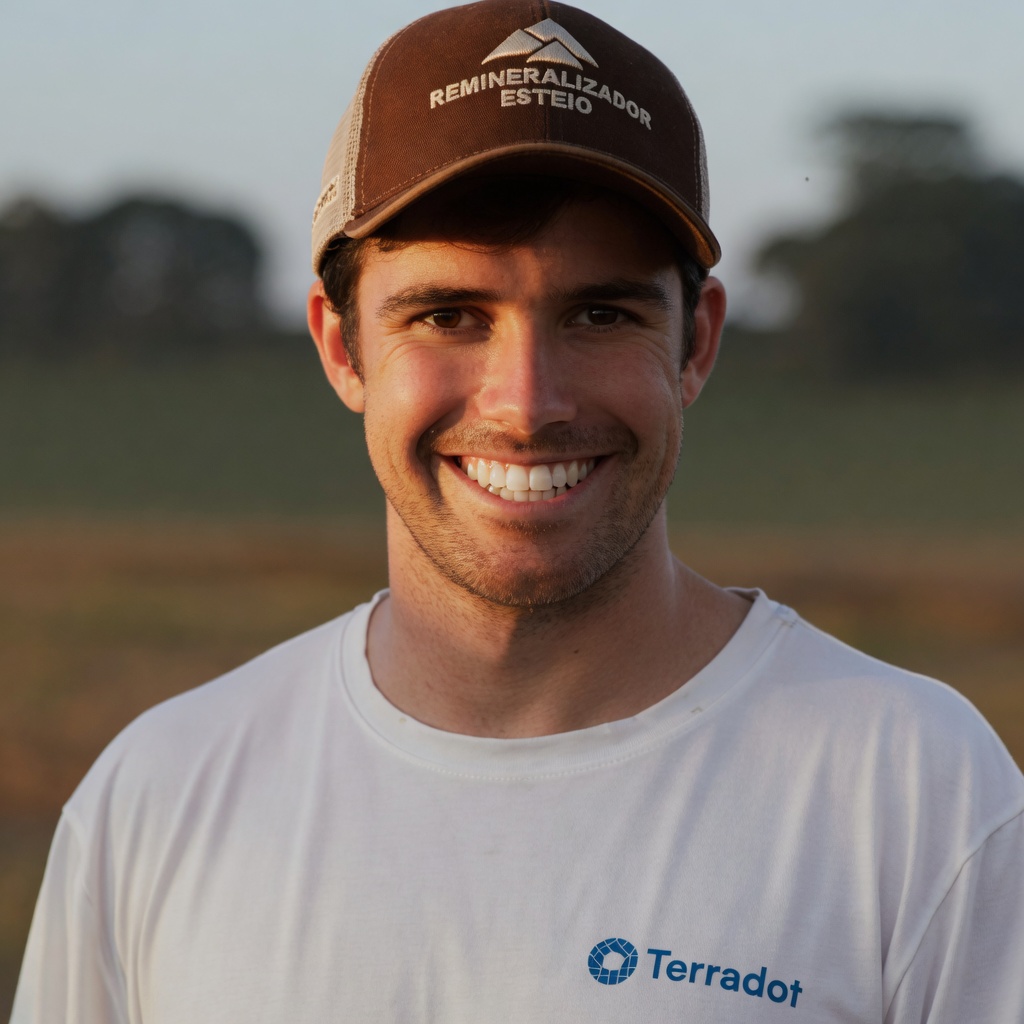
A college kid moved truckloads of vegetables. Now he moves mountains.
The pitch sounds like geology homework: enhanced rock weathering. Take silicate rock, crush it into powder, scatter it across farm fields, and let rain do the rest. Rainwater triggers a chemical reaction that pulls carbon dioxide out of the air and locks it into minerals. Nature already does this. It just takes a few thousand years. James Kanoff decided to make it take one growing season.
That is Terradot, the company he co-founded in 2022 inside a Stanford soil lab and launched to the public in December 2024 with $58.2 million in funding. The headline number is real, but the more interesting figure is the one most founders would bury: 10,000-plus years. That is how long the carbon stays put once the rock has done its work. Kanoff is not selling a gadget. He is selling permanence.
"This is a scalable solution that we have today. This is something for this decade, which is the critical decade."James Kanoff
What makes Kanoff unusual is that he did not arrive at climate through a chemistry degree. He studied Symbolic Systems at Stanford - an interdisciplinary tangle of computer science, philosophy, linguistics and psychology. The training shows. He treats carbon removal less like a science fair and more like a logistics and measurement problem, which is exactly the part of the industry most people would rather not talk about.
The measurement obsession
Carbon removal has a credibility problem. Too many credits have been sold for trees that were never planted or forests that later burned. Kanoff leans into the skepticism rather than dodging it. His verification standard is blunt enough to fit on a sticker.
"If you can measure it, we will pay for it."James Kanoff, on Terradot's verification standard
He says the quiet part out loud: "We want the scrutiny. This is one of the few climate solutions we have today that is scalable, but we have to be able to measure it in a high-integrity way." That posture - inviting auditors instead of avoiding them - is why some of the most cautious buyers in the world signed up early.
Borrowing a gigaton-scale machine
The cleverest decision at Terradot was choosing not to invent anything. Building new planetary infrastructure is slow. Kanoff looked at the industries that already run at the scale he needs and simply plugged in.
"We looked at systems already running at gigaton scale. Mining and agriculture already give us everything we need. There are quarries near farmland, crushers, spreaders, and haulers ready to go."James Kanoff
Quarries are next to farms. Crushers, spreaders and haulers already exist. The rock is a byproduct of mining the world does anyway. By riding on infrastructure that already moves billions of tons of material, Terradot skips the decade most hardware startups spend building from zero. The first full-scale hub opened in Brazil in early 2025, in a large farming region where the climate accelerates the weathering reaction.
The pandemic startup that fed a country
In March 2020, Kanoff and fellow student Aidan Reilly were sent home from college as the pandemic shut everything down. They heard that a Los Angeles food bank had seen demand jump fivefold while farmers, with restaurants closed, were plowing perfectly good produce back into the dirt. Surplus on one side, hunger on the other, and nothing connecting them.
So they built the connector. The Farmlink Project started with two students making phone calls and renting trucks. It has since rescued more than 130 million pounds of food, reached hundreds of communities, and is the subject of a documentary, Abundance: The Farmlink Story. The work earned Kanoff and Reilly the Congressional Medal of Honor Society's Citizen Honors, a Jefferson Award for Public Service, and a spot on the Forbes 30 Under 30 list for Social Impact.
The through-line from Farmlink to Terradot is not climate. It is the same instinct both times: find a system that already produces a surplus, then build the missing piece that moves it where it needs to go. Trucks of vegetables then. Trucks of rock now.
"It's just the way we operate. It's in the DNA of our company."James Kanoff, on moving fast
The room he is in now
Terradot's board reads like a Silicon Valley fever dream for a founder barely out of undergrad: venture legend John Doerr and former Meta executive Sheryl Sandberg both sit on it. The cap table is just as loaded. The $54 million Series A was led by Kleiner Perkins, with Google and Microsoft each making their first-ever direct investment in an enhanced-rock-weathering company. When Google placed its largest-ever single carbon-removal purchase, it placed it here. Frontier, the buyers' coalition backed by Stripe, committed roughly $27 million for 90,000 tons.
None of that money matters if the rock does not weather and the carbon does not stay down. Which brings everything back to the sticker. Measure it, and they will pay for it. Kanoff has bet his company on getting the math right, in public, where everyone can check it.