A sewer is an odd place to look for unused space. In South Bend, Indiana, rainwater and sewage share pipes. When too much arrives at once, the mixture can spill into the St. Joseph River. The obvious response is to build more room underground. But there is another question: how much room is already there, in a different part of the network, at precisely the moment it is needed?
- Xylem connects water machinery with measurement and control.
- South Bend used available sewer capacity to reduce overflow.
- The useful lesson: measure the bottleneck before paying to enlarge it.
The room between the raindrops
South Bend’s answer involved sensors, automated gates and software that redirected flows toward less busy parts of the system. Think of a street network where drivers can finally see the traffic. An empty route becomes useful only when someone knows it exists and can reach it. In a sewer, that coordination can change the construction budget.
A later Xylem case study reports an 80 percent reduction in combined sewer overflow volume and about $400 million in avoided capital work. Those dollars represent a smaller infrastructure plan, rather than money collected from the river. The project developed with EmNet, a local technology business whose acquisition Xylem announced in 2018. South Bend was already its proving ground.
less combined sewer overflow volume
estimated capital work avoided
Results from the city’s smart sewer programme, reported in Xylem’s later case study.
The initial implementation was substantial on its own terms. Indiana University’s historical account puts it at $7 million, with $280,500 a year for data collection, operations and maintenance. These are costs for that project at that time. They are a useful reminder that making infrastructure smarter requires equipment, people and continuing attention.
A company assembled around water
Xylem’s own history follows a similar widening of perspective. It became independent in 2011 when ITT spun off its water businesses. There is no solitary inventor at the beginning of this corporate story. There is an existing collection of engineering businesses, followed by a series of purchases that changed what the collection could do.
In 2016, Xylem bought Sensus for approximately $1.7 billion in cash, adding smart meters, communications and analytics. In 2023, it completed the approximately $7.5 billion all-stock acquisition of Evoqua, bringing water treatment and services into a broader portfolio. In December 2024, it increased its ownership of water-software specialist Idrica to 61 percent. Each move added another way to understand or handle the same resource.
The resulting business moves water, treats it, measures it and helps customers operate the systems around it. Its buyers include utilities, industrial plants and building operators. Flygt handles wastewater pumping; Goulds Water Technology and Bell & Gossett serve pumping and building applications. Treatment technologies help make water suitable for use or reuse. Xylem Vue brings operational data together so a utility can see relationships that separate screens might conceal.
- 01MovePumps & transport
- 02TreatQuality & reuse
- 03MeasureMeters & sensors
- 04DecideData & controls
An editorial map of Xylem’s capabilities, rather than a process design.
The pump earns its software
A less glamorous example comes from Welsh Water. In 2020, it tested Flygt Concertor pumps and Nexicon controls at 10 troublesome stations. One site went from 53 blockages to zero during the six-month trial. The utility subsequently upgraded roughly 80 stations; Xylem’s case study reports average energy savings of 40 percent across those sites.
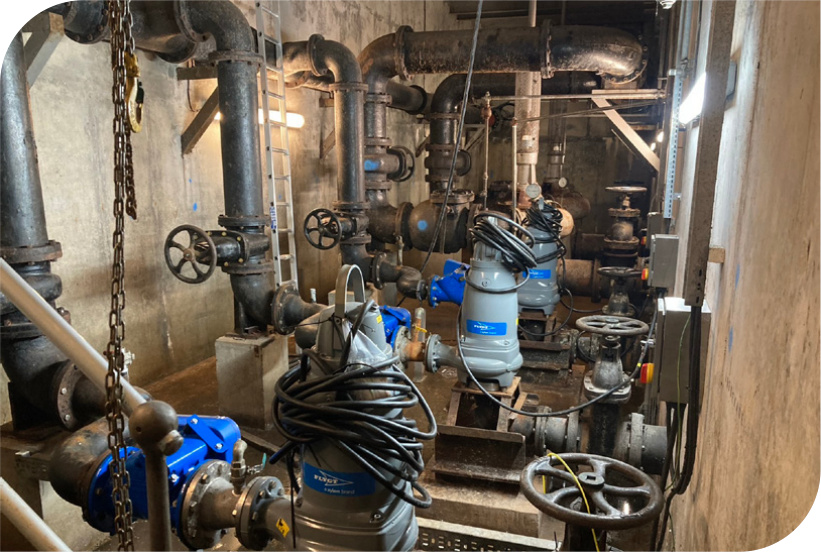
Concertor senses operating conditions and adjusts performance, with integrated cleaning functions. The combination matters: a pump’s usefulness depends on what happens when the flow changes or something clogs. Across the wider market, alternatives include Grundfos, KSB and Sulzer in pumping, and Itron and Badger Meter in metering. Xylem’s argument rests on connecting equipment, data and application expertise across several jobs.
Selling the years after installation
That breadth also explains the business model. Xylem sells equipment and systems, then earns revenue from parts, rentals, treatment services, software and operating support. The relationship can continue long after commissioning. For a customer, the attraction is practical: the company that understands the machine may also be able to maintain it or interpret the signals it sends.
The arrangement becomes especially clear in Xylem’s June 2026 agreement with Dow. Xylem will design, build and operate water systems at Dow’s Fort Saskatchewan complex in Alberta, with operation expected by August 2028. Supply, treatment and reuse fall within one assignment. That gives the industrial customer one partner responsible for a complicated water system over time.
This is a sizeable industrial business. Xylem reported $9.035 billion in 2025 revenue. It also prunes its collection: in May 2026, it completed the sale of Sensus International to AURELIUS while retaining North American Sensus. Broad capabilities still require choices about where ownership makes sense.
Even clever pipes fill up
The South Bend story contains a useful limit. In February 2018, heavy rain and snowmelt exceeded the system’s peak treatment capacity and combined sewage reached the river. Controls can redistribute water into available space. When the available space is exhausted, engineering capacity becomes the constraint again.
“If I had to do it over again I would invest more, earlier.”
Kieran Fahey, South Bend project director
The EPA makes a related point: smart sewer costs and returns vary with the application. Existing hardware, software and databases need to work together. A city with little spare capacity, weak measurements or insufficient maintenance staff should expect a different result from South Bend’s. An operator still needs a working system to control.
What another organisation can copy is the order of inquiry. Put measurements where the trouble occurs. Test a limited deployment. Give people responsibility for maintaining it. Use the evidence to decide what to replace, expand or leave alone. Xylem’s name comes from the tissue that moves water through plants. Its more interesting proposition is that human plumbing can improve when we learn to pay closer attention.