Derek Feebrey grew up wanting to fly a jumbo. It is a wonderfully specific ambition: a child could have settled for being a pilot, but he had picked the aircraft. Years later, having flown Boeing 747s for Qantas, he would find himself running a software company. The boyhood plan had worked. The sequel was rather less predictable.
“Growing up I always wanted to fly a jumbo,” he wrote in 2023. Entrepreneurship had not been part of that picture. Neither had software. His career is an account of what happens when an ambition gets you somewhere useful, and the work there introduces a problem you cannot quite leave alone.
Today, the Sydney-based CEO and co-founder of Trendspek spends his working life on structures that stay put. Buildings, port equipment and industrial facilities are his company’s territory. Its software turns inspection data into detailed three-dimensional records that engineers and owners can examine, annotate and use over time. For someone whose first ambition involved taking off, it is an unexpectedly grounded occupation.
The connection is the record. Aviation taught him to work in an environment where an aircraft’s history matters to the next decision. Trendspek carries that concern into infrastructure. A structure may stand for decades; the people looking after it change. Feebrey’s business is built around giving those people something dependable to inherit.
A better camera, the same old folder
Before the airline cockpit came bush flying in outback Australia. Feebrey’s co-founders, Fiona Church and Mitch Deam, also came through aviation. The three brought that experience into Hoverscape, the drone services company they co-founded in 2013. Their new aircraft were considerably smaller. Their customers still needed careful inspection work.
Drones gave them access to bridges, buildings, ports and industrial structures. A camera could cover surfaces that were awkward to reach by conventional inspection methods. The images were detailed, and there were plenty of them. This should have been the happy ending: a difficult job, a useful new tool, a better view.
Instead, the founders encountered the next problem in the chain. Thousands of photographs were being reviewed and turned into familiar reports. The inspection had changed, while much of the workflow afterwards remained familiar. Imagery sat in disconnected storage; findings still had to make their way into decisions. A very good camera had become a remarkably efficient way of filling a folder.
That distinction gave the venture its direction. In 2019, the trio founded Trendspek, developing the software with engineers and asset owners. Its present focus joins inspection evidence to maintenance, risk and capital planning. Feebrey leads the vision and direction of that work; Church is COO, and Deam is CCO. Their shared aviation background runs through the way the company describes its approach.
- Qantas 747sCommercial aviation
- 2013 · HoverscapeDrone inspection services
- 2019 · TrendspekA lasting condition record
Give the building a memory
There is a neat illustration of Feebrey’s thinking in his conversation with Michael Waitze. He discussed watching an American aircraft repossession programme and noticing the importance of recovering the logbook along with the plane. The aircraft and its history belonged together. He drew the same connection between a built asset and the accumulated evidence about it.
The analogy is useful because a building cannot answer questions about itself. A photograph might show a crack, but someone still needs to establish where it is, when it appeared and what happened afterwards. A dated record with spatial context gives the next person a starting point. The apparently dull business of keeping information becomes rather consequential when a repair budget is being discussed.
Feebrey’s ambition puts continuity at the centre of the product. Owners, engineers and contractors can change during a structure’s life. The record should remain useful across those changes. In practical terms, the value lies in being able to return to the same place, compare observations and carry previous work forward, rather than making each inspection an isolated event.
This helps explain why he talks about an asset’s history with the enthusiasm other founders reserve for new features. A model is interesting to look at. A model attached to an intelligible record of findings and decisions has a job to do. It gives a later conversation somewhere to begin.
“We’re trying to solve an outcome.”Derek Feebrey · Asia Tech Podcast, 2023
From the boardroom to the toolbox
By November 2023, Trendspek 2.0 was addressing some decidedly everyday difficulties. The upgrade added reporting templates, reorganised annotation tools and introduced nested folders. Surface deflection and cross-section analysis sat alongside improvements to how people structured and shared their work. A software release can sound like a list of buttons; here the buttons explain the customer.
An engineer, a facilities team and a person responsible for capital expenditure may all need to look at the same structure. They will ask different questions and produce different outputs. Templates let teams organise those requirements consistently across datasets. Folders make large collections of annotations manageable. Sharing a specific location saves someone else a search.
Feebrey describes the intended audience as stretching “from the boardroom to the toolbox”. The phrase earns its place because the distance between those rooms is often where useful information gets lost. His approach gives different stakeholders access to a shared online record, with enough flexibility to support the reporting each needs.
In September 2024, he spoke about collaboration with clients as the company added staff in partnerships, sales and customer success at its Sydney headquarters. Expansion, in this account, includes the unphotogenic work of helping people actually use a system. There is a certain pleasure in a technology story whose supporting cast includes well-organised folders.
A campus makes the argument
The University of Sydney gives the idea a concrete setting. Trendspek, Infracorr Consulting and the university worked on digital condition assessments of 110 buildings at the Camperdown campus. Infracorr’s engineers examined models, annotated defects and identified repair timeframes. University teams brought the resulting information into planning and tenders.
The project account reports 13,000 virtual inspections completed 80 per cent faster and information supporting 25-year capital expenditure projections. Those figures describe a particular collaboration, rather than a promise for every building. They show the breadth of the task: immediate findings had to be usable in plans stretching far beyond the next visit.
In September 2025, the project was recognised as an Outstanding Nominee for Engineers Australia’s Project of the Year in Sydney. The distinction belongs to a partnership, with engineering judgement and an asset owner’s needs alongside the software. Feebrey’s work fits that arrangement: he builds the setting in which those people can see and use the same evidence.
A bridge without the airport queue
The same ambition travels. In April 2024, Trendspek announced work with Egis, Applus+ and VSL on digitising condition assessments of the King Fahd Causeway, the 25-kilometre link between Bahrain and Saudi Arabia. The plan paired captured data with a detailed digital replica that specialists in more than seven countries could assess remotely.
For a former airline pilot, it is an amusing reversal. Part of his new company’s purpose is to help specialists do useful work without taking a flight. The causeway programme envisaged an interactive condition report and a historical record for subsequent inspections, giving a geographically dispersed team a common structure to examine.
Feebrey framed the project around a more international engineering workforce. The practical attraction is easy to understand: expertise can be somewhere other than the asset. A bridge still occupies one place. The conversation about its condition can involve people in several places, working with a record they can revisit.
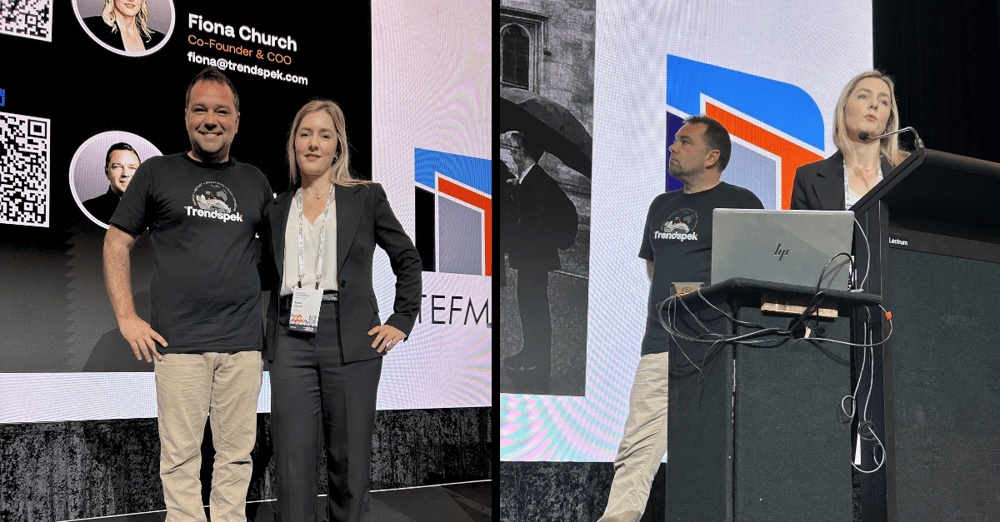
His own calendar has continued to involve travel. During 2024 he joined a Taronga Ventures technology delegation in the UAE. In 2025, he took part in New York Real Estate Week with Investment NSW, engaging with agencies, investors and innovators about asset renewal. He and Church also shared their experience with higher education audiences at TEFMA25.
Teach the machine what to look for
Feebrey’s attention has extended to the repetitive work of reviewing imagery. In March 2024, Trendspek and Datature described a proof of concept for detecting concrete cracks with computer vision. The work involved labelling image data and training a model. It was an experiment with a defined task, and its description retained a place for engineers to check the results.
That progression matters. An image collection can be too large for convenient manual review; a detection tool can help direct attention. The quality of the record and the judgement applied to it remain part of the job. The company’s AI work makes more sense within that inspection workflow than as a detached prediction about what machines might eventually do.
By its 2025 review, Trendspek reported launching Autodetect AI, allowing users to train their own models for repetitive defects while retaining control of the output and intellectual property. The same review reported more than 55,500 online site visits during the year. These are company-reported measures of activity and development, useful for seeing how far the original photograph problem has travelled.
In a February 2026 conversation with Owen Keenan, Feebrey returned to representative inspections, auditable data and the move from static reports to living models. The discussion also covered trust and changing processes. His subject keeps bringing him back to people: what they inspect, what they assume, and what they need before they will work differently.
The next entry in the logbook
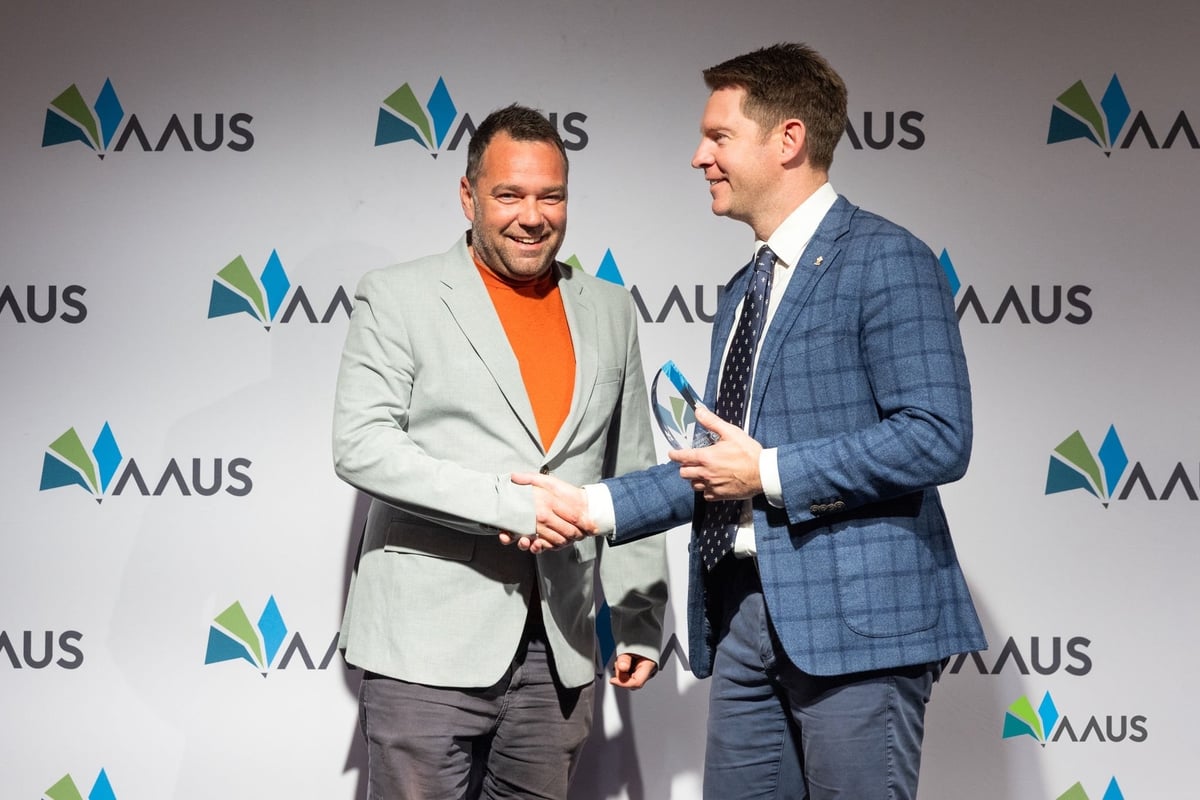
On 30 September 2026, Trendspek announced an A$6 million investment round led by OIF Ventures. The company said the funding would support expansion in North America and Europe and accelerate its AI roadmap. It named customers including Chevron, Woodside Energy and NSW Ports, with Suncor Energy and the Port of Rotterdam among its international relationships.
Feebrey described owners needing “a reliable picture of what they own”. The owners he described already had inspection data. They needed a usable view of condition and change, one that could support getting more service from existing infrastructure.
It is a fitting destination for the child who had chosen a jumbo. He got to fly one. Then a smaller flying machine introduced him to a problem on the ground, and that problem became a company. The thread through the changes is straightforward: look carefully, keep the record, make it useful to the next person. A building has no cockpit. Feebrey would still like it to have a logbook.